Alex Ovechkin’s final lap is now on the board: the Washington Capitals captain has said the 2026-27 season will close his NHL career. At 40, with 929 regular-season goals entering Wednesday’s home date against Sidney Crosby and the Pittsburgh Penguins, Ovechkin is preparing to leave the game as its all-time goals leader and the defining face of Capitals hockey for more than two decades.
Key takeaways
- Ovechkin surpassed Wayne Gretzky with career goal No. 895 on April 6, 2025, against the New York Islanders.
- His 929 regular-season goals lead NHL history, while his 1,688 points rank 10th all-time.
- Washington’s captain owns League records for power-play goals, game-winners, overtime goals and empty-net goals.
- The Capitals’ 2018 Stanley Cup run brought Ovechkin the Conn Smythe Trophy after he paced the playoffs with 15 goals.
- He has missed only 51 games because of injury in his career, despite ranking third in NHL hits since tracking began in 2005-06.
- Registered USA Hockey players across Washington, Maryland and Virginia rose 73 percent during the Ovechkin era.
From first shift to record book
Ovechkin arrived in Washington with force on Oct. 5, 2005. In his NHL debut against the Columbus Blue Jackets, his first shift included a crushing hit on defenseman Radoslav Suchy that knocked out a pane of glass behind the net. He followed with two second-period goals in a 3-2 Capitals win.
That season ended with 52 goals and the Calder Trophy, even as Washington finished 29-41-12, last in the Southeast Division with 70 points. The club was losing games, but its direction had changed. Ovechkin brought a blend few players have carried: elite finishing, a 6-foot-3, 238-pound frame and a willingness to use it.
His 3,877 career hits rank third since the NHL began recording the statistic in 2005-06. The physical edge never entirely disappeared with age, either. Ovechkin was third on the Capitals with 134 hits this season.
Former linemate Chris Clark recalled that defenders had little chance once Ovechkin lowered his shoulder at speed. Even before he filled out into the 220- to 230-pound range, Clark said, Ovechkin was already a powerful player who made opponents absorb the collision.
The pounding rarely pulled him from the lineup. Only 51 games have been lost to injury, including 16 after a fractured left fibula in 2024-25. He dealt with a hamstring issue at the opening of training camp last season but made the season opener and played all 82 games for the sixth time in his career.
By doing so, Ovechkin became the fifth NHL player to play a full 82-game regular season at age 40 or older, joining Jaromir Jagr, Teemu Selanne, Nicklas Lidstrom and Dave Andreychuk. He still led Washington with 32 goals and 64 points.
“Of course, I have some injuries. Of course, I have some problems,” Ovechkin said. “But our training staff do a good job to help me and I feel better.”
His scoring résumé is staggering beyond the Gretzky record. Ovechkin has 331 power-play goals, 141 game-winning goals, 27 overtime goals and 72 empty-netters, all NHL records. He has produced 20 seasons of at least 30 goals and 14 of at least 40. His nine 50-goal campaigns match Gretzky and Mike Bossy for the most in League history.
From 2013-14 through 2015-16, Ovechkin hit 50 goals in three straight seasons while nobody else in the NHL reached the mark in that stretch. Add 77 playoff goals to his regular-season total and he has 1,006 combined goals, second only to Gretzky’s 1,016.
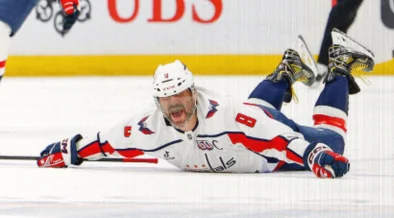
He also turned scoring into theater. The glove kiss and point skyward honored his late brother Sergei, who died when Ovechkin was 10. There was the hot-stick celebration after No. 50 in 2008-09 against Tampa Bay, and the belly-flop slide after passing Gretzky on Long Island.
“I can guarantee no one has more fun scoring goals than Ovi,” former Capitals forward T.J. Oshie said. “As far as someone that genuinely loves to score goals, and has fun doing it, no one comes close to the big man.”
Caps, Crosby and the Cup breakthrough
There is no clean way to separate Ovechkin’s career from Crosby’s. Ovechkin went first overall to Washington in 2004; Crosby became Pittsburgh’s No. 1 pick a year later. They arrived after the 2004-05 lockout carrying the burden of restoring two rebuilding franchises and helping the NHL regain attention.
Their first NHL meeting came Nov. 22, 2005. They have since faced one another 100 times, including 25 playoff games. Four of those postseason matchups came in the second round. Pittsburgh won the first three series and later captured the Stanley Cup in 2009, 2016 and 2017. Washington finally beat the Penguins in six games in 2018.
The signature night in the rivalry was Game 2 of the 2009 Eastern Conference Semifinals, when both players scored three times in Washington’s 4-3 victory. Pittsburgh recovered to take the series in seven.
Crosby, now seventh in NHL scoring with 1,763 points and the active runner-up to Ovechkin in goals with 654, has long recognized what his rival became.
“He’s had a huge impact on it, on and off the ice,” Crosby said last season. “Came in with such high expectations and I think he matched them if not more. To be the greatest goal-scorer of all time and to do what he’s done, as consistent as he’s been, pretty impressive.”
Their contrast helped make the matchup work: Crosby’s measured, detail-heavy approach against Ovechkin’s tinted visor, yellow laces, big hits and one-timers. The early hostility eventually became respect, rooted in what each player meant to his team and to the sport.
For Ovechkin and Washington, 2018 removed the final question. The Capitals had made the playoffs for the first time in his second season, 2007-08, and became regular postseason participants, missing only in 2013-14, 2022-23 and this season. They won Presidents’ Trophies in 2009-10, 2015-16 and 2016-17, but could not escape the second round.
Then came the breakthrough against Pittsburgh. Ovechkin recorded seven points, three goals and four assists, in the six-game series. His pass sent Evgeny Kuznetsov in alone for the overtime winner in Game 6, a 2-1 clincher that pushed Washington to its first Eastern Conference Final since 1998.
The Capitals beat Tampa Bay in seven games, then handled the Vegas Golden Knights in five games to secure the franchise’s first Stanley Cup. Ovechkin’s 15 playoff goals led the League, and he was voted playoff MVP.
Before lifting the Cup, he had already collected 607 goals, six Rocket Richard-style goal-scoring titles and three Hart Trophies, in 2007-08, 2008-09 and 2013. But the playoff losses followed him. The championship changed that conversation, and his celebration in a Georgetown fountain became part of the city’s sports memory.
“Winning was a big one,” said John Carlson, who played 17 seasons alongside Ovechkin before his March 6 trade to the Anaheim Ducks and is now with the Tampa Bay Lightning. “When you’re with someone for so many failures for all the years too, when you break through, something like that, it’s meaningful and lasting.”
Ovechkin has worn the captain’s C since Jan. 5, 2010. Teammates have increasingly pointed to the leadership behind the goals and personality, particularly after the Cup run. Tom Wilson said the captain’s standards and habits helped establish a culture he hopes will remain in Washington.
That imprint extended well beyond the dressing room. The arrival of Ovechkin, and the switch back to red as Washington’s primary home color in 2007-08, helped create the “Rock the Red” era. Red jerseys became standard around Capital One Arena, and the Capitals became a national draw.
The growth showed in participation numbers. USA Hockey listed 12,856 registered players across Washington, Maryland and Virginia in Ovechkin’s 2005-06 rookie season: 422 in Washington, 6,450 in Maryland and 5,984 in Virginia. The 2024-25 report counted 22,222 players, including 1,208 in Washington, 9,929 in Maryland and 11,085 in Virginia.
That 73 percent increase is commonly known locally as the Ovechkin Effect. Former Capitals goalie Olie Kolzig said Ovechkin turned Washington into a full-fledged hockey city, drawing the attention once largely held by the NFL’s Redskins and, for a time, the Wizards.
Clark saw the reach first-hand on Washington’s first Western Canada trip with Ovechkin in 2006-07. Fans in Edmonton, Calgary and Vancouver had heard about the young Russian star but had not watched him in person during his rookie year. During warmups, Clark remembered, the crowd packed the Capitals’ end to get a look at No. 8.
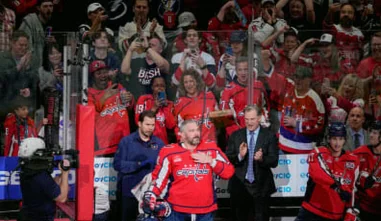
Ovechkin’s last season will bring a long list of celebrations and tributes, but the numbers will only cover part of the story. In April, following Washington’s final home game of last season, he stood with sons Sergei, 7, and Ilya, 5, and looked ahead to what they might remember from their father’s chase.
“I’ll remember this moment,” Ovechkin said. “I’ll remember the playoffs, the atmosphere that was tonight. Obviously, it’s a good thing we have lots of video cameras, cell phones and they’re going to watch when they’re grown up and they’re going to remember it and they’re going to enjoy it.”