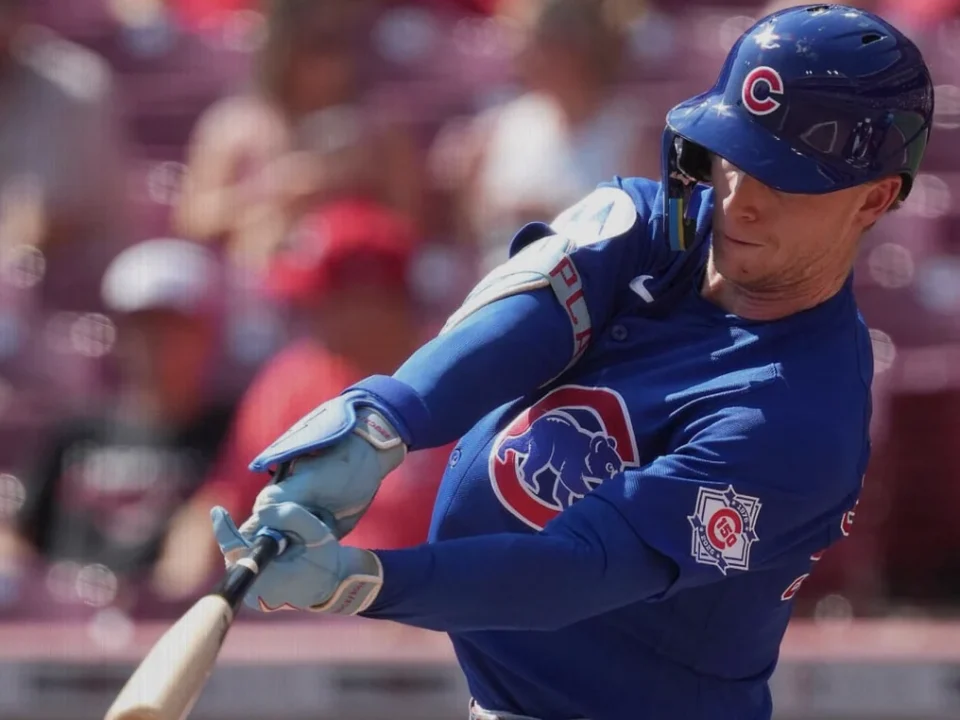
Pete Crow-Armstrong’s season did not become historic on one side of the ball. The Cubs center fielder has put together the kind of year that almost never comes through one uniform: a 40/40 campaign, record-setting Statcast-era defense, a place in the conversation for Chicago’s greatest single-season WAR totals, and the profile of an overwhelming MVP favorite.
The bigger point is not simply that Crow-Armstrong has been excellent. It is that he has been at or near the top of the Major Leagues with both the glove and the bat-and-running package. Baseball usually asks a player to specialize somewhere. Crow-Armstrong refused the assignment.
A rare combination at the top of the game
FanGraphs credits Crow-Armstrong with 24 defensive runs, narrowly ahead of Kansas City shortstop Bobby Witt Jr. and Detroit catcher Dillon Dingler. That places the Cubs standout first among Major League defenders after positional adjustments are factored into the measurement.
Then comes the other half of the ledger. Crow-Armstrong finished at 58 offensive runs, only two behind Houston’s Yordan Alvarez at 60. Seattle’s Randy Arozarena was next at 42, leaving a sizable gap between the leading pair and the rest of the league.
Alvarez supplies the more formidable pure hitting line, but offensive value includes what a player creates on the bases as well as in the batter’s box. Crow-Armstrong’s speed has made that distinction matter. He has been nearly the game’s most valuable offensive player while remaining its top defender.
That pairing has not appeared before in this form. Before 2026, only five player-seasons had landed in the top three in both offensive and defensive value.
The short historical list
- Rogers Hornsby ranked third offensively and second defensively in 1917.
- Snuffy Stirnweiss placed third on offense and first on defense in 1945.
- Lou Boudreau was third offensively and first defensively in 1948.
- Willie Mays finished third in offense and second in defense during his 1954 MVP season.
- Cal Ripken Jr. ranked second offensively and first defensively in 1991, another MVP year.
Mays and Ripken produced seasons that belong among the finest individual campaigns the sport has seen. The earlier entries require the usual historical context, including wartime seasons, the pre-integration game, and less certain defensive data. Still, the central truth holds: the players carrying the best gloves are rarely among the game’s best offensive forces.
Across the previous 123 seasons in which a player led the Majors in defensive value, those players averaged a 133rd-place finish in offensive value. Some were complete stars, including Mays, Ripken and Ernie Banks in 1959. Many were in the lineup because their defense was too good to leave on the bench.
Ozzie Smith ranked 266th offensively in 1980. Patrick Bailey was 303rd in 2024. Rey Ordóñez checked in 345th in 1999, when he posted a 64 OPS+ and hit one home run. Mark Belanger, one of the great defensive shortstops, recorded three separate seasons among the defensive leaders despite a career .280 slugging percentage over 18 years.
The reverse pattern is just as stark. The prior 123 Major League leaders in offensive value averaged a 142nd-place defensive ranking. There are exceptions, such as Mays and Joe Morgan, but the group also includes Alvarez this season at 355th defensively, Mark McGwire at 352nd in 1998, Frank Thomas at 301st in 1991 and Dick Allen at 220th in 1972.
More room in a season already full of it
Crow-Armstrong’s overall value has already placed his year among the top 35 position-player seasons on record by WAR. That does not make it the greatest season ever; the offensive peaks produced by players such as Barry Bonds, Babe Ruth and Lou Gehrig remain on a different scale. Defense, even at its most spectacular, cannot entirely bridge that gap.
But the shape of Crow-Armstrong’s value is its own landmark. No player had previously been the sport’s No. 1 defender while also essentially matching the No. 1 offensive performer. It took more than a century and a half of professional baseball for a season to get this close.
There is another reason the Cubs can wonder whether even more is coming. Through his first 50 games, Crow-Armstrong was hitting .225/.302/.357 with five homers. Nearly a third of the schedule had passed before the offensive side of his game truly caught fire.
He still reached 40/40, still became a record-breaking defender, and still pushed into territory occupied by only the game’s rarest all-around seasons. In a Cubs clubhouse, that is the part worth sitting with: this was not merely a great year from a gifted center fielder. It was a season that rewrote what a player can be asked to do.