
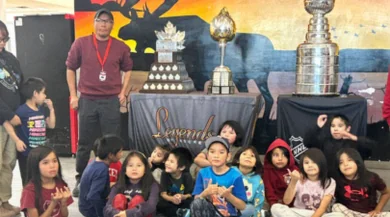
The Stanley Cup arrived in Pikangikum First Nation as more than hockey’s most recognizable piece of silver. For a community reachable by air or winter ice road, the 38-pound trophy turned a distant television image into something students, elders and families could stand beside, touch and remember.
The Cup’s 24-hour stop in the northern Ontario community on Wednesday and Thursday was staged around the 2026 Tim Hortons NHL Heritage Classic. The Montreal Canadiens meet the Winnipeg Jets outdoors at Princess Auto Stadium in Winnipeg on Sunday at 7 p.m. ET, with TVAS, SN, TNT, truTV and HBO MAX carrying the game.
Quick facts
- Pikangikum First Nation, on Pikangikum Lake, has about 3,800 residents and sits roughly a 45-minute flight from Winnipeg.
- The Stanley Cup visit also included the Hart Trophy and Conn Smythe Trophy.
- The Winnipeg Jets supplied 80 sticks and 100 balls; Tim Hortons brought 1,600 NHL trading cards and Timbits.
- Pikangikum’s eight-team recreational league, the PHL, remains the local hockey priority.
- Andrew Ference joined the trip through the NHL’s Social Impact, Growth and Legislative Affairs department.
For 15-year-old Neely Zdeno Turtle, the day carried a Bruins connection that went well beyond the black No. 63 Brad Marchand sweater he wore in the Eenchokay Birchstick School gym. His father, Dean Turtle, named him for Boston greats Cam Neely and Zdeno Chara.
Ference, a member of Boston’s 2011 Cup-winning club, learned the story and placed a video call to Chara. Turtle, who had just seen the Cup up close, suddenly found himself talking with the former Bruins captain.
“I never thought he would call Chara,” Turtle said after the conversation. He said hockey has been part of his life growing up, but seeing the Cup in person was different from watching champions lift it on television.
Dean Turtle had once backed the Toronto Maple Leafs before changing sides in 2010, joking that Toronto had “broken my heart.” He gravitated to Boston and to Cam Neely’s hard-driving power-forward style, then watched his son receive a moment he called surreal.
The event included a welcome dinner, cultural exchanges and time with community elders. Moose stew and fried bannock were served at the ceremonial meal, while the school later hosted nearly six hours of public viewing during Thursday’s community day.
Hockey is woven into daily life in Pikangikum. Residents watch NHL games at night, carry the talk into the morning and play on the outdoor rink by the school or at the indoor rink near the airport. Names such as Wayne Gretzky, Chris Chelios and Ondrej Pavel came up during the visit, while Jets sweaters mixed with jerseys from across the League and local school teams.
Justin Maddalena, a teacher and coach of the school’s boys team, put the local pecking order simply: the NHL ranks second in town, behind the Pikangikum Hockey League. But for one visit, every allegiance gave way to the Cup.
Deputy Chief Jonah Strang read remarks prepared by Chief Paddy Peters, who could not attend the dinner. The message described the trophy as a reminder that teamwork, sacrifice and shared belief can make faraway ambitions feel possible.
The symbolism landed hard in a community facing limited clean water, economic difficulty and severe living conditions. Residents spoke of promises that have not always been met, and of a place where hope can be difficult to hold onto. The Cup’s arrival did not erase those realities, but it gave the gathering something concrete to rally around.
Rachel Saly, who teaches gym, math and science at the school, said the display mattered even for children whose goals do not include the NHL. In her view, seeing the trophy in Pikangikum showed students that their own ambitions can have a path forward.
The elders had their own hockey memories. Leo Suggashie, 61, recalled watching the 1978 Stanley Cup Final on a generator-powered black-and-white television in the community. Montreal beat Boston in Game 6, with captain Yvan Cournoyer accepting the Cup and Larry Robinson taking home the Conn Smythe Trophy.
Nearly five decades later, Suggashie stood in the school foyer with the Stanley Cup and Conn Smythe Trophy within reach. He read the engraved names and called it the thrill of his life.
After a pig roast lunch, the celebration shifted outside to a ball-hockey game on the new sport court near the school. Students, teachers, police officers and Ference filled the rink, while a fire truck horn sounded after goals.
Ontario Provincial Police officers played in uniform, utility belts still on. The players wore a patchwork of NHL colors: Mark Scheifele’s Jets, Connor Bedard and Patrick Kane Blackhawks sweaters, William Nylander and Auston Matthews Leafs jerseys, plus Jack Eichel’s Golden Knights and Cale Makar’s Avalanche.
Turtle scored in his Marchand jersey, tugged at the Bruins crest and strutted toward the bench. There were big saves, slap shots, toe drags and one unsuccessful attempt at a Michigan-style lacrosse goal.
Franklin Paibomsai, an adviser to Chief Peters and council and a former chief of Whitefish River First Nation, returned to the crease after a self-imposed retirement and ended up on the losing side. Winded afterward, he promised he would be back, saying a loss was no way to leave the game.
The Cup’s final community stop came at the Welcome to Pikangikum First Nation sign on the road from the airport. Paibomsai and Amanda Sainnawap, assistant director of education for the Pikangikum Education Authority, shared a quiet celebration there.
Asked what could follow a day like this, Paibomsai floated the question with a laugh. Sainnawap’s answer was immediate: there would be no topping it.