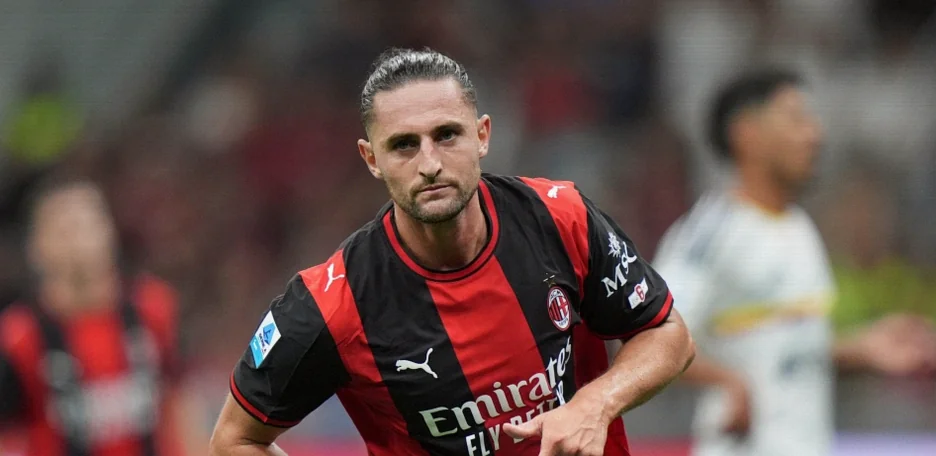
Adrien Rabiot has given Milan a useful reminder in recent weeks: versatility can help a coach through a difficult spell, but a player’s natural ground still matters across a long Serie A season.
Ruben Amorim has often stationed the Frenchman behind the striker, partly because the squad’s attacking options have required careful management. Christian Pulisic has been short of match fitness, 19-year-old Cisse cannot be overloaded, Alexis Saelemaekers is still being shaped for work in those areas, Ruben Loftus-Cheek has struggled to make an impact and Hutchinson has only recently arrived.
Quick facts
- Rabiot has been used both in central midfield and in an advanced role by Amorim.
- He previously played a similar attacking-midfield position under Roberto De Zerbi at Marseille.
- The matches against Lazio and Lecce strengthened the case for using him deeper.
- Milan are considering discussions over a contract renewal.
Rabiot has made clear that he does not see the two roles as incompatible. After speaking with Amorim, he said he and the coach agreed that he could operate in a midfield pair or further forward, adding that the advanced position was familiar from Marseille.
“I know that role well and I enjoy it because it lets me get into the box and score,” Rabiot said. His appetite for arriving in scoring areas remains one of his strongest features, alongside his ability to create for others.
Yet the recent games, particularly the win over Lecce after earlier signs against Lazio, pointed Milan towards a simpler conclusion. Rabiot can be deployed in several places, but he looks most complete when working from midfield.
Amorim has rotated not only personnel but also positions during his early work with the group. The Portuguese coach is nevertheless beginning to recognise that there are moments when established solutions offer more than constant adaptation.
In the advanced spaces demanded by Amorim’s system, players must work sharply in tight areas, find room between opponents and turn quickly under pressure. Rabiot brings technique, experience, tactical understanding and a strong footballing eye, but he is not a conventional number 10 operating with his back to goal.
He is more comfortable breaking forward than receiving in a congested pocket and having to play immediately. His best attacking actions tend to come when he has space to build momentum, arrive late and use his physical presence in the penalty area.
Deeper in the side, the picture has been clearer. Rabiot knows when to move beyond the ball, how to adjust his runs to Luka Modric’s positioning, when to support possession and when to provide protection in front of the defence.
That balance could become important as Milan’s season develops. Amorim is unlikely to rule out pushing Rabiot forward again when circumstances demand it, but midfield increasingly appears to be the place where the Frenchman gives the team its most reliable return.
For Milan, keeping that influence beyond the immediate campaign is the next consideration. Early thoughts of a renewal follow naturally from a player who has become valuable not simply because he can cover roles, but because he gives the side greater certainty in its central structure.