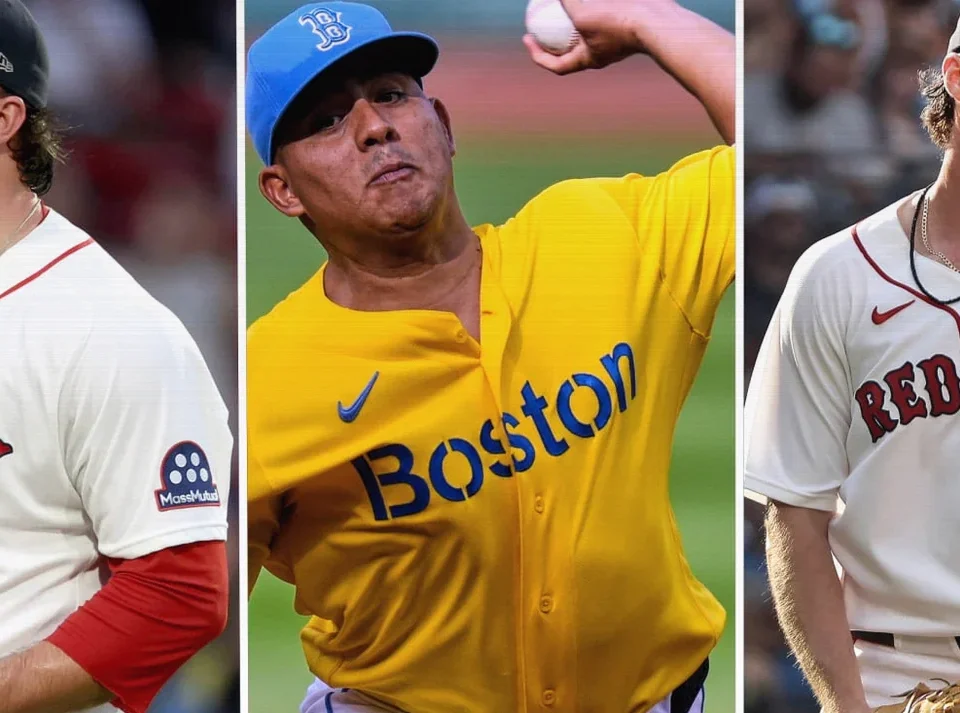
The Red Sox have not scored much in September, a troubling backdrop as October approaches. Yet Boston may carry an unusual answer into a likely Wild Card Series against the Yankees: a pitching staff so heavily left-handed that it has scarcely had a modern equal.
Nearly 60% of the plate appearances against Boston this season have come with a southpaw on the mound. The league rate sits around 30%. No club has relied on left-handed pitching at this level since the 1988 Reds, and Boston’s total ranks just outside the dozen most extreme seasons on record.
Through Friday, Red Sox lefties had supplied 832 1/3 innings, 264 more than the Phillies, who ranked second. Seattle, at the bottom of the list, had received fewer than one-fifth as many left-handed innings. Boston has also handed the ball to a left-handed starter 119 times, the third-highest single-season total ever and the most since the 1983 Yankees, whose rotation included Ron Guidry, Dave Righetti, Shane Rawley and Ray Fontenot.
It might have been an even more dramatic total. Garrett Crochet, the club’s left-handed ace, managed only 30 innings before a shoulder injury ended his regular season before April was out. Crochet still hopes he can return as an October reliever. Connelly Early, 24, logged 91 2/3 innings in the first half before getting hurt and later going to Washington in the trade that brought infielder Curtis Mead to Boston.
Ranger Suarez, Payton Tolle, Jake Bennett and Patrick Sandoval have helped hold down the rotation in their absence. Aroldis Chapman, Jovani Morán, Alec Gamboa, Raymond Burgos and deadline pickup Erik Miller have added more left-handed depth from the bullpen. In all, 14 Boston lefties have worked at least 10 innings, more than any other club.
A left-handed October test
The surge has coincided with Craig Breslow’s tenure atop baseball operations. Breslow, himself a former left-hander who appeared in 576 regular-season games across 12 seasons, took over after 2023. Boston ranked 28th in left-handed innings in 2024, rose to seventh in 2025 and then became the game’s most left-handed staff this year. The organization’s minor-league affiliates do not show quite the same pattern — Triple-A Worcester ranked 15th of 30 clubs, Double-A Portland eighth, while Greenville and Salem were just outside the top 10 — so it is difficult to call it a complete system-wide blueprint.
Still, the matchup logic is plain. Left-handed hitters have become a larger and more productive share of Major League lineups, while the most favorable platoon result remains a lefty pitcher against a lefty hitter. The leaguewide weighted on-base averages underline the advantage:
| Matchup | wOBA |
|---|---|
| Left-handed pitcher vs. left-handed hitter | .301 |
| Right-handed pitcher vs. left-handed hitter | .326 |
| Left-handed pitcher vs. right-handed hitter | .319 |
| Right-handed pitcher vs. right-handed hitter | .308 |
There is precedent for winning with an unusually left-handed staff. The 1965 Dodgers won 97 games and the World Series behind Sandy Koufax. The 1980 Yankees won 103. The 2017 Dodgers had four lefties make at least 20 starts apiece, won 104 games and reached Game 7 of the World Series. In 2017, then-Boston pitching coach Carl Willis brushed aside concerns about carrying four southpaws, saying the club would not overvalue the number because those arms were simply “four legitimate left-handed pitchers.” That remains a sensible view now.
Boston is not built entirely around lefties, either. Sonny Gray has put together an excellent season and appears certain to occupy one of the club’s top two postseason rotation spots. Garrett Whitlock, Tyron Guerrero and Brayan Bello should have important assignments as well. More importantly, the Red Sox lefties have not been exposed by right-handed hitters; their results in that split rank seventh-best in baseball. Since the three-batter minimum changed bullpen usage, left-handers have had to survive against hitters on both sides of the plate.
If Boston gets beyond New York, Cleveland and Tampa Bay could present favorable opponents. Both are among the six weakest offenses against left-handed pitching by wRC+. The Yankees are a different case. They have hit lefties better than righties, so Boston cannot simply expect its volume of southpaws to shut down a powerful lineup.
But the Red Sox can make Aaron Boone manage around it. No staff has faced fewer left-handed batters than Boston, by more than 200 compared with the next club. No pitching staff has faced more right-handed hitters, with Boston more than 100 ahead of the team in second. Opponents have regularly removed lefty bats and used right-handed platoon options against Boston’s starters and relievers. That is easier to arrange during a July series than in an all-or-nothing postseason set.
The Yankees’ decisions could become particularly uncomfortable if Aaron Judge remains uncertain for the series. Catcher Austin Wells has posted only a .441 OPS against left-handed pitching this season and owns a .580 career mark in the split, but turning to right-handed journeyman Ali Sánchez for playoff starts carries its own cost. Ryan McMahon has a .509 OPS against lefties this year and .667 for his career, which could push Anthony Volpe toward third base — a position Volpe had not played in the Majors before Friday.
Jazz Chisholm Jr. has been roughly 100 OPS points worse against left-handers both this year and over his career. Luis García Jr.’s breakout in Washington was aided by limiting his opportunities against southpaws, and New York has had reason to maintain that approach: 27 of his 30 home runs have come against right-handed pitchers. Ben Rice and Cody Bellinger are expected to stay in the lineup regardless, while Spencer Jones has fared well in a limited sample.
The Yankees have enough offense to handle left-handed pitching, and Boston’s own September scoring drought remains a real concern. But a club that brings this many southpaws into October can alter the other dugout before the first pitch. Boone may have to choose between preferred bats, platoon protection and defensive alignment in games with no margin for a soft spot. The Red Sox have not seen a pitching advantage quite like this in decades, and now they have a chance to find out how far it can carry them.