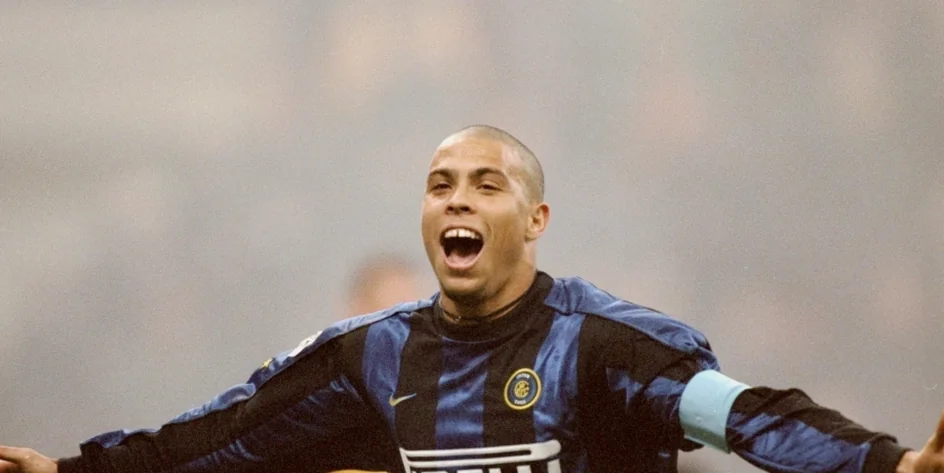
Ronaldo turns 50 with the old contradiction still intact: the most explosive striker of his generation and a figure whose life beyond the penalty area has rarely followed a straight line. In Italy, he remains tied above all to Inter, the club that brought him from Barcelona for 47 billion lire, and to the later Milan move that many Nerazzurri supporters could not forgive.
His story began far from the stadiums that would make him global. Ronaldo Luís Nazário de Lima grew up in Bento Ribeiro, in north-west Rio de Janeiro, the third child of Nélio Nazário de Lima and Sônia dos Santos Barata. His father, a travelling salesman with alcohol problems, left the family early, while Ronaldo’s bond with his mother became central.
Known as Dadado, he slept in the living room because he had no room of his own, alongside his sister Yone and brother Neio Junior, known as Nelinho. He suffered from sleepwalking from childhood and would wander through the house with his eyes closed. At the Maracanã he worked as a ball boy when Flamengo played, idolising Zico after the forward’s return from Udinese.
Quick facts
- Ronaldo began in youth football at Tennis Club Valqueire and also played at Social Ramos Clube and São Cristóvão.
- Jairzinho recommended him to Cruzeiro when he was 15.
- At Barcelona in 1996-97, he recorded 47 goals in 49 appearances across league and cup competitions.
- He won the 1994 World Cup without playing, Olympic bronze in 1996, the 1997 Ballon d’Or and another World Cup and Ballon d’Or in 2002.
- His later club ownership included Real Valladolid, Cruzeiro and a minority stake in Fort Lauderdale Strikers.
- He married Celina Locks in Ibiza in 2023, his fourth marriage.
There were physical insecurities before the fame: protruding teeth brought the Brazilian nickname Dentusco. But on the pitch his rise was immediate. After Cruzeiro, a visit from former Juventus player Franco Causio in the early 1990s produced an admiring report to the Turin club, although Juventus did not pursue the deal.
Instead, Ronaldo moved to PSV Eindhoven and then reached Barcelona under Bobby Robson at the age of 20. His sole season in Catalonia made him football’s central attacking force, including the celebrated solo goal against Compostela, begun around the halfway line and completed after he had beaten a succession of opponents.
Europe also forced a personal adjustment. Ronaldo later said he stopped wetting the bed after arriving in Spain. In the Netherlands, unable initially to understand the language, he would select restaurant orders at random from the menu.
By then he was already a regular for Brazil, having been part of the squad that won the World Cup in the United States in 1994 without him taking the field. Bronze followed at the Atlanta Olympics in 1996, then the Ballon d’Or in 1997, received as an Inter player.
During the Barcelona period he lived in Castelldefels with his mother, his sister and her family, agent Martins and a Brazilian friend named Cesar who served as an all-purpose assistant. Martins and Pitta had handled his Spanish move. He was dating model Susana Werner, nicknamed Ronaldinha, whose supposed career as a footballer had been manufactured with the help of Placar magazine.
Inter acquired a player already known as Il Fenomeno, the product of PSV, Barcelona and Brazil. The following years delivered extraordinary peaks but also repeated injuries, especially to his knees. He won the 2002 World Cup in Japan and South Korea at 26, along with a second Ballon d’Or, before joining Real Madrid.
By his 30th birthday, spent as a Madrid player, much of the physical ease had gone. In Spain he was dubbed El Gordo, yet even a patched-up Ronaldo could decide a match in a single moment. Fabio Capello’s public frustrations with his discipline became part of that period, as injuries and weight increasingly shaped the final phase of his elite career.
His January 2007 transfer from Real Madrid to Milan reopened a deeply Italian argument. For Inter fans, watching their former symbol in Rossoneri colours felt like a betrayal. Ronaldo eventually ended his playing career with Corinthians in 2011, aged 34.
His private life was no less eventful. By retirement he had married footballer Milene Domingues in 1999, model Daniela Ciccarelli in 2004 in a brief marriage that reportedly cost him close to €1 million, and Maria Beatriz Anthony, known as Bia, in 2010. He later underwent a vasectomy, saying he had chosen to “close the children’s factory”; he has four officially recognised children with three different women.
Retirement led to a different attempt at building a place in football. Around 40, he founded 9ine Sport & Entertainment, an image-management company for athletes, continued commercial work, served as a UN ambassador and began investing in clubs. He became a 10 per cent shareholder in Fort Lauderdale Strikers in 2014 before taking control at Real Valladolid four years later.
Valladolid proved a difficult project, marked by relegations and returns to La Liga over roughly a decade. He also bought Cruzeiro, the club that had launched his career, but sold it after two and a half years. The pattern suggested that Ronaldo the owner did not find the same certainty Ronaldo the centre-forward once possessed.
Now he appears more settled. His relationship with model and entrepreneur Celina Locks began in 2015; they married in Ibiza in 2023, and she is president of the Fundação Fenômenos, which works in Brazil’s favelas. Ronaldo has also developed steadier relationships with his children.
At the 2026 World Cup final, he appeared in the half-time ceremony alongside Ronaldinho and Madonna, joining in with a few dance moves. It was an unlikely image for a player once defined by relentless acceleration, but the place he holds in Serie A memory has not changed: even with all the ruptures, Ronaldo remains Il Fenomeno.