San Siro reaches its centenary on 19 September, one hundred years after Milan and Inter opened the ground with a 6-3 derby on 19 September 1926. It has long been more than Italy’s best-known stadium: three tiers of concrete, steel and memory, carrying the football life of Milan through changing owners, coaches and generations.
The old ground now faces an uncertain future, with demolition plans hanging over it. Yet its history explains why the debate extends beyond sport. For many supporters, San Siro is one of the defining Italian monuments of the twentieth century, as recognisable abroad as any building in the country.
Quick facts
- The first stone was laid in August 1925, and construction took roughly a year.
- Milan owned the stadium at first; coach Herbert Burgess even lived in a flat beneath the stands.
- The opening match ended Milan 3-6 Inter on 19 September 1926.
- The second tier arrived in 1955, floodlights in 1957 and the first electronic scoreboard in 1967.
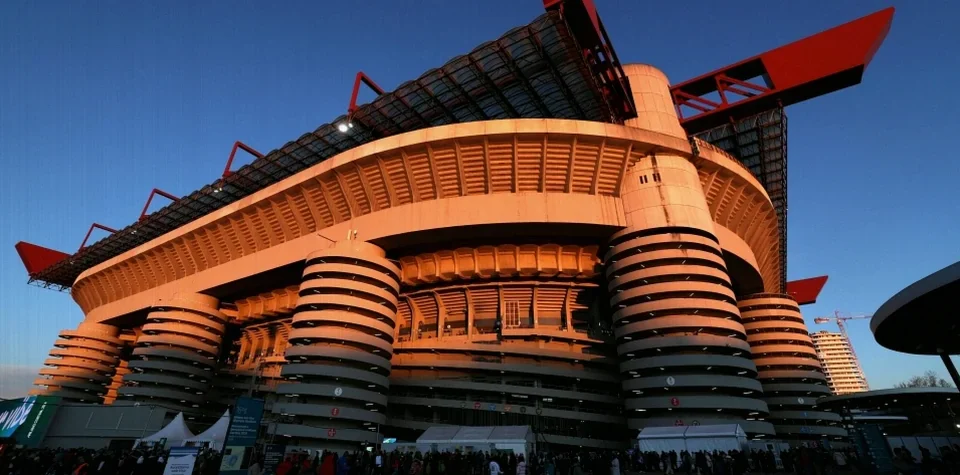
- Italy ’90 brought the third tier, supported by the familiar red girders and 11 circular towers.
- The stadium has carried the name of Giuseppe Meazza since the early 1980s, a designation never warmly accepted by much of the Milan support.
Designed by Ulisse Stacchini, the original structure was a single ring of four straight stands, without the curved corners that later completed its outline. It required 10,000 quintals of cement, 3,500 cubic metres of sand and 1,500 quintals of iron bars; 80 kilograms of chalk were used to mark the first pitch. The project cost five million lire.
The name comes from the nearby church of San Siro, dedicated to Siro, traditionally remembered as the child who brought the five loaves and two fish for the biblical miracle. The coincidence has its own football echo: Milan beat Inter 5-2 in the 1914 derby.
There are darker marks in the stadium’s early landscape. During the war, the church was also used as a place where partisans were tortured. At the inaugural derby in 1926, both teams gave the Fascist salute before kick-off.
In its first years, the stadium belonged exclusively to Milan. Burgess, the English coach with a Manchester United past, lived inside the building beneath a stand, an arrangement that now sounds almost impossible. In 1934, Italy and Austria used the area around the ground to prepare for their World Cup semi-final, won 1-0 by Italy through Enrique Guaita.
Post-war expansion turned the venue into the vast shared home recognised today. Poet Vittorio Sereni called it “the great basin”, and the description still fits: the pitch sits at the centre of a steep, enclosing bowl, watched from above by layers of seats.
Night football became part of its identity after the floodlights were installed. The first evening derby was a Coppa Italia tie in June 1958, kicking off at 21:30. The lighting and giant screens are now managed from a relatively small technical room above the press tribune.
San Siro also staged the defining European night of Helenio Herrera’s Inter. UEFA awarded it the 1965 European Cup final, and the Grande Inter beat Benfica 1-0, Jair scoring the decisive goal. That followed the celebrated 3-0 semi-final return against Liverpool, a result that entered the Nerazzurri’s own stadium folklore.
For Inter, the Curva Nord has supplied the colour, choreography and songs, as well as less admirable episodes such as a scooter being thrown from the terraces during Inter-Atalanta in 2001. Later generations added their own landmarks: the 2023 Champions League semi-final, José Mourinho’s 2010 victory over Barcelona and the record-breaking Scudetto campaign all belong to the same address.
Milan’s response came at the end of the 1980s, when Arrigo Sacchi’s side and its three Dutch stars made San Siro a stage for another era of European football. The Curva Sud still preserves references to that period, including the “Marco Nico” banner, and its place is expected to survive in some form even if the old stadium disappears.
The Rossoneri have their own catalogue of afternoons and wet evenings: the 5-0 against Real Madrid, the 3-0 over Manchester United in the rain, and the 6-0 derby marked by Giunti and Comandini. There were other images that never leave supporters: Mark Hateley rising above Fulvio Collovati, Andriy Shevchenko, Christian Abbiati’s calf injury in the 2003 derby, and the goalless draw with Bologna that delivered the club’s tenth league title.
The final transformation came for the 1990 World Cup. Rather than being placed directly on top of the second ring, the third tier was built as a separate superstructure. Its red supports and towers changed the skyline of the district, while the unfinished section above the orange stand remained absent to avoid problems for nearby homes.
That asymmetry has become part of San Siro’s character. It has never looked polished or perfectly balanced, but its imperfections are inseparable from its appeal. At number 100, the garden is not outside the house but inside it: a field where grass can struggle to grow, and where the city has continued to place its Sundays.