Sandro Mazzola has died at the age of 82, leaving Inter and Milan with the memory of a figure whose life was bound to football long before he became one of the defining faces of the Nerazzurri. His career brought famous goals, league triumphs and an enduring attachment to the city, but the man behind the captain’s armband carried a childhood marked by loss, family separation and an unshakeable faith.
Key takeaways
- Mazzola was born in Turin on 8 November 1942 and grew up in the shadow of his father Valentino, the Torino captain lost in the Superga disaster.
- Before committing himself to football, he passed a trial with Borletti basketball and was considered a promising point guard.
- Benito Lorenzi helped bring Sandro and his brother Ferruccio into the Inter world while they were still boys.
- Gianni Agnelli attempted to take Mazzola to Juventus in 1967 with a major business and salary proposal, but his mother Emilia refused the move.
- His final public reflections included an apology to Roberto Boninsegna over the striker’s exchange with Pietro Anastasi.
A childhood that led to Milan and Inter
Mazzola’s first sporting talent was not confined to the pitch. As a boy he played basketball as well as football, successfully trying out for Borletti. “They accepted me and I was a decent playmaker,” he later recalled, while making clear that football remained his real calling. His mother Emilia told him simply that the ball was his path.
His family story had already been shaped by separation. Sandro stayed with Valentino Mazzola and Valentino’s partner Giuseppina, while younger brother Ferruccio, born in 1945, lived with Emilia. After Valentino’s death at Superga, Giuseppina, who had raised Sandro, took him away and placed him with friends living at a mill. A search involving the Carabinieri and Torino supporters eventually found him. Mazzola said he was brought home after a month, and only then learnt that he had a brother.
Following years in Cassano d’Adda, the family moved to Milan, settling in Via De Amicis near Sant’Ambrogio, where two aunts were already based. Sandro and Ferruccio began playing at the San Lorenzo oratory in the Porta Ticinese area and formed a first team with friends, Milanesina.
Inter entered the picture through Benito Lorenzi, a close friend and admirer of Valentino. Lorenzi took the two boys under his protection, bringing them to San Siro in Inter shirts and seating them beside the bench. At Lorenzi’s instruction, they were even given a 30,000-lire match payment.
In Inter’s youth ranks, Mazzola also encountered Giuseppe Meazza as a coach. Meazza’s lessons were not merely technical. When Mazzola once shouted at a team-mate for failing to pass, the former World Cup winner stopped him and reminded him that he had never treated a colleague that way. Another outburst, Meazza warned, would leave the young forward out of the side.
After retiring, Mazzola moved to Monza and later spent his final years in Vedano al Lambro. Yet his identity remained inseparable from Inter, the club that became the principal stage of his football life.
Faith, loyalty and the episodes behind the public image
Mazzola was open about the importance of religion to him. During an Inter visit to Padre Pio, arranged by coach Helenio Herrera, he requested a private conversation. As a child, he had made a troubling vow: he would accept dying young, as his father had, if he could become a champion. A confessor had previously denied him absolution, considering the promise sacrilegious. Padre Pio, Mazzola said, dismissed the fear with a smile.
Faith returned to the foreground during Inter’s dramatic 1970-71 title recovery under Giovanni Invernizzi, which ended with the Nerazzurri overturning Milan in the Scudetto race. Before the derby, Mazzola, then Inter captain, asked Monsignor Spada, his former religion teacher at the Diaz school, to celebrate a special Mass for the squad. He offered an agreement: should Inter win, Don Bomba, as Spada was known to his pupils, would join the dressing-room celebration. Inter prevailed and the priest kept his side of the pact.
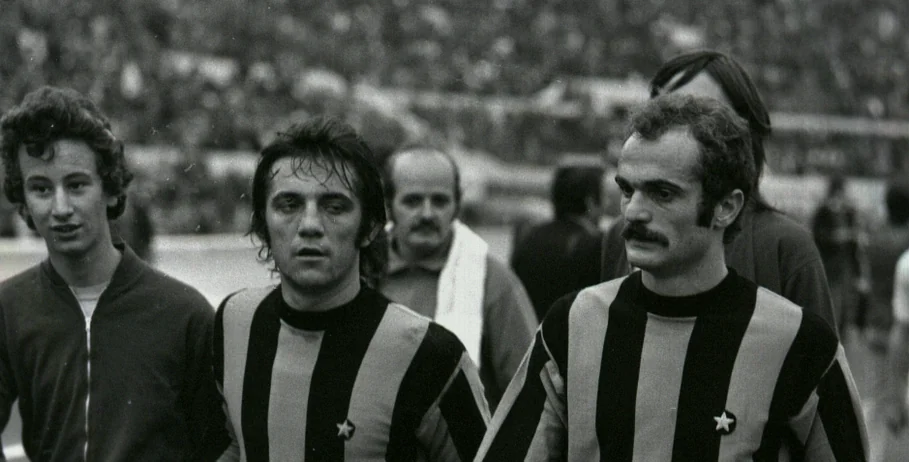
Mazzola retained a private connection with Milan’s Duomo too. Monsignor Spada, who also officiated at his wedding to Graziella, gave him part of an original cathedral spire, which Mazzola kept at home.
His belief in signs was often associated with the moustache that became part of his image, although Mazzola always rejected the suggestion that he had grown or retained it for luck.
The 1970 World Cup also produced one of the more awkward stories of his Italy career. After Italy defeated Sweden and Uruguay overcame Israel, a draw between the two sides would have sent both teams through. Uruguay captain Luis Ubiña proposed exactly that arrangement to Mazzola. The suggestion was passed to the Italian camp, where Mario Bertini alone objected. Bertini played at full intensity, angering the Uruguayans as he ran relentlessly through the match.
Club loyalty was tested three years earlier. In 1967, after Inter lost the title at Mantova, Agnelli met Mazzola at Villar Perosa in an effort to persuade him to join Juventus. The offer included a Fiat dealership, a Sai insurance agency and twice his existing salary, without the modern language of bonuses or agent commissions. Emilia brought the discussion to an end: in her view, the son of Torino’s captain could not wear the Juventus shirt.
In his last interview, Mazzola revisited another Inter decision with regret. Boninsegna often joked that Mazzola had forced him out, something Mazzola denied. But he accepted that he could have resisted the swap that sent Boninsegna away in exchange for Anastasi and chose not to, believing it served Inter’s interests. Boninsegna said he was pleased that his old concerns had finally been acknowledged, adding that he forgave him.