Some footballers belong not only to a club but to its memory, and Sandro Mazzola remains one of Inter’s defining figures because he seemed to carry every part of the side within him. In an era governed by contracts, bonuses and transfer values, the idea of one player becoming the lasting face of a people feels increasingly distant. For the Nerazzurri, Mazzola was that figure: a leader, a technical reference point and a player who could take responsibility on the pitch as readily as he could speak for the group away from it.
The coach and the club
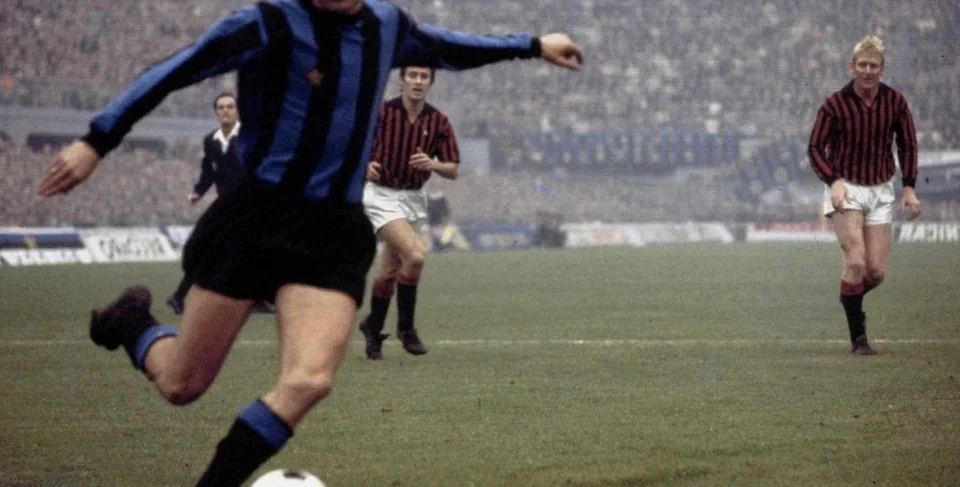
Mazzola’s place at Inter was built on more than talent. He inherited charisma and authority from his father Valentino, the great driving force of Grande Torino, but fashioned those gifts into his own career. He became the symbol of the Grande Inter, a player supporters could recognise immediately in the vast space of San Siro: the long stride, the moustache, the demand for the ball, the urge to attempt a dribble and then finish the move himself.
He was not immune to poor afternoons or periods below his usual standard. Yet even when Inter struggled, he retained the capacity to alter a match with one run, one pass or one decisive action. That consistency of presence mattered. Mazzola was not a player who waited at the edge of the game for a favourable moment; he wanted to shape it from its beginning to its conclusion.
His connection with Inter also rested on his role within the dressing room. He could be the point of contact when the squad needed to address the president or the manager, and he developed the authority of a player who understood both the demands of a match and the people around him. Such one-club standards are harder to find in modern football, where the relationship between player and badge is often more temporary.
A forward who became more than a forward
In his early years, Mazzola played with the speed and directness of a centre-forward. Put him into open ground and he would reach the pass before most defenders, making him a natural outlet for Inter’s counter-attacks. He benefited from the imagination of Mario Corso and the passing range of Luis Suárez, but he was never simply the final recipient of their work.
His game sat between roles. He was not a conventional striker, nor a pure creator in the mould of Gianni Rivera. He did not possess Rivera’s sudden flashes of invention, but he could combine neatly with team-mates, link moves through quick exchanges and arrive to shoot with genuine instinct. Over time he moved deeper, becoming an attacking midfielder with a forward’s appetite for goals.
- He had pace over distance and sharp movement in tighter spaces.
- He could beat opponents in individual duels and absorb the physical treatment common in his generation.
- He offered the passing vision and responsibility associated with a midfielder.
- He retained the timing, finishing and hunger of a scorer.
That flexibility made him well suited to the changing football of the 1960s and 1970s, when the game became increasingly athletic and rapid under influences arriving from England. Mazzola adapted without losing his technical quality. Rivera, a more measured player with perhaps greater fantasy, was less naturally suited to that shift in tempo.
The inheritance of Filadelfia
Before Inter made him an icon, Mazzola had grown up in the shadow of a father whose legacy was both magnificent and tragic. As a child at Torino’s Filadelfia ground, Sandro learned around the great names of Grande Torino: Menti, Loik, Gabetto, Ossola and, above all, Valentino Mazzola.
Those memories included the uncomplicated joy of the game. At the end of training, Sandro would ask goalkeeper Valerio Bacigalupo to take his place in goal while he practised penalties. Scoring brought the uninhibited celebration of a boy playing football, but those sessions also formed his understanding of finishing, movement and responsibility.
Valentino had been the commanding presence of Grande Torino, capable of giving a side direction and personality. Sandro inherited that sense of being both a player and a reference point. The son did not merely preserve his father’s name; he made it central to another great Italian club.
Why the modern comparisons remain incomplete
Lautaro Martínez has qualities Mazzola admired: he covers the attacking line, has speed, works in combination and carries the temperament of a leader. At modern Inter, he is a captain, a symbol and a favourite of the public in a way that invites the comparison.
But Martínez is still an attacker rather than the all-purpose midfielder-forward Mazzola became. He does not offer the same all-round peripheral vision or the capacity to occupy that hybrid role between mezzala and scorer. The comparison speaks to Lautaro’s importance at Inter, but it also illustrates how unusual Mazzola’s complete profile was.
Kylian Mbappé can occasionally recall one part of Mazzola’s game when he begins centrally from deep positions, accelerates past opponents, changes direction and finishes with precision. Yet the distinction is in the rhythm of their involvement. Mbappé can spend long passages outside a team’s construction; Mazzola remained involved everywhere, capable of appearing near his own penalty area to protect a lead that he may have created with a goal at the other end.
Mazzola’s football was collective. Individual brilliance was present, but it served the side. He played for the group rather than treating the group as the stage for his own performance.
Ronaldo, Di Stéfano and the rarest profile
Ronaldo Nazário offers another partial connection. Like Mazzola, he combined explosive pace with technique, possessed a natural eye for goal and could link with team-mates rather than merely finish their work. Both had the authority that comes when colleagues and opponents recognise exceptional ability. Their shared Nerazzurri association adds another thread, though they were never identical players.
The broader historical comparison leads instead to Alfredo Di Stéfano. At Real Madrid, Di Stéfano was described as a player able to occupy the whole field: beginning moves deep, contributing through midfield and arriving to complete them in front of goal. He was the leading figure in the Real side that dominated European football in the 1950s and 1960s.
Di Stéfano had admired Valentino Mazzola, and the connection is fitting. Sandro, like his father, could not be contained by a single label. He was neither solely a striker nor solely a midfielder, but both at once. That blend of work, personality, technique and collective purpose is why Mazzola remains difficult to match, even in a game that has produced so many specialists.
For Inter, his story is therefore not simply one of trophies or famous matches. It is the story of a player who became a club’s voice on the field, a bridge between the memory of Grande Torino and the identity of Grande Inter, and a reminder that the most complete footballers are often those who make the whole team feel larger.