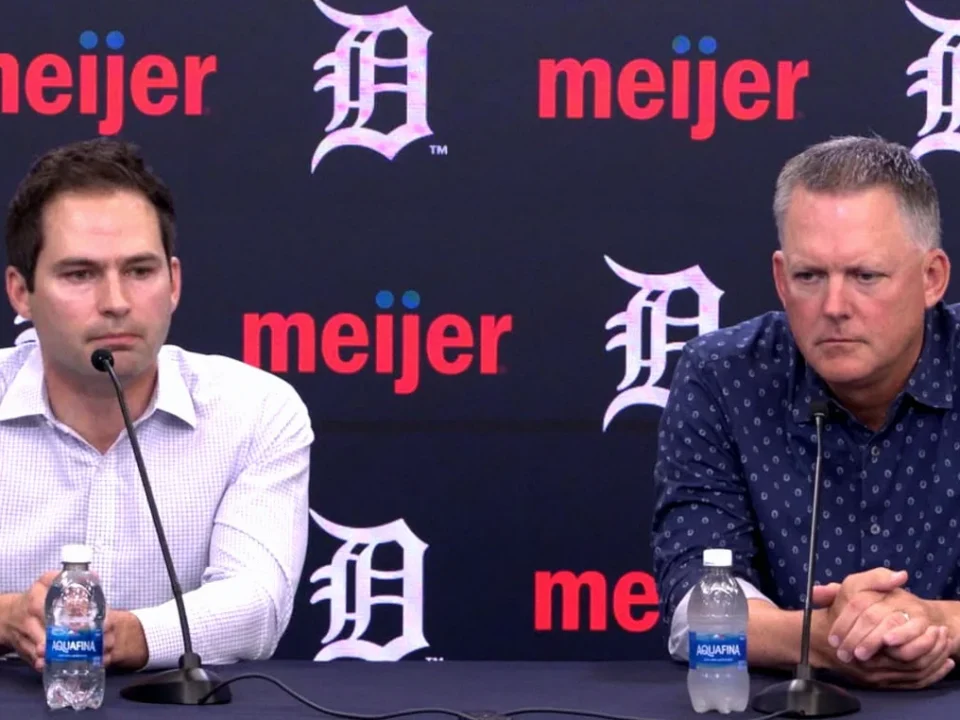
Detroit closed the regular season at 76-86, and Scott Harris did not try to dress up the result. One day after the Tigers’ season ended without October baseball, the club’s president of baseball operations joined manager A.J. Hinch for their annual review and called the year a missed chance. The message from the front office was clear: the Tigers have young talent and a better-stocked pitching pipeline, but they did not have the depth to survive the hard part of the schedule.
A season that slipped away in May
Detroit’s second straight postseason absence came after two consecutive playoff appearances, and Harris placed much of the blame on a roster that could not absorb early losses. The Tigers went 6-22 in May, fell to last place by June 1 and never fully recovered.
Harris said the club’s troubles were not simply a matter of bad timing. He viewed them as a construction problem, acknowledging that Detroit did not carry enough protection at key positions when injuries began piling up.
- Parker Meadows, Gleyber Torres and Javier Báez were all sidelined by May 3, thinning the Tigers at premium defensive positions.
- Tarik Skubal’s elbow injury took a major arm out of the rotation picture.
- The bullpen also dealt with a broad set of problems during the season.
- Detroit expected prospects to provide position-player cover, but several were not ready when the need arrived.
- The club had planned to regain rotation options in Troy Melton and Jackson Jobe, potentially freeing quality starters for bullpen work before adding help at the Trade Deadline.
Harris said the Tigers tried to avoid closing pathways for younger players, but he now believes the club should have added enough veteran or ready-made depth to get through April and May without losing its footing. “That was a mistake in the way we put the roster together,” he said in substance, taking responsibility for the shortfall.
A different look around the diamond
Hinch’s Tigers have frequently hunted matchups, using platoons, pinch-hitters and late-game switches to find an edge. Harris indicated that could be less central to the club’s approach going forward.
Detroit expects more players in its system to contribute on both sides of the ball, allowing the club to lean less heavily on the bench-driven matchup game. Kevin McGonigle and Max Clark have already signaled that kind of broader profile, while Hao-Yu Lee strengthened that impression during the season’s final stretch.
The shift could affect several players whose roles have often been shaped by platoon usage:
- Kerry Carpenter
- Zach McKinstry
- Colt Keith
Harris did not spell out how any individual assignment might change, but the organization’s stated preference is for a lineup with more everyday flexibility rather than one dependent on constant mixing and matching.
Greene remains the lineup’s centerpiece
Riley Greene delivered the best offensive season of his career, finishing with a 135 OPS+ and a 135 wRC+. Before a hamstring injury in August, he had become the central force in Detroit’s offense. His absence coincided with a late push for the postseason that lost momentum.
Greene is two seasons away from free agency, but Harris declined to publicly discuss the possibility of an extension. He did make clear how the club views the outfielder, describing his presence in the middle of the order as one of the forces that drives the offense.
The executive said contract conversations will remain private unless an agreement is completed, framing that policy as a matter of respect for Greene and the rest of the roster.
Torkelson still figures in Detroit’s plans
Spencer Torkelson’s offensive decline raised questions about his long-term place with the Tigers, particularly with only two years remaining before free agency. Harris, however, offered a firm vote of confidence.
He pointed to stretches in which Torkelson was a dangerous hitter, including strong work late in the season. Harris said the first baseman showed better pitch selection, did damage when he got pitches to hit and began using the opposite field more effectively, especially with two strikes and runners in scoring position.
Detroit still sees work ahead in the details of Torkelson’s defense at first base, but Harris emphasized the player’s value inside the clubhouse as well as on the field. The Tigers believe Torkelson remains part of the group that can bring the club back to the playoffs.
There was also a longer view to the meeting. Detroit added pitching depth through both the Trade Deadline and the Draft, moves the organization believes can help over the coming years. But after a season Harris called an opportunity lost, the immediate assignment is simpler: build a roster capable of staying upright when the injuries start coming.