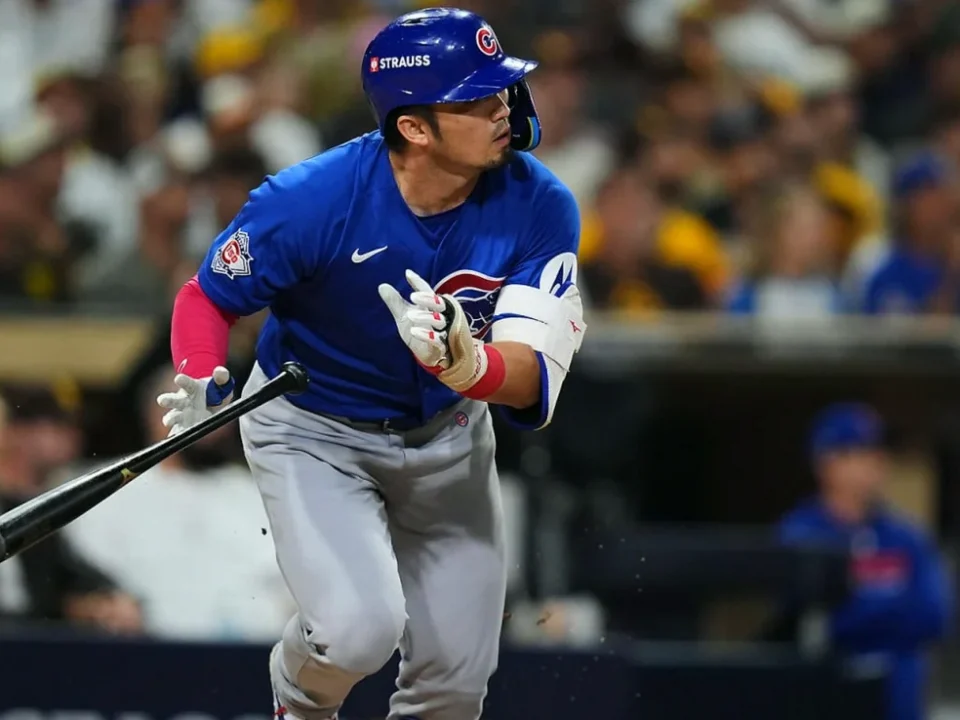
Seiya Suzuki arrived in Chicago with a swing built for attention, and after five seasons with the Cubs, he heads toward free agency as one of the club’s biggest offseason decisions. The 32-year-old outfielder has completed the five-year, $85 million deal he signed after leaving the Hiroshima Toyo Carp in March 2022, leaving both Suzuki and the Cubs to weigh what comes next after a postseason exit.
Key takeaways
- Suzuki produced a .269/.351/.472 career line for the Cubs, with 113 home runs and 382 RBIs across 675 games.
- He set a personal high with 81 walks in 2026 while posting an .841 OPS, 26 homers and 86 RBIs.
- Suzuki’s defense took a major step forward this season, finishing at +8 Fielding Run Value and +5 Outs Above Average.
- Only seven right-handed Major League hitters matched his five-year combination of at least 110 homers, 140 doubles, 300 walks and 380 RBIs.
- Ian Happ is also approaching free agency, part of a sizable group of Cubs hitters and pitchers whose futures remain unsettled.
A Chicago run that gained strength late
When Suzuki first took batting practice at Sloan Park, the crowd had come to see the Japanese slugger the Cubs had brought aboard. The early impression was a controlled setup: a measured front-leg lift, the bat drawn back, then a sharp and forceful release through the ball. Craig Counsell has long admired both the look of the swing and Suzuki’s physical strength.
The production did not arrive all at once. Suzuki had to adjust to Major League pitching and learn how to manage the demands of his daily routine, but he became a regular middle-of-the-order presence. His five Cubs seasons included 142 doubles, 316 walks and 374 runs scored, alongside his 113 home runs.
His best work often came as the calendar moved deeper into the season. Suzuki carried a .245/.313/.450 line in June for his career, then improved to .263/.342/.464 in July and .279/.364/.473 in August. In September and October, he hit .295/.393/.508, good for a .901 OPS.
That finishing kick showed again in his final season under contract. Suzuki batted .270 with 31 doubles, 26 homers and 86 RBIs, while his 81 walks marked a career best. His work in the field also changed the picture. After entering the season with negative career marks in both measures, he delivered positive ratings in Fielding Run Value and Outs Above Average.
Free agency brings an unfamiliar decision
Suzuki said the possibility that his final game as a Cub may already have been played has brought plenty to reflect on. Chicago was his entry point to life and baseball in the United States, and he spoke warmly of teammates, staff members, Wrigley Field and the passion of Cubs fans.
“If I start going through all the good memories, we might need three hours,” Suzuki said through interpreter Edwin Stanberry. “My first experience in the United States was in Chicago. I enjoyed being around the teammates, the staff and everyone who helped me. My family loves Chicago, too.”
He had hoped the Cubs would return to Wrigley Field for another postseason game, but the club’s elimination ended that chance. Now comes his first trip through free agency, a process Suzuki acknowledged carries many moving parts and no certain outcome.
The Cubs could make Suzuki a qualifying offer, which would give the club draft-pick compensation if he signs elsewhere. With the position-player market likely to include Suzuki among its stronger bats, he would have reason to pursue a longer contract rather than accept a one-year arrangement.
President of baseball operations Jed Hoyer did not outline a specific plan for Suzuki, but he made clear that the 2027 roster will not look identical. The Cubs have numerous pending free agents on both sides of the ball.
“We cannot keep everybody,” Hoyer said. “The team will look different next year, and in many respects that can be a positive. We have a lot of good players nearing free agency, though, and we will be talking with them.”
Suzuki remains his own toughest judge. He believes his game improved, particularly in right field this past season, but he also carries the frustration of wondering whether he fully matched the expectations attached to his arrival.
“I am not sure I reached what people expected from me,” Suzuki said. “At the end of each season, there was some frustration. Looking back, I did improve and I worked hard. Defensively, this last year was a big improvement, and I think the work paid off. Still, there are a lot of what-ifs. Did I meet the expectations others had, and the ones I had for myself?”