Milwaukee opens the National League Championship Series on Sunday night with 103 wins, home-field advantage and every reason to believe this October can look different from the one that ended a year ago. The Dodgers arrive with 100 victories and a rotation built for a seven-game grind, making this the first NLCS in 50 years to match two 100-win clubs.
It is also a return engagement. Los Angeles swept Milwaukee in last year’s NLCS, a result made more lopsided by the Brewers’ four total runs and a .118/.191/.193 team slash line. Shohei Ohtani’s remarkable Game 4 became the signature moment of that series, but Milwaukee’s lack of offense was the lasting problem. This Brewers club has more ways to compete, though it still faces the central October question: can it score often enough against the Dodgers’ pitching?
Different pieces around familiar stars
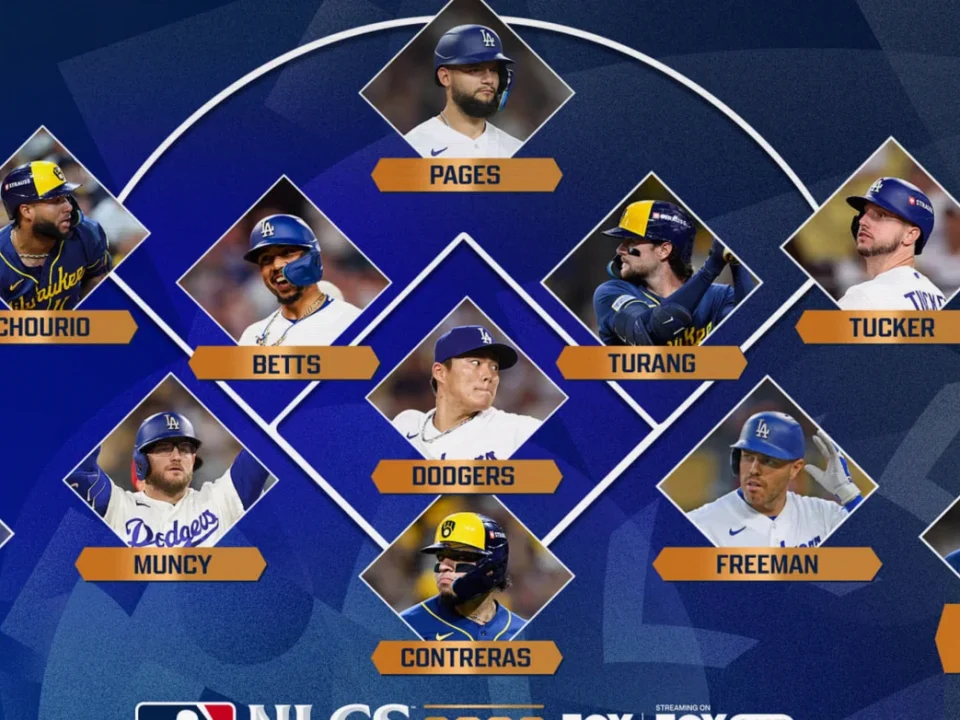
The catcher matchup is close, even if the Division Series numbers would suggest otherwise. William Contreras carried a 1.194 OPS in the previous round, while Will Smith posted a .125 mark over their combined 34 plate appearances. That is far too small a sample to settle anything. Smith owns the stronger two-year offensive record, with an .854 OPS compared with Contreras’ .756, although the gap narrowed this season and Smith lost much of the second half to a neck injury. Both are serviceable but slightly below-average defenders by the available measures. Milwaukee also holds an edge behind Contreras, where Gary Sánchez offers more punch than Dodgers reserve Hunter Feduccia.
First base offers a contrast between résumé and recent production. Freddie Freeman remains a future first-ballot Hall of Famer, but age and injuries pushed him below an .800 OPS for the first time since 2012. Jake Bauers, meanwhile, put together the best full season of his career and outperformed Freeman over the regular season. Freeman used the playoff bye to reset his timing and looked much sharper against Atlanta. His value around the bag could become important, too; he remains exceptional at rescuing errant infield throws, while that has not been a Bauers strength.
Milwaukee has a clear advantage at second base with Brice Turang, whose strong glove has been joined by more power than expected. Los Angeles can counter with combinations involving Tommy Edman and Kiké Hernández, and Hernández has spent enough Octobers making timely contributions to make that arrangement dangerous. Still, Turang has grown into one of the game’s premier all-around second basemen.
At shortstop, Mookie Betts recovered from an unusually modest season with one of the best Septembers of his career. Milwaukee rookie Cooper Pratt, who turned 22 in August, reached base at a .350 clip after his midseason arrival. Pratt has had some rough defensive moments this month despite projections of a strong future glove, and Betts retains a sizeable power edge.
Third base gives Pat Murphy flexibility. Joey Ortiz shifted from shortstop after Pratt’s promotion and brings elite defense, while David Hamilton can change an inning with his speed. Max Muncy is still a formidable counterpunch for Los Angeles: 29 home runs, offense 29 percent above league average, and defense that has settled around average. In the Division Series, Muncy hit three homers; Ortiz and Hamilton combined for two hits.
The outfield carries some of Milwaukee’s greatest promise and some of its vulnerability. Jackson Chourio has now reached 20 homers in three straight seasons before the end of his age-22 campaign, and his defense deserves more attention. Only Pete Crow-Armstrong delivered more outfield value in the second half. Chourio is the better overall choice over Teoscar Hernández, even after Hernández closed the regular season hot.
Garrett Mitchell’s breakout year included a key catch that prevented Manny Machado from leaving the yard in the deciding game of the NLDS. Andy Pages, who has delivered memorable postseason defense himself, grades among the sport’s finest defenders. Pages also had the stronger overall offensive season, made more contact, and finished better down the stretch. The margin is narrow, but it grows because Mitchell was merely average against left-handed pitching and Los Angeles is expected to deploy two lefty starters.
Right field is less convincing for either side. Kyle Tucker’s first Dodgers season fell well short of expectations, with a good September merely lifting him to a league-average 100 OPS+. His Division Series was productive, and his established track record still matters. Milwaukee’s Sal Frelick finished at 70 OPS+, while 21-year-old rookie Luis Lara posted a 77 OPS+. The Brewers get better defense from that tandem, but their right-field offense was among the club’s soft spots.
At designated hitter, Ohtani is not quite operating at his normal breathtaking level. Injuries have cooled his bat, and his diminished second half left room for Pete Crow-Armstrong to take command of the NL MVP conversation. Christian Yelich, a two-time MVP himself, has the stature to make this an argument, but his .692 OPS was the lowest of his career. Even an imperfect Ohtani out-hit Yelich this season, though both stars have something meaningful to prove over the coming week.
Rotation depth may decide the rematch
The front ends of these staffs can stand beside anybody’s. Milwaukee has Jacob Misiorowski, the overwhelming flamethrower, and Logan Henderson, who owns a 2.33 ERA through his first 23 major league starts. The Dodgers can counter with back-to-back Cy Young winner Tarik Skubal and Yoshinobu Yamamoto. There is no easy choice among that group.
The separation comes later. Los Angeles can send Blake Snell and Tyler Glasnow behind its first two starters, a depth advantage that becomes more meaningful in a best-of-seven series. Milwaukee may need Dustin May and Robert Gasser after Misiorowski and Henderson, with Kyle Harrison apparently no longer trusted for a prominent role and the bullpen ready for heavy use. That remains a very good Brewers staff; the Dodgers simply have the fuller stack of starters.
Milwaukee’s relief corps showed exactly why it can keep this matchup tight. Brewers relievers covered 19 Division Series innings and allowed one run, good for a 0.47 ERA, even with a strikeout rate below their regular-season standard. Abner Uribe, Trevor Megill and Aaron Ashby were particularly effective late in games, outpitching a much-hyped Padres bullpen.
The Dodgers have useful answers of their own, including Tanner Scott’s revival and Evan Phillips’ return. But Edwin Díaz and Roki Sasaki have not inspired complete certainty, and Edgardo Henriquez’s back remains a health concern. Los Angeles might also use a starter for relief when the calendar demands it. On balance, Milwaukee’s bullpen contains fewer unanswered questions.
The Brewers are better equipped than the club swept last October. Chourio is an ascending star, Misiorowski gives them a true ace, and the roster has enough athleticism, speed and defensive ability to win in several fashions. They earned 103 victories, and they own the home park for this series. The uneven defense seen against San Diego, particularly from Pratt, will need to settle down.
Still, postseason baseball eventually asks for runs. Milwaukee has legitimate power in Bauers, Turang and Chourio, each of whom cleared 20 homers, but the Dodgers bring the more intimidating collection of long-ball threats. The Brewers can win several games, and they can win the series. To change the ending from last year, however, they must find enough hard contact against a Los Angeles rotation that leaves very little room for a quiet night at the plate.