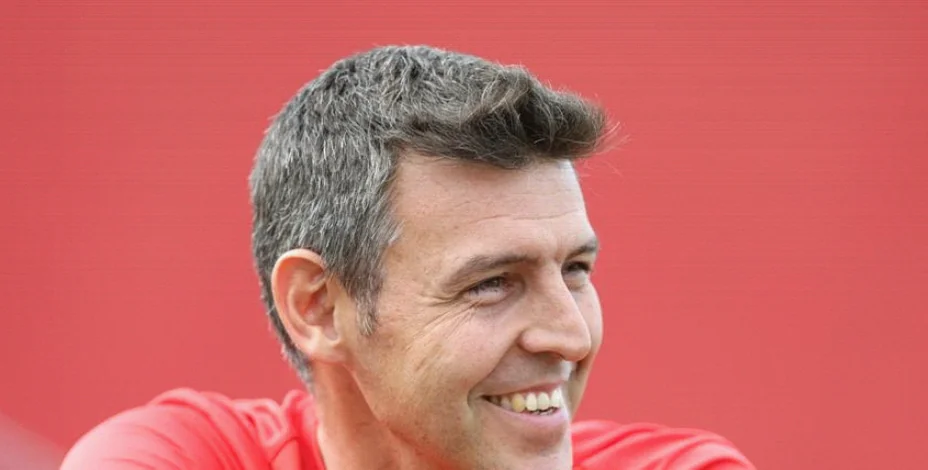
Sergio Navarro has arrived at Milan Futuro with a conviction that places responsibility before instruction. The Spanish coach sees the reserve side not simply as a training ground for a system, but as a place where young footballers must learn to make decisions, understand one another and develop beyond the pitch.
For Navarro, the central measure of progress is not whether Milan Futuro win 4-0 or lose by the same margin. He wants his players to take initiative with and without the ball, while judging each match through the growth of individuals and the group.
A coach shaped by education
- Navarro played as a midfielder until the age of 26, spending his career in the lower divisions. Although he believed he had good technical ability, he felt his own coaches had not offered him sufficient guidance.
- That experience led him towards coaching young players. He completed studies in pedagogy and physical preparation, followed by a Barcelona master’s course.
- He also formed a friendship with Juanma Lillo, whom he regards as a coach of exceptional stature.
- Before joining Milan, Navarro worked as a first-team coach at Karpaty Lviv and Debrecen, served as a methodology specialist at Villarreal and held responsibility for youth football at Athletic Bilbao.
- His move to Milan began in the spring, when Jovan Kirovski contacted him. Navarro said the conversation was striking because it centred on the need for a sensitive coach rather than money or results.
Navarro said Milan’s standing was not the decisive factor in accepting the role. What persuaded him was the sense that the club’s project shared his view of how young players should be treated.
Responsibility before the tactical board
His method is deliberately unusual. Navarro has at times allowed players to lead technical meetings and decide whether the team should press, wait or retain possession. His reasoning is that footballers must make such choices themselves during a match, when the coach cannot decide every action for them.
He recalled being asked how his Debrecen team would play at the beginning of his spell in Hungary’s top division. His answer was that he did not yet know, an approach that initially unsettled the squad. Critics in Spain and Hungary suggested that he made players do everything themselves; Navarro considers that accusation an accurate description of his strategy.
In a match against Everton, he divided responsibility among members of the squad: some were asked to establish the attacking approach, others the defensive plan, and others the set-piece arrangements. He maintains that players are often better placed than coaches to read what is happening on the grass.
Navarro has spoken particularly warmly about Plazzotta and Pandolfi, saying they anticipate situations on the field before staff can react. In his view, players possess a considerable emotional intelligence for the game, otherwise they would not have reached Milan Futuro.
He believes every player he coaches has the potential to become a Milan first-team starter. His long-term ambition is even more direct: he hopes that, within two years, the present Milan Futuro group can effectively become Milan’s senior side.
Building a group at Milanello
Navarro’s work extends well beyond sessions and team selections. Over the previous two months, he held 100 individual conversations with players. He takes notes, observes them closely, and asks about relationships, hobbies, interests and the areas in which they themselves want to improve.
He has recommended books including Timothy Gallwey’s The Inner Game of Tennis and a work by Kagan, The Fabric of Life. Navarro himself is reading about Arrigo Sacchi’s Milan.
His work with Silvano Vos has followed the same line. Vos arrived from Ajax in 2024 and later lost momentum, but Navarro said their conversations were not about football. They discussed what made the midfielder content or unhappy away from the game. Navarro has seen a change in Vos’s daily manner: greater punctuality, more conversation with teammates and a more open demeanour. When a player feels well, he believes, ability becomes visible again.
- A goal in internal games does not count unless the entire team celebrates together.
- The players chose their own behavioural rules and fines.
- The squad elected Ossola, Sala, Piermarini and Mancioppi as its four captains.
- Navarro brought chess, playing cards and Connect Four into the Milanello hall, hoping players will put smartphones aside and spend time together.
Training itself is intended to remain varied. One day may involve four-versus-four games, the next one-versus-one work. Navarro does not routinely whistle fouls in training, preferring the players to referee themselves and manage the situation.
Human development as part of the programme
Navarro’s approach has roots in his earlier work at Villarreal and Athletic Bilbao, where emotional development programmes were created alongside football training.
- At Villarreal, players worked with an organisation caring for abandoned dogs. Once a month, one player would miss training to spend time with the animals.
- With Villarreal’s second team, some players spent Fridays assisting people with cerebral palsy, including washing and helping with personal care.
- Navarro said the players themselves described those visits as the finest experience of their lives.
He wants his Milan Futuro players to cultivate other interests as well: reading, other sports and pursuits outside football. In his view, a missed training session can sometimes be less valuable than an experience which broadens a young player’s understanding of life.
That outlook also informs how he handles discipline. If someone is repeatedly late, Navarro does not see only a breach of rules. He sees a chance to understand the cause. Players live with expectations from families, personal problems and the pressures that accompany professional football. Navarro said he cried often during his own playing days and remains conscious of the strain young footballers can carry.
Trust with the senior club
Navarro has said he speaks frequently with Ruben Amorim. When they first met, he told Amorim to say so if his work was becoming a disaster. He described the senior coach as a strong personality with close attention to young players and an evident connection to his squad.
He arrived in Milan with only one assistant, Roberto Robles, but has praised the Italian staff already at the club. Navarro said he found a group with genuine affection for Milan and a desire to learn, in contrast to environments where professional jealousy and internal disputes can undermine the work.
His own routine is simple: he reaches Milanello at 8am, leaves at 6pm, drives for an hour, helps his daughter with homework, sleeps and starts again the following day.
Navarro rarely raises his voice. He said he had argued with a referee only once in the previous two months, over a foul, and later felt he had been wrong. With his players, he almost never shouts.
He is equally unconvinced by the idea that a formation or a GPS report can explain everything. Systems such as 4-2-3-1 and 4-4-1-1 are not his priority, while data is useful but secondary. A tracking device, he argues, cannot measure humanity or establish whether a player is truly strong. That requires observation, instinct and the opinions of people around the player.
At Milan Futuro, Navarro’s project rests on a simpler foundation: players must feel safe enough to trust each other. Only then, he believes, can they show their best football.