SEO Title: Thomas Magnusson Calls for More Creative Goaltending
SEO Description: Swedish goaltending leader Thomas Magnusson urges coaches to replace isolated drills with game-like practice that develops adaptable, less predictable NHL-caliber goalies.
BOSTON — Thomas Magnusson’s prescription for the next generation of goaltenders is not more perfectly repeated drills. It is more uncertainty. The longtime Swedish goalie coach believes the position has become too standardized, leaving too many netminders easy to scout and read.
Thomas Magnusson Wants Goaltenders to Embrace Chaos
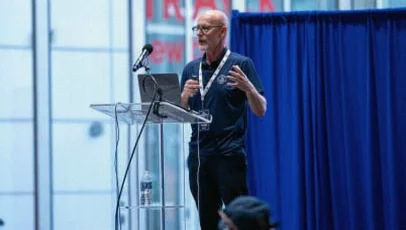
Magnusson, who stepped down in 2025 as head of goaltending development for the Swedish Ice Hockey Association, brought that message to the 2026 National Goaltending Symposium in Boston in August. Still active in discussions with NHL coaches, goalie coaches and development leaders, he is pushing for a style of training that asks goaltenders to solve live problems instead of simply repeating prescribed movements.
His preferred outcome is a goalie capable of making what he calls a “sketchbook save” when the usual textbook answer is not there.
The central concern is predictability. Magnusson sees too many goalies being taught the same technical templates, producing similar responses to similar plays. He wants coaches to preserve the technical foundation of the position while giving each goalie more room to develop an individual way of moving, reading and reacting.
Sweden’s pipeline remains strong, but the goalie draft picture is thinner
Magnusson said Swedish hockey continues to produce substantial young talent and remains well represented at the NHL Draft. He was less encouraged by Sweden’s recent goaltending results at the draft, however, saying the country has not matched its broader player-development success between the pipes.
Having retired from his association post, Magnusson said he no longer follows Swedish prospects closely enough to single out one goalie. What stands out instead is the increasingly international makeup of NHL crease talent.
- Finland helped establish the modern European goaltending wave.
- Sweden followed with its own steady NHL presence.
- Russia has continued to supply high-end goalies.
- Czech goaltenders are now adding to the league’s expanding international pool.
That broader trend has been visible on the sport’s biggest stages. Connor Hellebuyck delivered an outstanding run for the United States on its way to gold at the Olympic Winter Games Milano Cortina 2026. Sweden had its own defining Olympic goaltending moment when Henrik Lundqvist led the country to the 2006 gold medal.
Lundqvist remains Sweden’s standard
For Magnusson, Lundqvist’s influence reaches beyond his saves and medals. He pointed to Lundqvist’s professionalism, commitment and public stature as qualities that made him an important example for Swedish players and especially for the country’s goalie community.
Lundqvist represented Swedish hockey for years as both an elite player and a recognizable figure away from the rink. Magnusson views that combination as a major asset for young goalies looking for a model to follow.
From isolated drills to game decisions
Magnusson is not arguing that technique should disappear from goalie practice. Skating, glove work, blocker positioning and save mechanics remain necessary building blocks. His issue is with separating those elements too completely from the rushes, passes, screens and split-second reads that create real saves.
He wants practices to more closely resemble the information overload of a game, where a goalie must identify cues, process them immediately and choose a response before the puck reaches the net.
-
Early in his coaching career, Magnusson used a traditional drill structure: separate sessions and repetitions for glove saves, low shots, high shots and other technical pieces.
-
In the 1980s, wider use of video gave coaches a chance to sit with goalies after games and ask what they had seen on a play instead of simply telling them what they should have done.
-
That led Magnusson toward practices built around one game situation rather than a slate of disconnected drills.
-
A single scenario could then be expanded over an hour, with coaches changing the skater’s route, the pass, the shot option and the play that developed before the save.
-
The goal is to train perception and action together, so the goalie learns to react to real information rather than attempting to retrieve a rehearsed movement pattern under game pressure.
Balance and economy, not one universal style
Magnusson’s approach is rooted in ecological dynamics, a research field that examines how athletes respond directly to the environment around them. In the crease, that means a goalie does not have time to sort through a library of isolated drills when a puck is coming through traffic.
Instead, the goalie needs to become attuned to the details of the play: the shooter’s body position, a passing threat, a screen, a rebound chance or the movement of teammates and opponents. Practice must include those cues if a goalie is expected to recognize them in a game.
Magnusson does not want coaches dictating one exact stance, angle or movement pattern for every netminder. He believes the common principles should be simpler:
- Stay balanced through movement.
- Use efficient routes and avoid wasting energy.
- Build mobility and power.
- Allow the goalie’s own physical traits and instincts to shape the final movement.
The desired result is not a less prepared goalie. It is a more adaptable one — a goaltender who can handle the broken play, the unexpected pass and the save that cannot be found in a drill diagram.