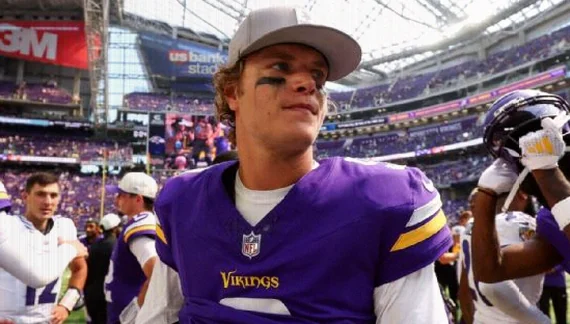
The Minnesota Vikings have moved on from J.J. McCarthy after only two seasons, sending the former first-round quarterback to the New York Giants for a fifth-round selection in a dramatic end to a tenure that produced 10 starts and 243 passing attempts.
Key takeaways
- McCarthy leaves Minnesota at 23 years and 9 months old, still younger than many quarterbacks selected in the most recent draft class.
- The Vikings added Kyler Murray in free agency, with Murray taking the starting job and Carson Wentz serving as the No. 2 quarterback.
- McCarthy missed his entire rookie campaign because of a knee injury and dealt with ankle, concussion and hand issues during his time with the club.
- He is one of only four first-round quarterbacks over the past 25 years to make 10 or fewer starts for the team that drafted him.
- Former general manager Kwesi Adofo-Mensah, who selected McCarthy, was dismissed in January before Minnesota made its final decision at quarterback.
A swift ending to Minnesota’s quarterback experiment
McCarthy’s departure closes one of the shortest and most disappointing quarterback runs in franchise history. Minnesota selected him in the first round, but injuries, uneven play and organizational impatience prevented the Vikings from seeing a fully developed version of the player.
The club’s decision-makers changed during that period. Adofo-Mensah was fired in January, leaving coach Kevin O’Connell, former interim general manager Rob Brzezinski and new general manager Nolan Teasley to decide whether McCarthy remained part of the franchise’s plans. They instead acquired Murray, who is now atop the depth chart, while Wentz is the backup and McCarthy had slipped to third string before the trade.
Minnesota’s urgency to remain competitive also shaped the situation. When McCarthy lost his rookie season to a knee injury, Sam Darnold stepped in. The Vikings have long resisted a full-scale rebuilding period, a philosophy that has generally kept the team competitive but offered little room for a young quarterback to develop through mistakes.
McCarthy did show improvement late in his 10-game stretch last season after a rough beginning. Still, the Vikings did not give him the extended evaluation often afforded young passers. Former Minnesota coach Brad Childress has pointed to a longtime Bill Walsh benchmark of roughly 24 games before reaching major conclusions on a promising quarterback. McCarthy received less than half that opportunity.
O’Connell had previously expressed the belief that teams can fail young quarterbacks before those quarterbacks fail their teams. The McCarthy outcome, however, carries responsibility on both sides. Minnesota put him in games before he was fully ready, but the quarterback also created concerns with his availability, decision-making and approach behind the scenes.
Injuries, communication issues and a historic disappointment
McCarthy’s aggressive style regularly exposed him to contact. He sustained knee and ankle injuries and suffered a concussion while leaving the pocket. He also fractured a bone in his right hand after climbing the pocket and striking his thumb against the helmet of left guard Donovan Jackson, a movement coaches believed was avoidable.
His original knee recovery became another issue. During the fall of 2024, McCarthy pushed his rehabilitation before receiving medical clearance, leading to swelling and a second procedure. The surgery succeeded, but the episode raised concerns within the organization about his maturity and judgment.
There were also questions about his commitment to the structure of O’Connell’s offense. In a December 2025 discussion of postgame film sessions, O’Connell described McCarthy occasionally focusing on what a defender might do based on instinct or prior familiarity rather than executing the quarterback’s assigned responsibility. O’Connell said his message was to clear those thoughts, avoid overanalyzing and concentrate on making the proper read and delivering the football.
McCarthy also drew attention for his on-field demeanor. He used the nickname “Nine” for a game-day persona in 2025. In a Week 15 game at Dallas, he began celebrating a touchdown before reaching the goal line. Afterward, he said coaches had warned him against premature celebrations during practice, a warning that made him more determined to do it in a game.
His communication with the team became a concern in different ways at different times. In 2025, McCarthy had drawn frustration for not quickly disclosing certain injuries. In Week 16, pain in his injured thumb caused him to lose the ball in the pocket, and the Giants recovered it for a touchdown. This summer, he took the opposite approach by telling team officials he did not feel comfortable playing in the final preseason game because of an ankle problem.
The statistical context underscores how unusual his Minnesota exit has been. McCarthy joins Paxton Lynch, Trey Lance and Johnny Manziel as first-round quarterbacks drafted within the past quarter-century who started no more than 10 games for their original teams. Among all Vikings first-round choices, he joins Lewis Cine, Dimitrius Underwood and Leo Hayden as players who appeared in 10 games or fewer for Minnesota.
McCarthy also becomes the latest failed first-round quarterback investment for the Vikings. Since 1999, Minnesota’s four first-round quarterback selections have all fallen short for different reasons: Daunte Culpepper suffered a devastating knee injury in 2005, Christian Ponder was benched during his third season, and Teddy Bridgewater never regained the same trajectory after his severe 2016 knee injury.
For McCarthy, the trade gives him a chance to restart with the Giants. For the Vikings, it leaves a costly and unusually brief quarterback chapter defined by injuries, missed development time and a decision that arrived before the franchise ever saw a complete answer.