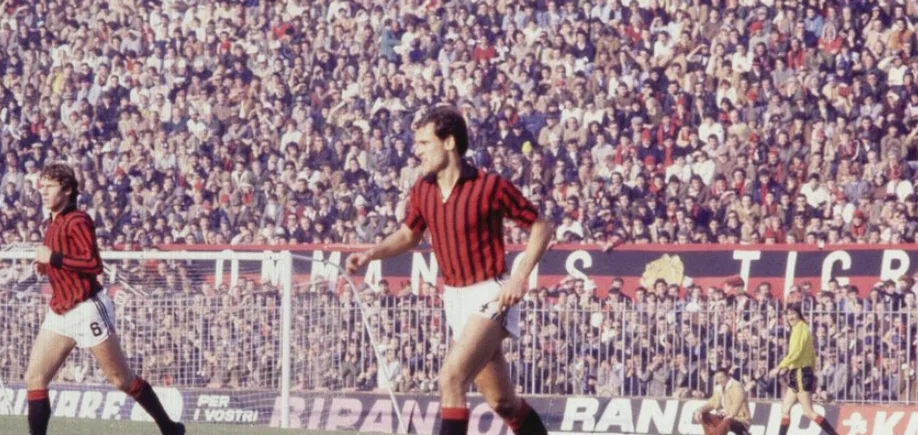
Walter De Vecchi’s place in Milan’s first-star story was secured in the space of nine minutes. In the derby of 18 March 1979, Inter appeared to be in command at 2-0 after goals from Gabriele Oriali and Alessandro Altobelli, only for De Vecchi to pull Milan level with two low strikes from outside the area, each placed inside Ivano Bordon’s right-hand post.
Key takeaways
- De Vecchi scored in the 80th and 89th minutes to rescue a 2-2 derby draw for Milan.
- The midfielder remembers Nils Liedholm as a manager who understood both tactics and dressing-room psychology.
- He identifies the parish football grounds of Bresso as the foundation of his career and lasting friendships.
- De Vecchi believes the disappearance of such local playing spaces has contributed to Italian football’s wider difficulties.
- He also regards Roberto De Zerbi as a coach whose total focus on football always marked him out for management.
Nine minutes that entered Milan memory
The image remains one of the defining moments of that Milan generation: Liedholm celebrating on the touchline, De Vecchi dropping to the turf after his second goal, and an 18-year-old Franco Baresi watching on. The two late efforts denied Inter a derby victory and gave De Vecchi a permanent connection with the side that would go on to bring Milan their first league star.
For De Vecchi, that squad was built on closeness as much as quality. He recalls a particularly united dressing room containing Fulvio Collovati, Roberto Antonelli, Gianni Rivera, Enrico Albertosi, Fabio Capello, Walter Novellino, Aldo Maldera, Ruben Buriani, Liedholm and the young Baresi, already an exceptional player despite his age.
Liedholm’s influence extended beyond match preparation. De Vecchi describes the Swedish coach as a teacher in tactical matters and in the management of people, capable of maintaining the right balance inside the group. He sees the later coaching careers of Capello, Novellino and Alberto Bigon as part of that inheritance: leading managers emerged from a Milan team educated by a leading manager.
From Bresso to the modern game
Before Milan, De Vecchi’s football began on the parish pitches in Bresso. Even after representing clubs across Italy, he says the friendships that remain closest to him are those formed in childhood. In his view, the parish was a uniquely important meeting place, offering young players a setting in which to play, grow and belong.
He believes Italian football has lost something with the decline of those spaces. Fewer children now go to parish grounds to play, he argues, and that loss is one element in the broader problems facing the game in Italy.
De Vecchi also spoke with emotion about the death of the Milan figure known within the club as Piscinin. On hearing the news, he immediately drove to Milan. He considers him Milan’s most representative footballer, recalling how he turned down interest from clubs around the world in order to remain with the Rossoneri. The sound of supporters gathered outside the church, he said, will stay with him.
Looking towards the present, De Vecchi offered a clear assessment of De Zerbi. He sees the coach as the opposite of a player distracted by life beyond the pitch: someone who lives for football and has always treated the game with complete seriousness. For that reason, De Vecchi says he expected him to become a major coach.