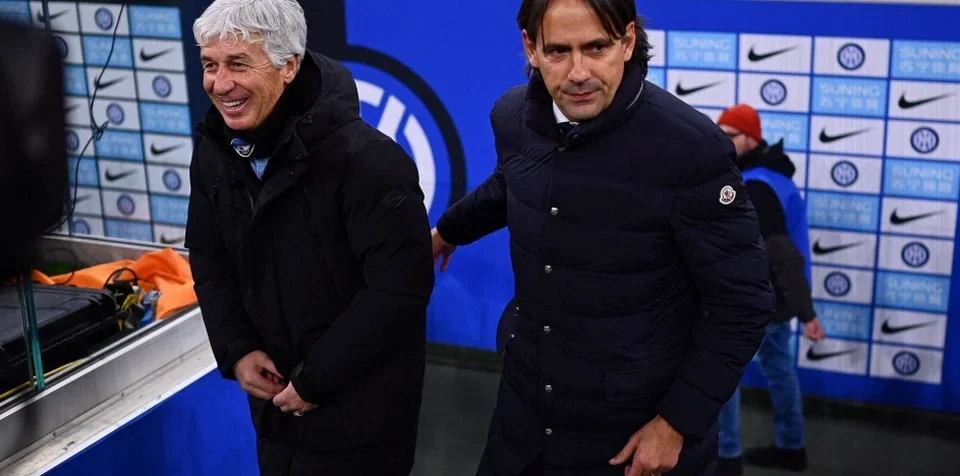
Cesc Fabregas looked to Simone Inzaghi’s Inter when preparing Como for their draw with Roma, identifying the former Nerazzurri side as the opponent that had caused Gian Piero Gasperini the greatest difficulties. It was a revealing reference point, not merely a coaching compliment. Gasperini’s record against Inzaghi during his Atalanta years tells a severe story: ten meetings, two draws at the beginning and then eight consecutive defeats.
The later results were particularly stark. Atalanta failed to score in the last four of those matches, losing 4-0 twice before two 2-0 defeats. More broadly, Gasperini has long struggled against Inter, the club he briefly managed in 2011: across his career, his record against the Nerazzurri stands at five wins, ten draws and 22 losses.
Inzaghi’s Inter found answers to the defining features of Gasperini’s football: man-oriented defending, early pressure, aggressive duels and the physical intensity that drives his teams. Their response was based partly on technical superiority and athletic strength, but also on the freedom of players to move away from fixed positions and combine in close spaces.
This relational element within a positional structure could disrupt man-to-man assignments. When several players gather in the same area, markers can be pulled out of their reference points, creating room elsewhere. Inzaghi’s Inter often achieved that through the midfield three, while the wing-backs and even central defenders could alter the usual picture. Federico Dimarco could appear on the opposite side or move inside, while Alessandro Bastoni and Benjamin Pavard also contributed beyond their defensive starting zones.
The wall pass was another recurring solution. Lautaro Martinez was especially effective with his back to goal, setting the ball for a teammate arriving face-on, while Marcus Thuram attacked the space released by those movements. Vertical passes into the forwards became more dangerous once Inter’s midfield rotations had opened a channel through the centre.
There was also a direct tactical explanation for the pattern. Gasperini’s Atalanta often developed attacks through wide-sided four-man combinations, involving a centre-back, wing player, midfielder and attacking midfielder. Inzaghi’s 3-5-2 was able to match those routes closely: wing-back against wing-back, centre-back against attacking midfielder, midfielders against their counterparts and a forward pressing the relevant central defender. The result was congestion around Atalanta’s creative zones and limited access to the penalty area.
At the other end, Inter’s defenders added another problem. Bastoni, often alongside Dimarco on the left, and Pavard on the right brought quality and force into attacking phases that opposition attacking midfielders struggled to track. The late runs of Nicolo Barella, Henrikh Mkhitaryan and Davide Frattesi further complicated matters for the spare central defender, once Inter’s two forwards had drawn the other markers away.
Individual quality remained decisive. Gasperini’s structure is at its most vulnerable when it loses the one-against-one contests on which it depends, whether through technical disadvantage or a deficit in physical duels. Inzaghi’s wing-backs repeatedly made the difference: Denzel Dumfries, Dimarco, Matteo Darmian and Carlos Augusto have all scored during Inter’s successful sequence against Gasperini.
Martinez has been the most punishing figure, scoring five times against Atalanta. Edin Dzeko added three, while Romelu Lukaku and Thuram each scored twice. Inter’s ability to fill the penalty area gave those individual strengths a collective weight.
Fabregas has introduced similar relational ideas into his own Catalan-influenced positional game at Como. Against Roma, however, the final ingredient was missing: the physical force needed to break through a side built to withstand confrontation. His late decision to use Ramon as a centre-forward underlined the search for a different route, but the draw showed that studying Inzaghi’s solution and reproducing it are very different tasks.