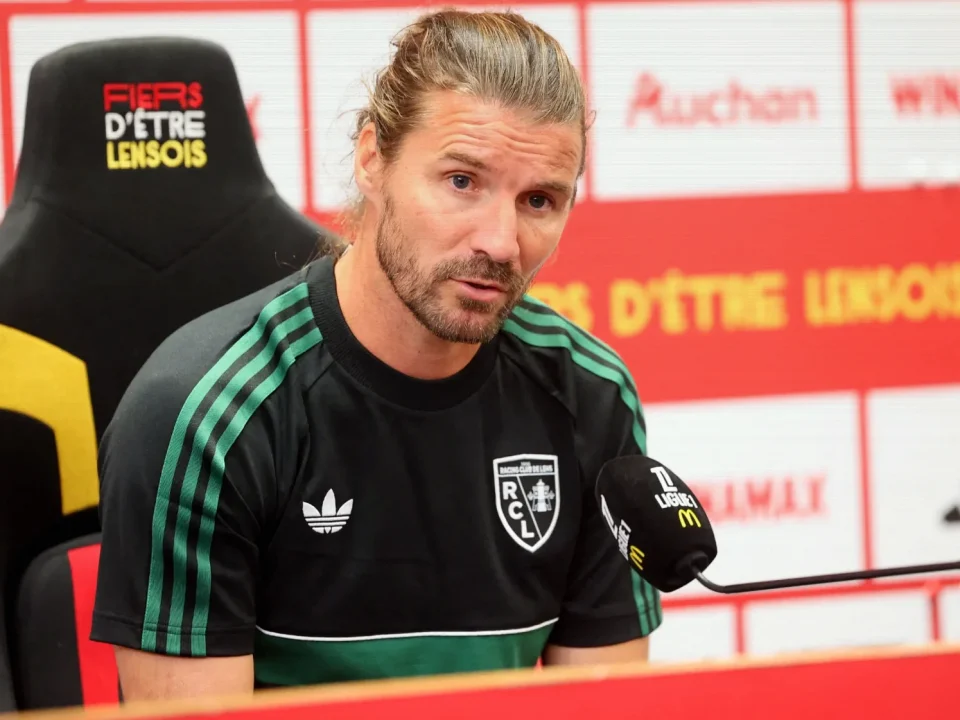
Three days, one narrow defeat and then the long international break: Yannick Cahuzac’s first steps as Lens head coach have come quickly. Now, with Sporting CP arriving at Bollaert on Tuesday, the 41-year-old faces the Champions League as he begins to put his own ideas into place.
Cahuzac took charge of Racing Club de Lens on 15 September, replacing Dino Toppmöller for his first senior job as a number one. His opening match ended in a 2-1 Ligue 1 loss to Monaco, after only three days of preparation.
Quick facts
- Yannick Cahuzac became Lens head coach on 15 September.
- The 41-year-old succeeded Dino Toppmöller.
- His first match was a 2-1 defeat against Monaco.
- Lens host Sporting CP at Bollaert in the Champions League on Tuesday.
- Cahuzac is continuing his BEPF coaching qualification alongside the job.
- Lens pay a €25,000 charge for each Ligue 1 match while he completes the required training.
The international break gave Cahuzac close to three weeks to work, though several members of his squad were away with their national teams. It was valuable time for a coach seeking to establish a recognisable Lens rather than reshape the side from one opponent to the next.
“I really want us to build our own identity and stay focused on ourselves,” Cahuzac said. The plan is to establish common principles and habits first, then make adjustments for each rival.
That approach has been forming since the closing years of his playing career. At Toulouse, aged 33 and aware that his physical level was beginning to decline, the former defensive midfielder began considering life after football.
He studied the coaches around him, including Franck Haise, Régis Le Bris and Olivier Pantaloni, and regularly questioned them about tactical details. More than six years later, that interest has led him to the Lens dugout.
Jonathan Gradit has seen Cahuzac in several roles: teammate, Haise’s assistant and now head coach. The Lens defender believes the tactical side of the new manager has long been clear.
“He is very strong tactically and watches opponents closely,” Gradit said. “He has firm beliefs with the ball and very clear, strong ideas about the game.”
Gradit also recalled a player who listened closely to coaches and analysed what was happening around him. In his view, Cahuzac absorbed the best elements from the managers he worked under, while Haise himself frequently sought his input.
Pantaloni, who worked with Cahuzac on a daily basis when he was an assistant, has also stressed the difference between the fierce competitor remembered from his playing days and the measured coach now leading Lens.
Cahuzac, Pantaloni said, was not defined by exceptional athletic qualities as a player. Instead, his intelligence, positioning and understanding of the game allowed him to succeed — qualities now visible in his analysis of Lens and their opponents.
He is regarded as a coach who constantly examines situations and looks for solutions capable of disrupting rivals, while listening closely to players and staff. His working days at La Gaillette typically begin around 8am and run until between 6pm and 7pm.
Sporting director Jean-Louis Leca, a close friend of Cahuzac, made clear at the time of the appointment that Lens see development as part of the project. “Yannick is not a finished coach; he is a young coach,” Leca said, while insisting the club had deep faith in his vision and his understanding of Lens.
Cahuzac’s coaching course remains another part of an already demanding schedule. His classes scheduled for Tuesday have been moved to the following day, allowing him to lead Lens against Sporting at Bollaert.
The accommodation enables him to continue working towards his BEPF qualification, but it comes at a cost of €25,000 to Lens for every Ligue 1 fixture. For the club, it is also a public measure of confidence in a coach asked to handle domestic pressure, European nights and his own education at once.