France’s next international squad is due on Friday, with Zinédine Zidane preparing his selection for the Nations League trip to Turkey on 25 September at 20:45. Every new France coach inherits a different kind of silence: the injuries, the retirements, the scars of a failed tournament and the pressure to decide who belongs to the next chapter.
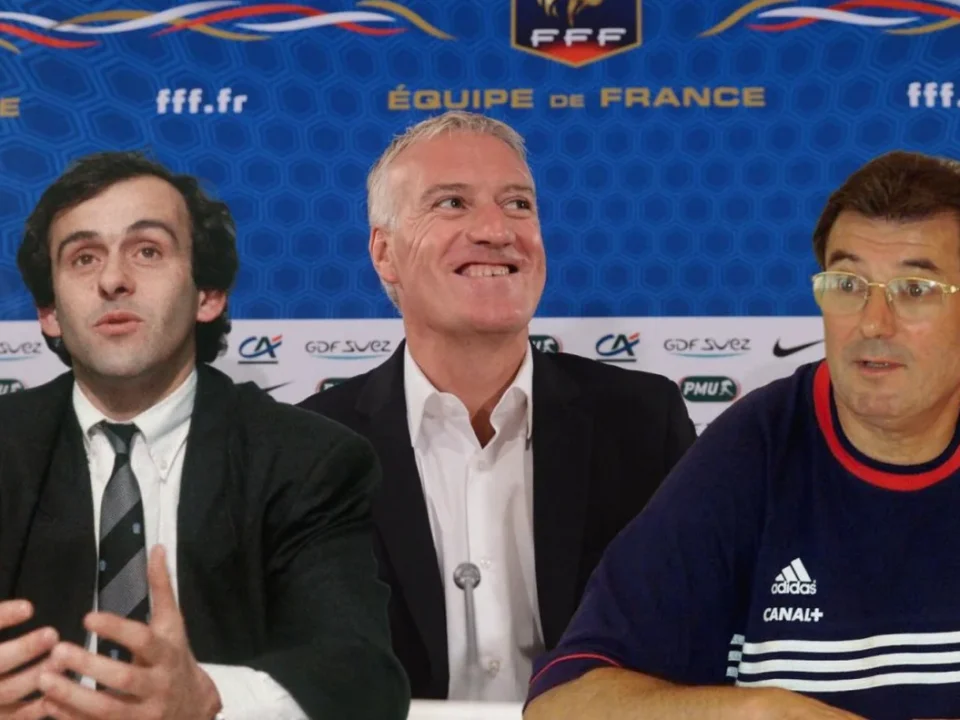
Since Michel Platini’s first selection in 1988, the opening lists of France managers have often carried the marks of upheaval. Some tore up the previous order, others trusted survivors, and several used the moment to introduce players who would shape the national side for years.
Deschamps began amid Euro 2012 sanctions
When Didier Deschamps named his first group in 2012, France were still dealing with disciplinary fallout from Euro 2012. Samir Nasri and Jérémy Ménez were unavailable through suspensions, while Hatem Ben Arfa and Yann M’Vila were also left out.
Injuries to Yohan Cabaye and Adil Rami added to the disruption. Only 12 of the 23 players who had travelled to Ukraine were retained for the friendly against Uruguay, with Florent Malouda, Philippe Mexès and Alou Diarra among the most notable omissions from a 22-man group.
Étienne Capoue, Bafétimbi Gomis and Jimmy Briand were the unexpected inclusions as Deschamps began rebuilding after a troubled campaign.
Blanc wiped the slate clean after Knysna
Laurent Blanc’s first squad in 2010 came in the shadow of the players’ strike at Knysna during the World Cup in South Africa. The 23 players involved in that episode were excluded for the Norway friendly, although goalkeeper Stéphane Ruffier was spared.
Mickaël Landreau, Jean-Alain Boumsong and Julien Escudé also missed out, despite not having been involved in the notorious bus protest.
The 22 selected players had just 99 France caps between them, almost matching Blanc’s personal total of 97. Thirteen were uncapped: Cabaye, Aly Cissokho, Mathieu Debuchy, Nicolas Douchez, Guillaume Hoarau, Blaise Matuidi, Ménez, M’Vila, Charles N’Zogbia, Rami, Ruffier, Mamadou Sakho and Benoît Trémoulinas.
Blanc also restored Hatem Ben Arfa, Karim Benzema, Mexès and Nasri to the international set-up.
Domenech turned to a new generation
Raymond Domenech faced a different kind of break in 2004. Marcel Desailly, Lilian Thuram and Bixente Lizarazu had announced their international retirements, while Zidane followed them a day before Domenech unveiled his squad for a friendly against Bosnia-Herzegovina.
Those departures removed 409 caps from the picture: Desailly had played 116 times for France, Thuram 103, Lizarazu 97 and Zidane 93.
Domenech selected 21 players, including seven men without a senior appearance: Eric Abidal, Alou Diarra, Patrice Evra, Pierre-Alain Frau, Gaël Givet, Sébastien Squillaci and Rio Mavuba.
Nicolas Anelka was absent, as were Michaël Silvestre, Claude Makelele and Steve Marlet, three outfield players who had been part of the Euro 2004 group. Their omissions were not explained by injury, Serie A commitments or matches in Spain.
Santini kept faith after the World Cup collapse
Jacques Santini took charge after France’s group-stage elimination at the 2002 World Cup in South Korea, but his response was not a wholesale clear-out. For the friendly with Tunisia, he chose 22 players and retained 15 from the World Cup squad.
That number could have risen to 18 had Fabien Barthez, David Trezeguet and Lizarazu not been injured. The departures of Youri Djorkaeff, Christophe Dugarry and Frank Leboeuf through retirement helped shape the transition.
Alain Boghossian and Johan Micoud were the major casualties from the World Cup squad. Santini brought in Under-21 players Sidney Govou, Mexès and Anthony Réveillère, while Bruno Cheyrou received a first call-up after never previously appearing for any France age group.
Lemerre’s champions and the first fresh faces
Roger Lemerre, previously Aimé Jacquet’s assistant, led France into the post-World Cup period in 1998. For a friendly in Austria, the newly crowned world champions were represented by 12 members of the victorious squad within an 18-man selection.
Several established names were unavailable. Laurent Blanc was considering his international future, while Trezeguet, Stéphane Guivarc’h and Dugarry were injured. Emmanuel Petit and Patrick Vieira had Arsenal commitments 48 hours before France played, and Desailly was suspended for the opening Euro 2000 qualifier in Iceland.
Lens title winners Frédéric Déhu and Tony Vairelles entered the squad. Lilian Laslandes, Alain Goma, Florian Maurice and Lionel Letizi were also called up, with Letizi having been one of six players excluded before the World Cup.
Jacquet inherited the pain of the Parc des Princes
Aimé Jacquet had been Gérard Houllier’s assistant for the 1-2 defeat by Bulgaria in 1993, the result that ended France’s hopes of reaching the 1994 World Cup. When he took charge three months later, several leading players were still affected by that night at the Parc des Princes.
Laurent Blanc, Jean-Pierre Papin and Franck Sauzée temporarily stepped away from international duty, while Petit needed a rest. For the friendly against Italy in Naples, Jacquet opted for experience at the back, recalling Eric Di Meco and Basile Boli, although Boli subsequently withdrew.
Jean-Pierre Cyprien of Saint-Étienne was the only newcomer. Jacquet had decided not to take players from Domenech’s Under-21 side.
Houllier brought Ginola back into view
Gérard Houllier’s first selection arrived three weeks before Bulgaria visited France in the opening qualifier for the 1994 World Cup. Following France’s group-stage exit at Euro 1992, he altered roughly a quarter of Platini’s previous group for the Brazil friendly.
Monaco’s Jérôme Gnako was among five fresh names. David Ginola returned after his lone France appearance in November 1990, having established himself at Paris Saint-Germain. Alain Roche, William Prunier and Bernard Lama were the other additions.
Luis Fernandez and Jocelyn Angloma were the principal absentees, while Rémi Garde, Fabrice Divert and Gilles Rousset also disappeared from the squad. Blanc, meanwhile, was selected as a midfielder rather than as a libero.
Platini’s first move was to recall Tigana
Michel Platini began his managerial spell in 1988, 19 days after a 1-1 draw in Nicosia that ended Henri Michel’s hopes of taking France to the World Cup. For a match against Yugoslavia in Belgrade, Platini summoned Jean Tigana out of international retirement after the midfielder had stepped away in June 1987.
Jean-Marc Ferreri and Jean-Christophe Thouvenel also returned, while Alain Roche received his first France call-up. All four were Bordeaux players.
Philippe Vercruysse, once viewed as Platini’s potential successor as France’s No. 10 after 1986, was left out alongside Gérald Passi and Bernard Casoni. Eric Guérit and Christian Perez were the surprise selections.
Zidane’s first list will now be measured against that history. France managers have rarely begun with a clean sheet; their first squads have usually revealed exactly what the previous era left behind.