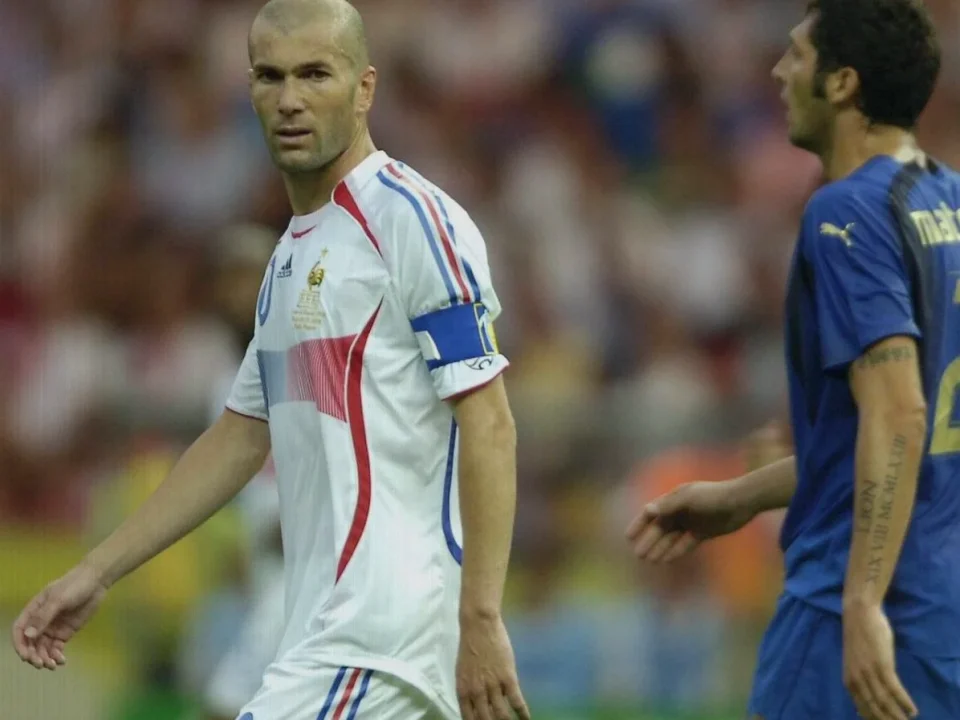
The night of 9 July 2006 is still reduced, too often, to one image: Zinédine Zidane walking away after his headbutt on Marco Materazzi. But the World Cup final between France and Italy had already left the French captain close to the exit long before extra time.
A documentary, “9 July 2006”, revisits the overlooked physical incidents from that final in Berlin, including Zidane’s dislocated shoulder after a collision with Fabio Cannavaro in the 80th minute.
Quick facts
- France faced Italy in the 2006 World Cup final on 9 July.
- Zidane suffered a shoulder dislocation after an aerial challenge involving Fabio Cannavaro.
- France doctor Jean-Pierre Paclet put the shoulder back in place on the pitch.
- Thierry Henry had earlier sustained a head injury following a clash with Cannavaro.
- Cannavaro later won the 2006 Ballon d’Or and is now Uzbekistan’s national-team coach at the World Cup.
Zidane had moved under a long ball when Cannavaro arrived from behind at speed. The Italian defender went into the challenge with his knee raised and sent the France captain heavily to the ground.
On landing, Zidane dislocated his shoulder. Pale and disorientated, he signalled towards the French bench for a substitution, with the match appearing to be over for him.
Paclet reached him quickly and recognised the injury. “You could see it was a shoulder dislocation, and everybody thought that was the end of his final,” the former France team doctor recalled.
The doctor said Materazzi came close while Zidane was receiving treatment and spoke to him in Italian. Paclet recalled the defender saying there was no point continuing because “the old man is finished”. Zidane, who understood Italian, heard the remark.
With France in a World Cup final and Zidane playing the last match of his career, Paclet decided to attempt a careful reduction. “Then it clicked, and the shoulder went back,” he said.
Zidane returned to the field, to the relief of the French camp, before the final took the extraordinary turn for which it would become famous.
Cannavaro’s intensity had been evident from the opening minutes. Henry was knocked down in an early collision and suffered what Paclet described as head trauma.
“Perhaps medically he should not have stayed on, but he wanted to continue,” Paclet said. “At that time, we could not do much.”
Patrick Vieira later interpreted the tone of Italy’s display as deliberate intimidation. He believed the Italians feared France and expected the contest to become a battle of physical authority.
Vieira said Cannavaro’s early challenge on Henry carried a clear message: Italy intended to dominate them and make it “a match to the death”. Cannavaro would finish that year with football’s biggest individual prize, while France’s final instead remains marked by the moments before Zidane’s final, unforgettable dismissal.