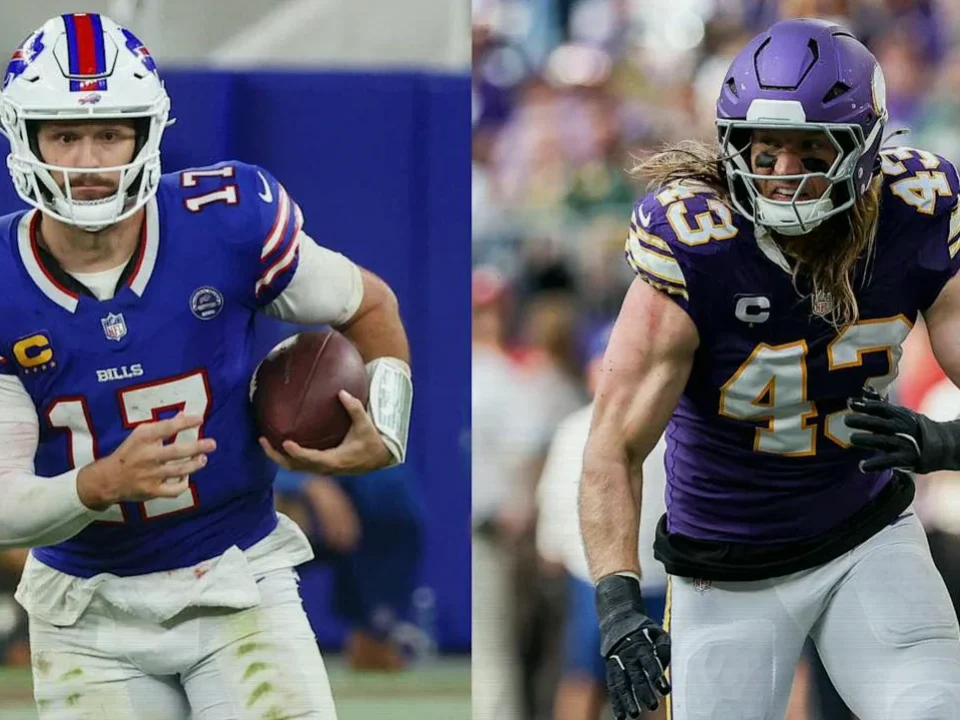
The Buffalo Bills’ offense and Minnesota Vikings’ defense have set the early standard in 2026, carrying 2-0 records and first place in their respective divisions with contrasting but equally difficult formulas for opponents to solve. Buffalo is scoring at an NFL-best 38.5 points per game, while Minnesota’s relentless pressure package has made every snap an uncomfortable proposition for opposing quarterbacks.
Buffalo has been especially dangerous despite possessing the ball for only 28 minutes, 44 seconds per game, 24th in the league. The Bills are averaging 60.5 offensive snaps, placing them 15th, yet they rank second in total offense at 427.5 yards per game. That efficiency leaves opponents with a clear first priority: limit Buffalo’s opportunities by controlling the clock themselves.
A deliberate offensive approach can reduce the number of possessions available to Josh Allen and the Bills. Teams facing Buffalo need to bleed the play clock, keep perimeter runs in bounds and avoid handing the ball back quickly. Fewer drives raise the value of every stop, takeaway and short field, even against an offense that has been highly productive with relatively limited possession time.
The next challenge is keeping Allen inside the pocket. The 2024 NFL MVP has produced more than 35 combined touchdowns in each of the past six seasons. Over the last three years, the 6-foot-5, 237-pound quarterback has recorded at least 25 passing touchdowns and 12 rushing scores in every season, a combination no other NFL quarterback has matched.
Allen remains a high-level passer from the pocket, but defenses are most vulnerable when he extends plays, breaks containment or becomes a runner near the goal line and in short-yardage situations. Pass rushers must stay connected, work to the depth of his drop and avoid opening escape lanes through overly aggressive individual rushes. Defenses also need an assigned quarterback defender on designed runs, where Allen’s presence gives Buffalo an extra blocker advantage. Third downs, red-zone snaps and late-game two-minute possessions demand particular discipline because those are the moments when Allen is most likely to create outside structure.
Buffalo’s passing game also runs through the middle of the field. The Bills acquired wide receiver DJ Moore in March, but tight ends Dalton Kincaid and Dawson Knox remain central to the aerial attack. Kincaid has emerged as the team’s leading receiver through two games, posting 14 targets, 12 catches and 225 receiving yards. Much of that production has come on short and intermediate routes between the numbers, although he can also threaten defenses vertically up the seam.
Since 2024, Allen has completed 11 downfield throws to Kincaid for 253 yards and three touchdowns when the tight end has at least three yards of separation and the pass travels 10 or more yards in the air. Opponents may need to use a robber safety or bracket coverage involving a linebacker and safety to crowd Kincaid and force Allen toward perimeter matchups. Moore is averaging 20.0 yards per catch, but slowing Kincaid’s work inside remains a major part of disrupting Buffalo’s rhythm.
How offenses can handle Minnesota’s pressure
The Vikings have made life difficult by disguising coverage and pressure before the snap under defensive coordinator Brian Flores. Minnesota has blitzed on 75 percent of defensive snaps, nearly 30 percentage points above any other team, while mixing heavy six-man rushes with three-man fronts and eight defenders dropping into coverage. That variety can lure quarterbacks into rushed decisions and turnovers.
Tempo is one potential answer. Operating without a huddle, using a sugar huddle or moving quickly to the line can limit Minnesota’s time to organize disguises. It also allows a quarterback to use the communication system before it shuts off with 15 seconds remaining on the play clock, then adjust after a double cadence reveals more about the defense’s intentions. Faster operation may force simpler alignments from a unit built on confusion and late movement.
Offenses also need to avoid the long-yardage situations in which Flores can fully unleash his pressure calls. Early-down gains of at least four yards through quick throws, screens and downhill runs can help keep an offense on schedule. Swings to running backs, quick outs, hitches and slants put the emphasis on Minnesota’s tackling in space, while also giving playmakers a chance to turn short completions into larger gains.
Running the ball remains important even against a defense that frequently sends six rushers. Minnesota is ranked 13th against the run, allowing 100 rushing yards per game. A sustained ground game can prevent an opponent from becoming one-dimensional and may create manageable second- and third-down situations.
There is risk in challenging the Vikings deep, but there is also opportunity. Flores’ aggressive calls can leave defensive backs isolated if an offense holds up in protection. Teams can use maximum protection from run-oriented formations or choose carefully timed first-down shots to attack downfield. Green Bay showed the value of that approach in Week 1, taking an early lead after connecting on aggressive attempts involving Christian Watson, Tucker Kraft and Jonnu Smith.
Buffalo’s offense and Minnesota’s defense have delivered the strongest early impressions of the season, but each presents a different tactical demand. The Bills force opponents to manage possessions, contain an elite dual-threat quarterback and defend the middle. The Vikings require offenses to identify pressure quickly, stay ahead of the chains and remain willing to test isolated coverage when the chance arrives.