Milwaukee and San Diego came into the National League together in 1969, but it took 57 seasons for the Brewers and Padres to finally find each other in October. Their first postseason meeting opens Saturday night in Milwaukee, with two clubs carrying deep lineups, late-inning relief weapons and very different paths into the Division Series.
Quick facts
- NLDS Game 1 is Saturday at 8:30 p.m. ET, 7:30 p.m. CT and 5:30 p.m. PT on FS1, FOX Deportes and FOX One.
- Milwaukee won an MLB-best and franchise-record 103 games, then received a Wild Card bye.
- San Diego advanced by beating the Cubs 4-1 to clinch its Wild Card Series.
- The Brewers went 55-26 at American Family Field, tied with Tampa Bay for baseball’s best home mark.
- Petco Park was no picnic for visitors, either: the Padres posted a 51-30 home record.
The Brewers hold the home field, including a possible Game 5, and that is no small edge in a series this tight. Both teams are still chasing their first World Series title, and each has enough pitching to make an early lead feel like a big one.
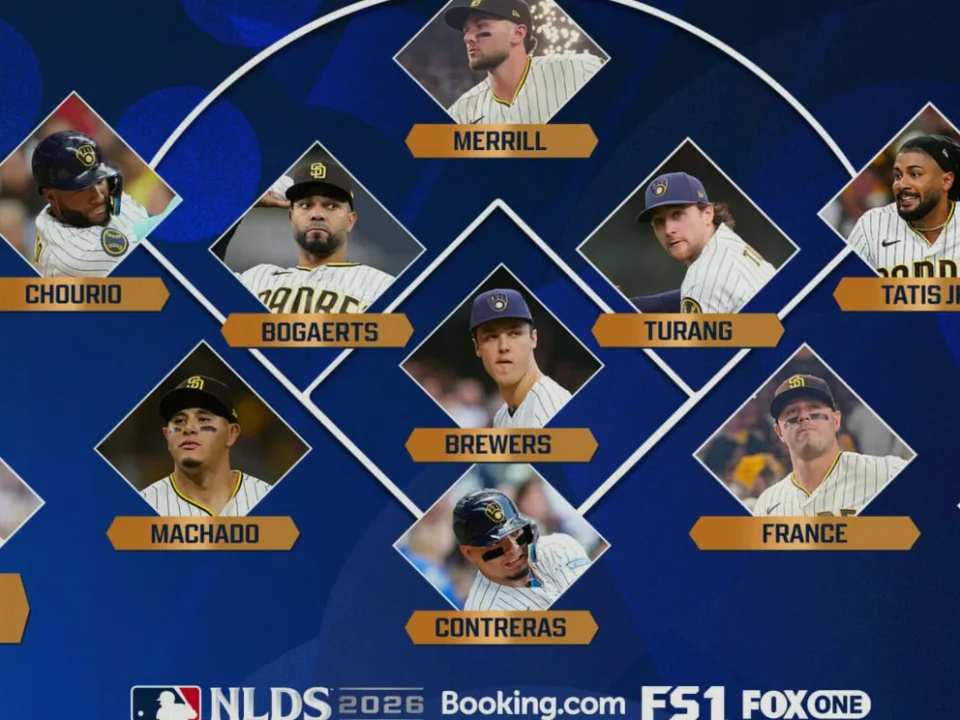
Behind the plate, Milwaukee has the established answer in William Contreras. The three-time All-Star hit 18 homers with a .758 OPS, threw out 34.2% of attempted base stealers and brings considerable October experience.
San Diego counters with a useful three-man catching mix. Luis Campusano produced a .795 OPS and eight homers in 248 plate appearances while ranking in the 90th percentile with four caught-stealing runs above average. Freddy Fermin supplies strong defense, and 20-year-old Ethan Salas already made history as the youngest catcher to appear in a postseason game, then drove in a run on a sacrifice fly in the Wild Card clincher.
First base is a matchup of breakout seasons. Jake Bauers hit 26 homers with an .874 OPS at age 30 for Milwaukee, while Ty France posted 21 homers and an .865 OPS in his age-31 campaign for San Diego.
France has the cleaner defensive ledger, however. His seven outs above average and plus-10 fielding run value both trailed only Atlanta’s Matt Olson among Major League first basemen.
Milwaukee owns a major advantage at second. Brice Turang put together a 6.1 fWAR season, tops among MLB second basemen, while hitting 21 homers, driving in 100 and scoring 102 times. His 23 defensive runs saved ranked second among all big league position players.
Jake Cronenworth remains a respected two-time All-Star for the Padres, but injuries held him to 109 games and a career-low .629 OPS at age 32.
Shortstop is a more complicated read for Milwaukee. Cooper Pratt arrived June 26 as the organization’s No. 4 prospect and hit .281/.350/.368 across 74 games at the position, flashing the glove that earned him a Minor League Gold Glove. But he is 22 and has only about half a season in the Majors.
Joey Ortiz struggled while playing shortstop, batting .198/.281/.247 there, but found his stroke after moving to third and closed the year with a .730 OPS. Milwaukee shortstops as a group finished with a .648 OPS.
The Padres can send out Xander Bogaerts, even after the four-time All-Star’s .676 OPS and 13 homers marked his least productive offensive year since his 2014 rookie season. Bogaerts turned 34 Thursday, but his 56 postseason games, plus a double and homer against the Cubs, carry weight in this setting.
Third base swings strongly toward San Diego. Manny Machado finished with 30 homers and a position-leading plus-8 fielding run value, even in a regular season below his usual offensive standard. This will be his eighth trip to the postseason.
Ortiz was excellent defensively at third, posting a plus-7 fielding run value despite fewer innings than Machado. Still, Milwaukee received only eight homers and a .370 slugging percentage from the position, with David Hamilton also taking turns there.
The outfield starts with Milwaukee’s Jackson Chourio, who continued to play like one of the sport’s young pillars. His 25 homers, 23 steals and .837 OPS made him the first player in Major League history to record three 20-homer, 20-steal seasons before turning 23, and he paired it with standout defense in left.
San Diego’s left-field picture changed when Ramón Laureano underwent June surgery for a torn labrum in his right hip and was lost for the year. Samad Taylor, Jase Bowen, Dustin Harris and Austin Hays have cycled through the spot.
Center field brings the other Jackson into focus. Jackson Merrill had a career-low .743 OPS, but still set personal bests with 26 homers and 27 steals while remaining an elite defender. His 4.2 fWAR ranked fourth among MLB center fielders, and his .491 expected slugging percentage sat more than 50 points above his actual result.
Garrett Mitchell gave Milwaukee 145 games after injuries had previously kept him from reaching 70 in a season. The 27-year-old hit .262/.354/.416 with 11 homers and 14 steals, added seven outs above average and ran at 29.8 feet per second. Merrill’s power upside gives San Diego the slight edge, but Mitchell can affect a game on both sides of the ball.
Right field is Fernando Tatis Jr.’s territory. Tatis finished at .289/.358/.470 with 25 homers and 38 steals after a late power surge that included 20 home runs over his final 63 games. The two-time Gold Glove and two-time Platinum Glove winner also opened the Cubs series with a leadoff homer and created another key moment with aggressive baserunning.
Sal Frelick’s shoulder injury limited him to 384 plate appearances and a .614 OPS. His contact skills did not disappear — his 10.1% whiff rate ranked in the 99th percentile and his 9.9% strikeout rate in the 97th — but he faces a difficult comparison with Tatis.
Neither designated hitter spot has been a steady source of offense. San Diego received a collective .213/.289/.338 line and 12 homers from Miguel Andujar, Gavin Sheets and Hays. Milwaukee’s primary DH, Christian Yelich, dealt with more back trouble and finished with a career-low .692 OPS at age 34, though his October experience still makes him a threat in a late at-bat.
Misiorowski sets the tone
The Brewers’ biggest rotation advantage begins with Jacob Misiorowski, the NL Cy Young frontrunner. The 24-year-old right-hander led the Majors with a 1.80 ERA, struck out 252 hitters and has rewritten expectations for starter velocity.
Logan Henderson, also 24, followed with a 2.47 ERA in 18 starts after Kyle Harrison’s season unraveled. Beyond those two, Milwaukee’s rotation picture is less settled.
San Diego has veteran options but uneven recent results. Michael King has anchored the group, and Nick Pivetta has pitched well since returning from the injured list last month. Deadline additions Robbie Ray and Casey Mize have not delivered the same certainty: Ray has a 5.02 ERA since arriving, while Mize carried a 7.46 ERA before an ankle injury.
The Padres’ counterpunch is at the back of the bullpen, where Mason Miller gives them the game’s most overpowering closer. San Diego’s relief corps led baseball with 8.9 fWAR and posted MLB’s best expected ERA at 3.33.
Milwaukee’s bullpen led the National League with a 3.40 ERA, compared with San Diego’s 3.53 mark, and its 3.58 expected ERA tied the Dodgers for second in the Majors. Trevor Megill, Abner Uribe and Aaron Ashby have all been excellent.
Still, the Padres can cover innings in waves. Adrian Morejon has handled heavy work, Yuki Matsui and Wandy Peralta give the club more left-handed options, and Bradgley Rodriguez and Jason Adam deepen the right-handed side. Manager Craig Stammen has several relievers capable of working beyond three outs.
That makes the opening innings the hinge of this matchup. Both bullpens can turn a modest lead into a long night, while San Diego’s offense has been the best in the Majors since the start of September.
The Brewers arrive rested, with a 103-win season behind them and their own dominant home environment waiting. The Padres arrive hot after surviving the Wild Card round. It has the look of a five-game series, with Milwaukee’s home field possibly becoming the final separator.