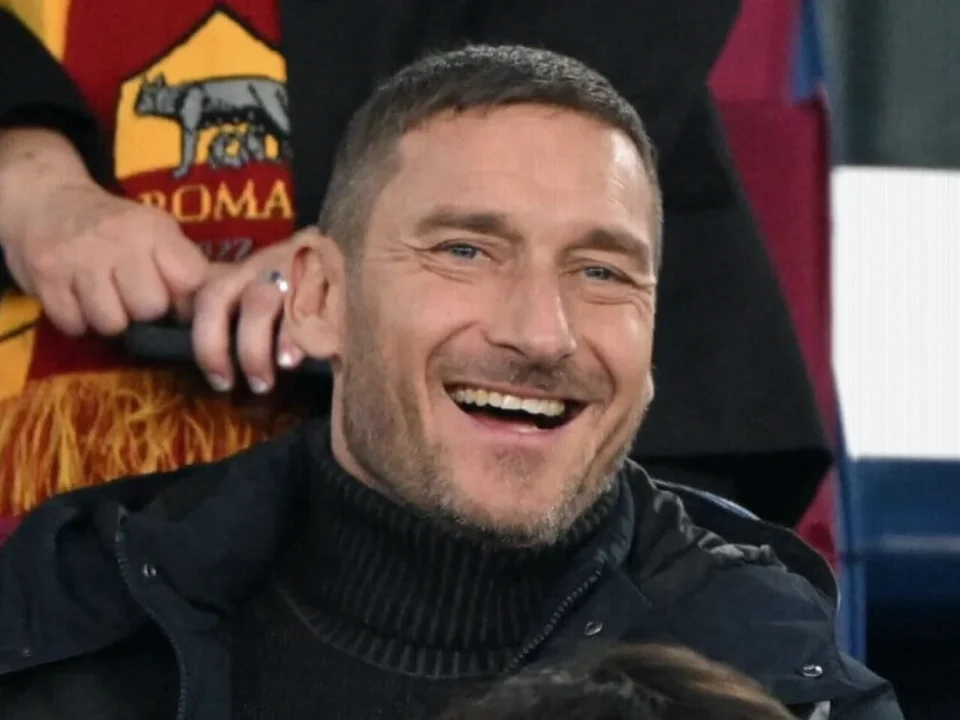
Francesco Totti’s relationship with Roma has never been reduced to a shirt number, but the number still tells part of the story. As he reflects on turning 50, the former captain sees a life tied to one club, a World Cup that completed his career, and a bond with supporters that he feels has become even stronger since retirement.
He described himself as having been “embarrassing” between 2001 and 2008, a smiling answer from a player who remains unusually direct about his own standing. Totti believes there has been no identical Italian successor, though he named Roberto Mancini as the comparison most commonly made, recalling the Sampdoria man’s ability to play across attacking roles.
Quick facts
- Totti said Carlo Mazzone and Zdenek Zeman were the coaches who understood him best.
- He named Antonio Cassano as the teammate with whom he connected most naturally on the pitch.
- His regret as a player is never sharing a side with Ronaldo Nazario.
- He said Diego Maradona stands above every other footballer in his personal ranking.
- Totti remains unconvinced that Roma’s number 10 should be handed out to a player after only a short spell of form.
Before Luciano Spalletti moved him into the centre-forward role, Totti said he valued assists more than scoring. His understanding with Cassano was particularly strong, while he also spoke warmly of Vincent Candela, whom he helped settle after the Frenchman arrived from Guingamp without knowledge of Rome or the language.
He did not present himself as a dressing-room orator. For Totti, responsibility belonged first to the player once the match began; professional footballers, he said, should know their jobs without needing constant instruction or pre-match speeches.
That outlook matched his matchday routine. While other players prepared through music, treatment or massages, Totti would drink coffee and talk at the bar before warming up. He said he rarely felt pre-game anxiety and approached the 90 minutes with a sense of calm and enjoyment.
Roma remains the central line in his account. Having been born, raised and effectively spent his football life in the same colours, he feels supporters have kept him close even after a 25-year playing story came to its end.
His Italy career supplied the achievement that carried him beyond the capital. Totti said that, without the 2006 World Cup, his honours — one Serie A title, two Coppa Italia wins, two Supercoppe and the European Golden Shoe — might have left him viewed mainly within Rome. He also insisted Italy would not have won the tournament without him, while acknowledging that he played it at only 40 or 50 per cent fitness.
The penalty against Australia remains one of the defining moments of that campaign. In his view, the World Cup was the prize that took a Roman idol onto the wider stage, even if his physical condition meant he could not perform at full capacity throughout the competition.
People around the captain
Totti reserved special words for Vito Scala, describing him as an elder brother who protected him and allowed him to focus entirely on football. Scala, he said, anticipated problems and handled the risks around a high-profile Roma player before they could grow.
He also praised his brother Riccardo as a consistently present, humble and discreet figure. Totti said Riccardo has always stayed behind the scenes rather than seeking a place alongside him.
On the field, Totti’s view of his own talent remains clear. He said teammates such as Marco Delvecchio, Simone Perrotta and Cassano often understood his intention almost immediately, recognising the run or pass he had envisaged before the ball reached him.
He called that instinct a natural gift, while adding that every player reads football differently. Yet he maintained that he has not seen anyone reproduce the things he was able to do in matches.
Totti rejected the old idea that he was lazy in training. He said he worked with the group and completed what was required, although Monday and Tuesday sessions could involve individual recovery after the physical punishment absorbed on Sundays.
Coaches, boardrooms and the number 10
Mazzone and Zeman were the two managers he felt understood him most deeply. At the other end stood Carlos Bianchi, whom Totti said wanted him out of Roma; he stressed, however, that it was president Franco Sensi, rather than himself, who removed the coach.
He accepted that his role as captain and leading player gave him influence at the club, but denied being part of the decision-making circle. There was weight attached to his opinion, he said, yet he was still a player rather than a member of the boardroom.
His eventual departure from a Roma executive role remains part of that complicated post-playing chapter. Totti said relationships require both sides to work, adding that he left a three-year contract because he had no intention of remaining at the club merely to collect a salary without a meaningful task.
That same long-term view shapes his position on Paulo Dybala and the vacant number 10. Totti believes the shirt should not be awarded simply because someone has produced five, six or seven good matches. A player given that responsibility should have a pathway to remain in Rome for years, though he underlined that the final choice belongs to the club, whoever the candidate may be.
If Roma had not been his only Italian club, Totti said Milan would have appealed to him. As a boy, he was captivated by Arrigo Sacchi’s side and the Dutch trio, a team he remembered as both successful and beautiful to watch.
His reconciliation with Spalletti is still incomplete. Their meeting over an amaro began the process, he said, but the ice has not entirely gone; Totti nonetheless welcomed the renewed contact and admitted he too made mistakes, including in some of his public answers.
He recalled the response that came on the pitch after their tensions, beginning at Atalanta when he entered for roughly eight minutes and scored. The next match brought another goal after about seven minutes, a sequence he interpreted as protection from above at a moment when he feared his Roma ending could not be allowed to finish that way.
A career measured beyond the figures
Totti’s only playing regret concerns Ronaldo Nazario. He imagined the Brazilian scoring “four or five hundred goals” with him supplying from behind, but differentiated that fantasy from the special chemistry he actually enjoyed with Cassano.
For his greatest player, there was no debate. Maradona, Totti said, was football itself, with everyone else following below. He also noted that he earned substantial money during his career, while pointing out that some lesser players were paid more and wondering, with a laugh, what his value would be in the present market.
Turning 50 has brought a little disorientation because football is no longer the daily occupation he loved. Yet he said he had already turned a corner at 40, and now intends to enjoy the next 20 or 30 years without regretting his life as either a professional or a private individual.
Asked whether another Totti will emerge, he said he hopes so — not only for himself, but for Roma’s people and for the game. The numbers still return to him easily: 10 is Totti, 50 is his age, and 100 is Roma’s centenary. Perfect numbers, he suggested, are as rare as perfect men.