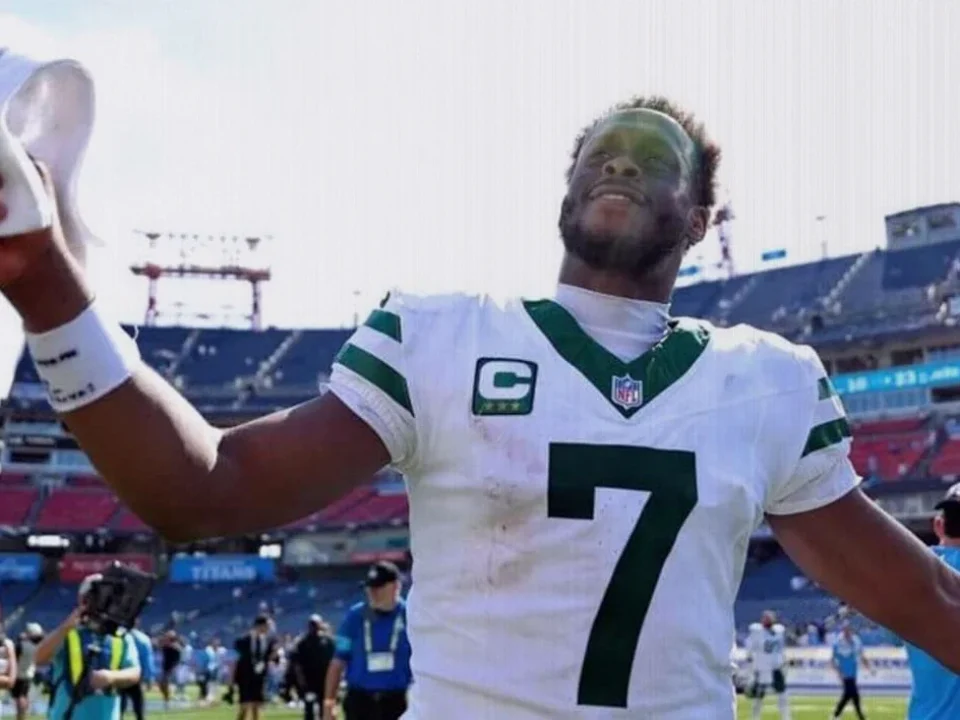
Geno Smith’s return to the New York Jets has quickly become one of the league’s early-season stories, with the veteran quarterback delivering efficient, poised football for a franchise that has spent a decade searching for stability at the position.
Through three games, Smith has the Jets at a level of quarterback play they have rarely seen since his first stint with the club. He has completed 75.5% of his throws for 783 yards, with no interceptions, after rejoining the organization following a difficult one-year stop with the Las Vegas Raiders.
Quick facts
- Smith ranks first in the NFL in completion percentage at 75.5%.
- He has thrown for 783 yards and remains interception-free on at least 50 attempts.
- Smith completed more than 80% of his passes with 300-plus yards and three touchdowns against Detroit in Week 3.
- His 12.9 percentage-point completion rate above expectation leads the league.
- Only 9.8% of his passes have come outside the pocket, the fourth-lowest rate among qualifying quarterbacks.
The Jets originally selected Smith in the second round of the 2013 draft after considering him in the first round. Then-general manager John Idzik saw the arm strength, competitiveness and confidence that had helped Smith post consecutive 4,000-yard seasons at West Virginia.
Smith entered a crowded quarterback room that included Mark Sanchez, Tim Tebow, David Garrard, Matt Simms and Greg McElroy. He dealt with a significant ankle sprain in training camp but did not want to miss practice, a trait Idzik remembers as evidence of Smith’s toughness.
His first Jets run was uneven. Smith threw 12 touchdowns and 21 interceptions as a rookie while New York finished 8-8, then endured a 4-12 season in 2014. He was caught shouting back at a fan after a poor early-season game, and the pressure intensified as calls grew for Michael Vick.
Still, Smith closed that 2014 season with one of the best games of his career, completing 20 of 25 attempts for 358 yards and three touchdowns in a win. He posted a perfect 158.3 passer rating with no interceptions, though Idzik and coach Rex Ryan were dismissed after the season.
Smith appeared set to start for a new staff in 2015 before teammate IK Enemkpali broke his jaw during a locker-room confrontation. An ACL tear followed in 2016, sending Smith into an extended stretch as a reserve quarterback.
He backed up Eli Manning with the Giants, Philip Rivers with the Chargers and Russell Wilson in Seattle, making only four combined starts across those stops. Smith eventually replaced Wilson in 2022, led Seattle to the playoffs and earned Comeback Player of the Year honors.
Idzik believes those years reshaped Smith’s game. He said the quarterback has become more patient, more aware of game situations and less likely to force throws, while retaining the arm talent that made him appealing in 2013.
“He has both mental and physical toughness,” Idzik said. “He learned from being behind Eli, Philip Rivers and Russ. You see it now in his patience, his situational awareness and how he manages a game.”
Sterling Shepard, now on the Jets’ practice squad after signing Sept. 15, was with Smith on the Giants in 2017. Shepard said Smith prepared every week as if he would start and remains among the most diligent film students he has encountered.
“He is always in the playbook,” Shepard said. “He is in the building early, studies film and knows exactly what he needs to do on game day.”
Smith’s availability came after a turbulent year in Las Vegas. The Raiders acquired him and gave him a two-year, $75 million deal, but the offense struggled behind a battered line, the league’s weakest rushing attack and an unstable coaching situation.
Smith was sacked more than any other NFL quarterback and finished with a league-high 17 interceptions. Pete Carroll was fired after one season as Raiders coach, and offensive coordinator Chip Kelly was dismissed during the year.
Smith pushed back on judgments based solely on the interception total, saying film provides greater context. He maintained that protecting the football has been a priority throughout his career and noted that tipped passes and other variables can turn sound decisions into turnovers.
The film and tracking data offer some support. Only five of Smith’s 17 interceptions were classified as inaccurate throws, while four hit receivers’ hands before being deflected to defenders. Another was tipped at the line, and Smith faced pressure on at least three others.
Pro Football Focus still charged Smith with 23 turnover-worthy plays against 14 big-time throws last season. His early Jets performance, however, has looked markedly different.
Smith ranks 12th in expected points added per dropback. He is 15th in the QBI quarterback metric and 13th in QBR. His 3.9% off-target rate is second only to Brock Purdy’s, while he has completed 70% of his throws under pressure and 79% when blitzed.
He has also been aggressive without sacrificing accuracy. Smith owns the NFL’s sixth-highest tight-window attempt rate, and his completion percentage over expectation is the best in the league.
Against the Lions in Week 3, Smith became only the third Jets quarterback to complete more than 80% of his passes while throwing for at least 300 yards, three touchdowns and no interceptions. The others were Ken O’Brien and Smith himself in the 2014 finale against Miami.
Right guard Joe Tippmann said Smith’s pocket movement has been especially valuable for the offense. Smith has stayed in the structure of plays rather than regularly escaping the pocket, helping the offensive line operate with more predictability.
“He does not get out of there too often,” Tippmann said. “The way he can feel and work inside the pocket is something people can overlook.”
Smith’s command has been apparent around the building as well. He regularly studies film on his tablet, sends clips to receivers and maintains communication about route details and expectations.
Wide receiver Adonai Mitchell called Smith a natural leader during training camp. Smith also built timing with teammates during offseason workouts in Miami, often choosing the hottest part of the afternoon for sessions that included tight end Mason Taylor and, at times, Mitchell.
That work showed against Detroit. Garrett Wilson caught 10 passes for 107 yards and a touchdown on a critical fourth-down throw, setting up a tying two-point conversion. Smith then fit a pass into a narrow window for Shepard.
“That opening was almost gone,” Shepard said. “He still got the ball in there. That is what he does. If we handle our jobs, he can carve defenses up.”
Offensive coordinator Frank Reich has praised Smith’s preparation, football intelligence and leadership. After the season-opening win over Tennessee, Reich told Smith he wished he could take back a few play calls. Smith’s response was that there were no bad calls and that the offense would make every play on the call sheet work.
Reich said that approach stood out. He now calls games from the booth and communicates with Smith either directly or through quarterbacks coach Bill Musgrave and pass-game coordinator Seth Ryan. Between series, Smith will offer feedback on potential calls, sometimes endorsing a sequence and sometimes asking to save a concept for later.
Rookie backup Cade Klubnik has noticed Smith’s decisiveness during games. Klubnik said Smith does not blame teammates when something breaks down, instead directing the group toward an immediate adjustment.
For Idzik, the quarterback’s resurgence carries personal meaning. He has remained close to football through his role with SumerSports, while also following his son Brad’s work as Carolina’s offensive coordinator. He has watched every Jets game this season and sees the same resilience in Smith that first convinced the organization to draft him.
“He is his own man,” Idzik said. “Nothing shakes him. He has been through difficult times and came out stronger on the other side.”