Alex Ovechkin’s final NHL season will close a landmark chapter in Washington, but the Capitals captain’s reach around the rink has always stretched beyond goals and records. From special hockey programs and cancer patients to school gyms and neighborhood rinks, Ovechkin helped turn a region once dominated by football and college basketball into a deeper hockey market.
The Ovechkin Effect in the DMV
Ovechkin arrived for the 2005-06 season and became the NHL’s career goals leader, eventually passing Wayne Gretzky’s former record of 894. He announced Monday that this will be his last NHL campaign. His impact in the District, Maryland and Virginia is visible in participation totals, renovated facilities and the players who grew up trying his one-timer.
- USA Hockey registered 22,222 youth and adult players in the Potomac Valley Region last season, up from 12,856 in Ovechkin’s rookie year — a 73 percent increase.
- Men’s participation rose from 3,820 in 2005-06 to 8,378 last season.
- Women’s hockey grew from 425 participants to 994.
- Boys’ registration increased from 8,154 to 10,459, while girls’ hockey climbed from 821 players to 2,328.
- The Capitals have constructed or upgraded 14 outdoor inline and ball-hockey rinks in response to increased demand.
Alexandria Briggs-Blake, who leads the Tucker Road Parent Organization and its minority-focused youth program in Prince George’s County, said Ovechkin’s legacy cannot be reduced to the scoreboard. She said he consistently arrives in communities that need support, often without seeking a spotlight.
“Real greatness is about the impact someone leaves,” Briggs-Blake said. “That is where Ovi stands out. He is always there, and he does it quietly.”
Showing up for special hockey and underserved players
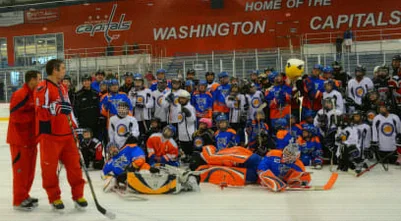
Jen O’Brien, executive director of the American Special Hockey Association, first saw that side of Ovechkin at a 2014 clinic with ASHA skaters. She recalled him staying beyond his scheduled ice time, connecting directly with the children and bringing an easygoing energy to the session.
“Scoring goals may be his superpower, but so is being grounded and wanting to do the right thing,” O’Brien said. “He recognizes that everybody can love this sport, play it and be a fan of it.”
Ovechkin became an ASHA ambassador in 2014 and has contributed funds supporting 136 special-hockey teams across the United States, along with more than 5,260 athletes and nearly 400 coaches. During that span, ASHA grew from 45 programs in 30 cities into 140 programs nationwide, reaching more than 8,750 athletes and 11,500 total members when coaches and volunteers are included.
The Washington area has five ASHA clubs: the Baltimore Saints, Montgomery Cheetahs, NOVA Cool Cats, Washington Saints and Frederick Gargoyles.
- Ovechkin started Ovi’s 8’s in 2006 to provide Capitals tickets for underserved children.
- More than 6,000 people have attended Capitals games free through the initiative, including many ASHA participants.
- O’Brien said children view Ovechkin as a genuine friend, a connection that can matter especially when they face bullying or isolation at school.
Ralph Featherstone, a coach with the Fort Dupont Cannons, said Ovechkin’s individuality helped him connect with young Black players and fans. The Cannons are North America’s oldest minority-oriented youth hockey program.
Ovechkin practiced with the Cannons multiple times during his career and brought the Stanley Cup to Fort Dupont Ice Arena in 2018. The visit honored the program and founder Neal Henderson, who became the first Black inductee in the U.S. Hockey Hall of Fame in 2019.
Featherstone, a retired U.S. Marine colonel and the first Black captain of the U.S. Naval Academy’s club hockey team, said players noticed Ovechkin’s yellow laces, early-career tinted visor and willingness to stand apart while remaining committed to the team. He said that example can give young athletes confidence to be themselves.
A personal connection in the cancer fight
Ovechkin’s community work also included a lasting relationship with Alex Luey, a young fan diagnosed with osteosarcoma. Luey had his right leg amputated in September 2016 after the bone-cancer diagnosis.
After a 2017 Rogers Hometown Hockey broadcast in Niagara Falls, hosts Ron MacLean and Tara Slone surprised Luey with a video greeting from Ovechkin, his favorite NHL player. Ovechkin later invited Luey to the Capitals’ Nov. 25, 2017 road game against the Toronto Maple Leafs at Air Canada Centre.
- Ovechkin promised Luey he would score and delivered a hat trick in Washington’s 4-2 win.
- He scored in two other games attended by Luey that season.
- Ovechkin invited Luey and his family to Washington’s 2018 Stanley Cup parade.
- Luey died of cancer in 2019 at age 15.
Cat Luey, Alex’s mother, said the captain’s support continued well beyond public appearances. She said Ovechkin called to ask how Alex was doing and remained in contact with the family after Alex died.
“It was a real, authentic relationship, and that showed me who Ovi was away from hockey,” she said. “He is compassionate and caring. He did not stop caring after my son passed away.”
Last season, Ovechkin launched the GR8 Chase for Victory Over Cancer initiative while pursuing Gretzky’s goals mark. Working with Hockey Fights Cancer and the V Foundation for Cancer Research, he pledged donations equal to his career goal total for every goal he scored for the rest of his career. The effort has raised more than $256,000.
The next generation carries the memory
Ovechkin’s influence is also evident in players who first picked up a stick while watching him fill nets at Capital One Arena, previously known as Verizon Center.
Annapolis native Lacey Eden said Ovechkin’s scoring touch, personality and style made him impossible to miss while hockey was still finding its footing in the area. Eden led NCAA Division I women’s hockey with 77 points — 29 goals and 48 assists — in 41 games for Wisconsin this season. Wisconsin defeated Ohio State 3-2 on March 22 to win its second straight Women’s Frozen Four title, and Las Vegas selected Eden fifth overall in the 2026 Professional Women’s Hockey League Draft.
Eden remembered practicing one-timers from “Ovi’s office” as a young player and attending Capitals games with her father. She was also at the 2018 Stanley Cup Final watch party outside Capital One Arena, part of the crowd that reflected hockey’s expanding footprint in the region.
“There was always that star power around Ovechkin,” Eden said. “The growth of hockey in the DMV was sparked by Alex Ovechkin.”
The Capitals’ broader development programs have reached well beyond the arena:
- More than one million local elementary-school students have taken part in Capitals Hockey School.
- The program is available for grades 1 through 8 at 1,722 schools and provides street-hockey gear, curriculum materials and staff training.
- Through support from the NHL/NHLPA Industry Growth Fund, the program has supplied 67,946 sticks, 3,048 nets, 45,080 balls and 12,848 pucks.
- Since 2019, more than 25,000 players have participated in a Capitals Youth Hockey event.
- Future Caps Learn to Play, presented by Worldwide Technology, has served 11,700 participants across the DMV since 2017.
Ovechkin may leave the NHL after this season, but Briggs-Blake believes the work will remain rooted in the area he helped reshape.
“His commitment to access, representation and opportunity will keep growing and changing hockey’s future,” she said. “He can leave for Russia or anywhere else, but his legacy will stay here.”