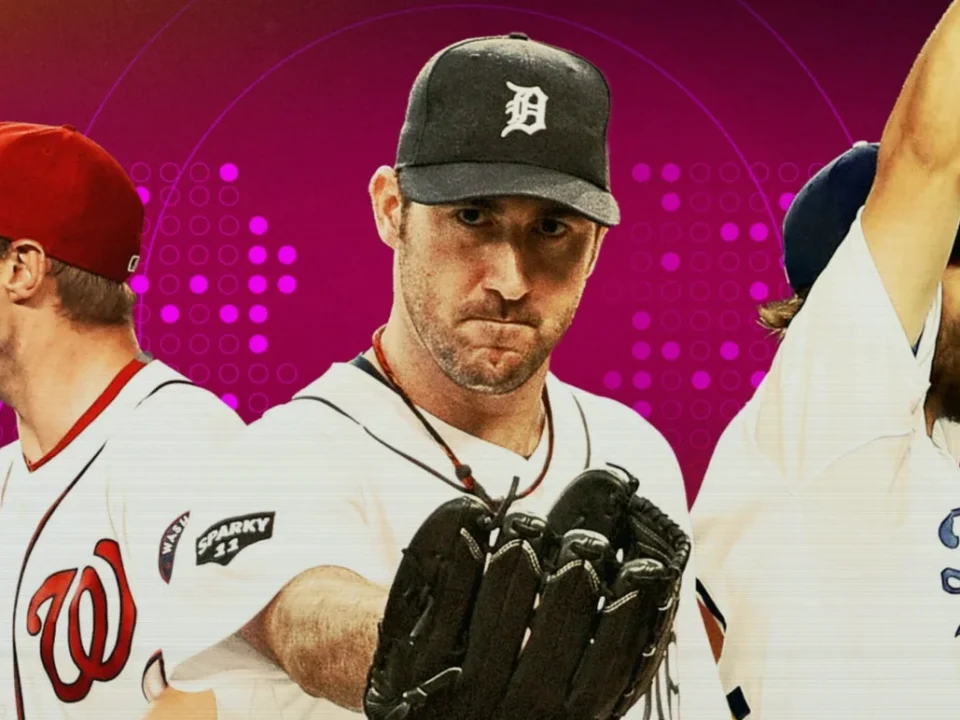
Justin Verlander will take the ball one last time Saturday in Detroit, facing the Pirates as a 21-year major league career reaches its final turn. Three Cy Young Awards, an American League MVP, two World Series rings, 266 wins and 3,554 strikeouts have already settled his place in Cooperstown. The more lively clubhouse question is where Verlander stands beside Max Scherzer, Clayton Kershaw and Zack Greinke.
Four aces, no easy order
There is no clean way to separate four pitchers who defined their era in different fashions. Kershaw owns the eye-catching rate numbers, Verlander paired overwhelming peaks with remarkable durability, Scherzer brought a fierce strikeout profile and late-career staying power, and Greinke carved out a distinctive career built as much on craft and intelligence as raw power.
-
Kershaw earned support as the top choice because of his historic run prevention. His 154 ERA+ is tied with Pedro Martinez for the best mark among starters with at least 2,000 innings. He won three Cy Youngs, five ERA titles and reached 3,000 strikeouts despite working fewer innings than Verlander, Scherzer and Greinke.
-
Verlander’s case starts with his workload and his heights. His 2011-12 stretch belongs in any conversation about the greatest two-year runs by a starter, while his no-hitters add another layer to the résumé. He also remained elite at age 39, turning in an outstanding 2022 season.
-
Scherzer’s argument includes nine seasons worth at least 5.0 bWAR, one more than Verlander, even though Verlander was credited with the better top two individual seasons. Much of Scherzer’s greatness came after he turned 30, and he was still excellent in 2022 at age 37.
-
Greinke’s 2009 season remains one of the standout single campaigns among the four, and his 2015 season belongs in that same conversation. His broader body of work was viewed by some as a step below the other three, but his style remains singular in a generation increasingly shaped by strikeouts.
The numbers on the board
| Pitcher | Wins | Strikeouts | Innings pitched |
|---|---|---|---|
| Justin Verlander | 266 | 3,554 | 3,571 1/3 |
| Max Scherzer | 224 | 3,550 | 3,040 2/3 |
| Clayton Kershaw | 223 | 3,052 | 2,855 1/3 |
| Zack Greinke | 225 | 2,979 | 3,389 1/3 |
Wins have become a complicated measuring stick, especially as modern starters are pulled earlier and relievers can inherit decisions. Still, reaching the 200-win neighborhood in this environment says something about a pitcher’s workload, health and career length. Those totals may become increasingly rare as clubs ask less of starters beyond the opening turns through a lineup.
Strikeouts tell another part of the story. Verlander and Scherzer have both crossed 3,500, with Scherzer only four behind Verlander entering the next chapter of his own career. Kershaw’s 3,052 came while he struck out more than one hitter per inning across 2,855 1/3 frames. Greinke’s lower strikeout count is often cited when he is placed behind the other three, though it also reflects the command-and-craft approach that made him such an unusual ace.
Cooperstown questions
All four have Hall of Fame cases, but unanimous election is another matter entirely. Mariano Rivera remains the only player elected unanimously, a reminder that even the most obvious candidates can lose votes for reasons that have little to do with their accomplishments.
Kershaw was considered the most plausible unanimous candidate of the group because of his historic ERA record, sustained dominance and the fact that he spent his entire career with the Dodgers. A suggested order of likelihood ran Kershaw first, then Scherzer, Verlander and Greinke.
There are still reasons to expect none of them to sweep every ballot. Greg Maddux was not unanimous, and Verlander could encounter voters who hold his time with the Astros during their sign-stealing scandal against him, despite Verlander being a pitcher. The broader point remains simple: each of Verlander, Scherzer and Kershaw should be a first-ballot choice, with Greinke carrying a strong candidacy of his own.
How this group fits with the previous generation
The natural comparison is with Greg Maddux, Randy Johnson, Pedro Martinez and Roger Clemens. The earlier group pitched when starters generally carried even greater game-to-game responsibility, which can shape a discussion of value across eras. But Verlander, Scherzer, Kershaw and Greinke would not look out of place in that company.
The offensive climate matters, too. Martinez’s 1999-2003 run remains a particularly daunting standard because it came in a period when scoring was heavily inflated. Maddux’s precision-based dominance also stands apart; in a sport now geared toward velocity and strikeouts, his style may be harder than ever to reproduce.
Verlander’s influence is already visible in younger pitchers who grew up watching him, from Michigan native Hunter Brown to arms around the game. Scherzer’s all-out mentality has shaped the way many pitchers approach their work, even as some, like Tarik Skubal, have learned to conserve their best stuff for the later innings rather than spending everything from the first pitch.
There may never be a final answer to the ranking. Kershaw has the rate-stat case, Verlander has the length and the towering peak, Scherzer has the relentless competitive edge and elite strikeout production, and Greinke has a career that resists easy comparison. What is clear as Verlander prepares for his farewell start is that these four carried the ace standard for a generation.
Scherzer’s next decision will add one final wrinkle. He could return for 2027, perhaps with Verlander’s strikeout total in reach, or he could head toward the Hall of Fame on a timetable closer to his old rival and teammate. Either way, Verlander’s last afternoon in Detroit is a fitting moment to appreciate just how rare this group has been.