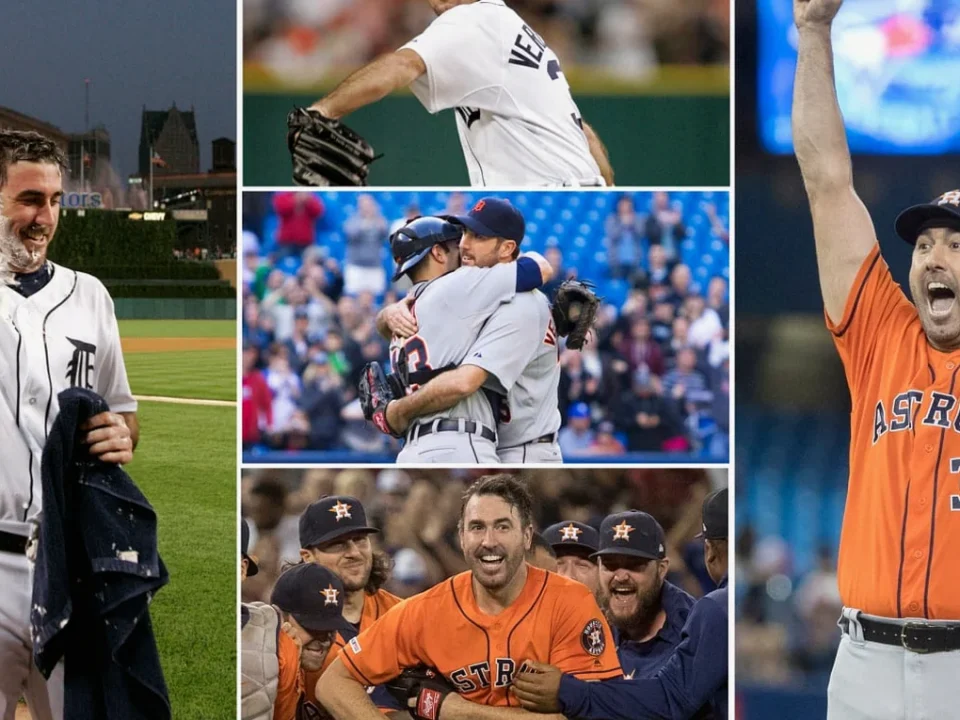
Justin Verlander will take the ball for the last time on Saturday, closing a Major League career that stretched across parts of 21 seasons and included the kind of starts that change the feel of a ballpark. His three no-hitters stand as clean markers on that long road: one in Detroit, then two in Toronto, each with a different kind of tension.
A career built on the biggest stages
Verlander entered the game as the American League Rookie of the Year and eventually grew into one of the defining starters of his era. He won the 2011 AL MVP Award, collected three Cy Young Awards and placed among the top five in Cy Young voting six additional times.
- He ranks eighth in Major League history with 3,554 strikeouts.
- He is one of six pitchers to throw three career no-hitters.
- His 2011 season included a 24-5 record, an AL-best 2.40 ERA and 251 regular-season innings.
- He added 20 1/3 postseason innings that year while winning both the league MVP and Cy Young honors.
That workload and that level of command made 2011 the high-water mark of his résumé, but Verlander’s no-hit games tell a fuller story. They span his rise with the Tigers, his dominant peak and his later work with Houston.
The Comerica Park breakthrough
Verlander’s first no-hitter came on June 12, 2007, against the Brewers at Comerica Park. The ballpark had opened in 2000 and had yet to host a no-hitter; in his second full big-league season, Verlander gave Detroit its first.
Milwaukee drew four walks, but Verlander still attacked the strike zone, landing 73 strikes among his 112 pitches. His fastball reached 102 mph, and his curveball gave the Brewers little room to settle in.
- He struck out 12, then a personal best.
- Ten of the strikeouts came on swings and misses.
- His final six strikeouts were all swinging strikeouts.
- He needed only 11 pitches in the ninth inning.
The final frame ended with two strikeouts and a fly ball by J.J. Hardy that Magglio Ordonez caught. Verlander later recalled stepping away from the mound with two outs and one strike remaining, not to celebrate early, but to slow himself down. He called it perhaps the best stuff he had ever brought to the mound.
Toronto became his no-hit home away from home
The 2011 close call
On May 7, 2011, Verlander threw his second no-hitter against the Blue Jays at Rogers Centre. It was one of the 24 victories in his award-sweeping season, and that win total has not been equaled since.
This time, the strikeout total was modest by Verlander standards: four. The Blue Jays had only one runner, when J.P. Arencibia worked a walk in the eighth inning. Three pitches later, Toronto’s threat vanished on an inning-ending double play.
The closest call had arrived much earlier. In the fifth, Edwin Encarnacion lined a ball off Verlander’s right arm. Verlander tracked it near the third-base foul line and fired a short-hop throw to Miguel Cabrera at first. Cabrera made the scoop on a tight play, preserving the no-hit bid. Verlander showed no lingering trouble from the blow, completing the game on 108 pitches.
The third no-hitter and a place in history
Eight years later, on Sept. 1, 2019, Verlander returned to Rogers Centre with the Astros and no-hit Toronto again. It was his second no-hitter in that building, and the third of his career.
The outing had almost no margin for error, though Houston gave him no lead until the ninth. The game remained scoreless until Abraham Toro drove a two-run homer in the final inning.
- Verlander struck out 14 Blue Jays.
- The only Toronto baserunner was Cavan Biggio, who walked with one out in the first.
- Biggio is the son of former Astro and Hall of Famer Craig Biggio.
- Verlander completed the no-hitter with 120 pitches.
- He became the third pitcher with multiple no-hitters against one club, and the first to do it twice on the road.
The performance placed Verlander alongside Larry Corcoran, Cy Young, Bob Feller, Sandy Koufax and Nolan Ryan as the only pitchers with three no-hitters. Afterward, Verlander acknowledged that reaching the three-no-hitter group mattered deeply to him, calling it a special threshold in his career.
Saturday’s final start will not erase any of those nights. The radar-gun heat of 2007, the right-arm scare in 2011 and the ninth-inning wait in 2019 are already part of the record. They are also the kind of memories that explain why Verlander’s final walk from the mound carries more weight than an ordinary September goodbye.