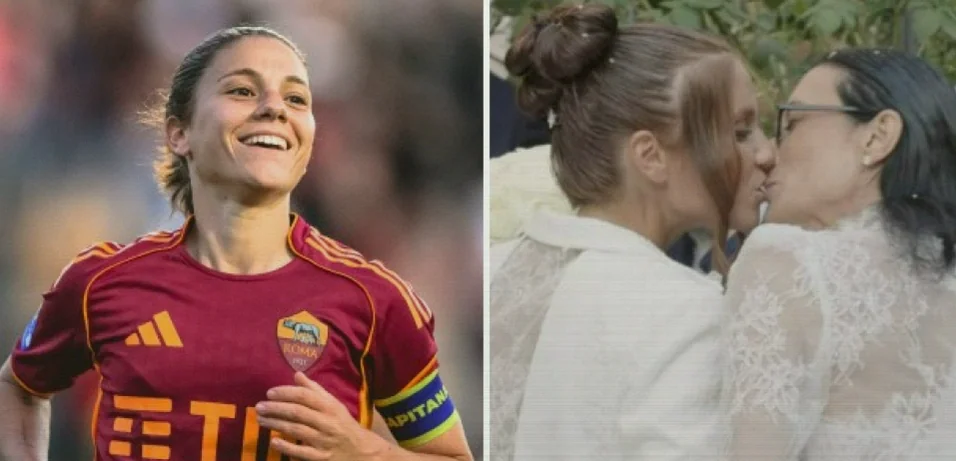
Manuela Giugliano has made her choice clear: Roma remains the place where she wants to measure both her own progress and that of Italian women’s football. The midfielder, Roma’s number 10 since arriving in the capital, sees her future tied to the club, the national team and the possibility that the game around her can grow with greater ambition.
The decision
Giugliano has become one of the defining figures of Roma’s recent rise. She ended last season with the Scudetto and the Serie A MVP award, while also becoming the first Italian player to be included among the Ballon d’Or nominees. Yet she does not describe herself simply as the country’s leading player.
“I do not fully think of myself as the best in Italy,” she said. “But I understand that, with the maturity and responsibility I have now, I can help this movement develop.”
Her decision to remain at Roma carries that meaning. Giugliano said she has consistently put “my family” first when opportunities elsewhere have arisen, and regards staying in her city and in Italy as a way of testing how far the domestic game can still travel.
Roma’s Champions League meeting with Barcelona brought that question into focus. The occasion recalled the 2023 match at the Olimpico, played before almost 40,000 spectators. Giugliano wants such evenings to become more frequent, while acknowledging that Italian clubs still have ground to make up.
“We work to have nights like that again,” she said. “I hope they can become normal, but there is still a lot to do. Roma have always treated me as a complete professional, on and off the pitch, and every club should offer that. You have to be prepared to take risks.”
In her view, clubs abroad began investing with greater conviction earlier than those in Italy. “Without courage, you cannot reach the level of a Barcelona,” she said.
The bond within Roma has also been visible around the women’s side. Malen was in the stands for the Barcelona match, a presence Giugliano welcomed as evidence of a club culture shared across the men’s and women’s teams. “We are one family here,” she said. “There is only Roma.”
Giugliano’s own status has grown quickly. She learned of her Ballon d’Or nomination while travelling to a team dinner, initially dismissing what she saw online as a false social-media post before Roma’s press officer called her. She viewed the nomination as the reward for a strong campaign with both club and Italy, and as a significant moment for the women’s game in the country.
Individual recognition, however, is not her finish line. She wants to improve on last season’s numbers and links every personal award to the work of teammates, staff and the club. Under new coach Alessandro Spugna’s successor Luca Piovani, she said Roma are still identifying the position in which she can give her best.
Piovani has brought new ideas, she said, and the squad is building something positive. Giugliano began the season with two goals and spoke of enjoying the freedom to move through the pitch rather than offering opponents a fixed reference point.
The number 10 on her back has its own weight in Rome. Her father introduced her to the great players associated with the shirt when she was young, and she believes it should belong to a player able to pair ability with the harder work of developing it. At Roma, she recognises that the number is inseparable from Francesco Totti.
“Totti is Roma,” she said. “I feel proud and fortunate to wear this shirt.”
The wider horizon
At international level, the 2027 World Cup is already a central objective. Giugliano will turn 30 next year and wants to play in that tournament as a major figure for Italy, although she stressed that qualification must come first.
“It is always on my mind,” she said. “It is a dream, because you always want to win something important. Winning with Italy is something I still lack, but first we have to qualify.”
That absence explains why she does not consider herself fulfilled. She has won everything available in Italian club football, but has not lifted the Champions League trophy or won a major honour with the national side. Those missing prizes continue to drive her.
During the summer, Giugliano also worked as a television pundit for the men’s World Cup. She admitted to nerves before taking on an unfamiliar role, but wanted to understand whether broadcasting could become part of her life after playing. She also hoped her appearance would show other female players that such work is open to them.
Football remains the centre of her professional life, although she knows how important it is to step away from it. For Giugliano, freedom means returning to her family and to the sense of security it provides. She married her wife Veronica and says the family model in which she grew up has shaped her own hopes.
Her path from Castelfranco Veneto has been long and demanding. Leaving home early to pursue football meant giving up parts of adolescence, she said, but she believes the experience will one day help her explain to her future children what she pursued and achieved.
Giugliano has never seriously imagined a life without football. Had the game not worked out, she believes she might have worked with children, having studied in the social-healthcare field. She has not ruled out doing so in the future.
For now, Roma, Italy and the unfinished business of elite competition remain her priorities. Motherhood is a future wish rather than an immediate plan, but she hopes one day to show her children what she won and what she built, and to make them proud.