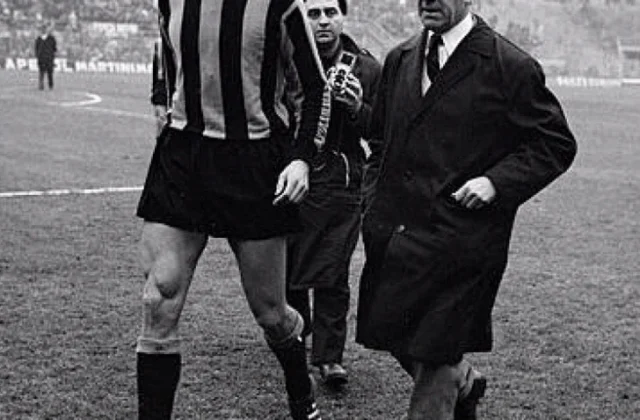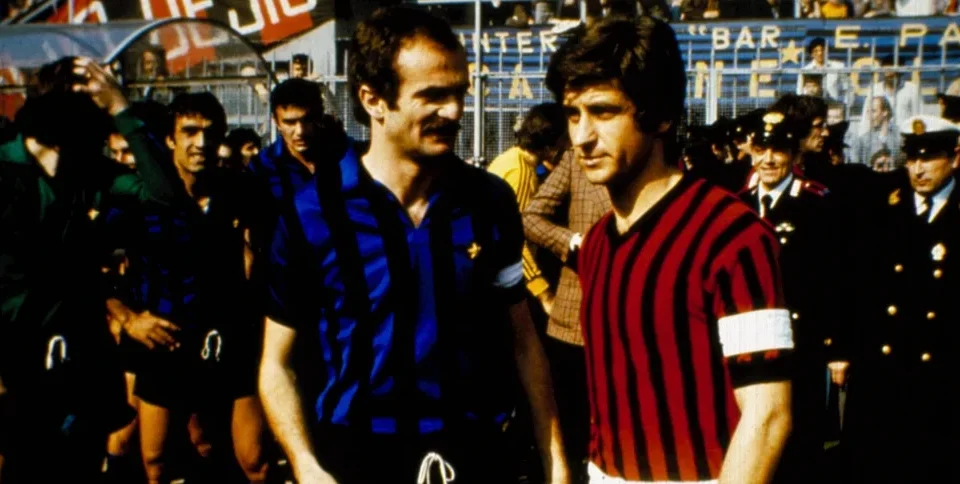
Before Italy reached the 1970 World Cup final, the national side carried a domestic argument across the Atlantic. Sandro Mazzola and Gianni Rivera were more than two gifted footballers from Milan: one stood for Inter, the other for Milan, and a country that did not necessarily support either club still felt compelled to choose.
Their rivalry became a singular part of Italian football history. The symbolic figures of the two Milan clubs came to embody a contest larger than the derby itself, much as Fausto Coppi and Gino Bartali had divided sporting Italy in an earlier age. Mazzola or Rivera became a question of taste, allegiance and, in time, national-team selection.
Two figures of Milan and Italy
Mazzola, son of the great Valentino Mazzola, and Rivera were both shaped by the post-war years, but they offered sharply contrasting images. Sandro’s game was built on sudden acceleration, feints and changes of direction. Initially a forward, he found his natural place as an inside player, escaping markers with an abrupt, restless style.
Rivera’s football appeared more measured and flowing. Slender but powerful in the thigh, Milan’s “Golden Boy” played with an elegance that Gianni Brera famously characterised through the nickname “Abatino”, a fragile-looking and refined little man whose style could seem almost too polished. Brera’s preference, however, was for Mazzola, whom he considered more valuable to the balance of a team and renamed “Mazzandro”.
The contrast extended beyond the pitch. Mazzola, often looking untidy as he ran and wearing the moustache fashionable at the time, was the opposite of the impeccably groomed Rivera, whose hair seemed untouched even in motion. Yet both men possessed a calm public manner and considerable inner resolve. They were leaders, aware of their standing and capable of holding their ground.
They could not easily have been seen dining together without creating a national commotion, as Mazzola later observed. Still, there was mutual respect rather than personal hostility. They were never close companions in everyday life, but they maintained a good relationship and later became among the founders of the players’ union.
The World Cup selection problem
Their partnership became famous precisely because it was rarely a partnership on the field. At Mexico 1970, with only two substitutions permitted and changes usually reserved for injury, coach Fulvio Valcareggi made the Mazzola-Rivera rotation into a practical and political solution.
- On the eve of the tournament, Valcareggi stated that Mazzola and Rivera could not start together.
- Rivera, then 27 and only six months removed from becoming the first Italian winner of the Ballon d’Or, reacted badly to being excluded from the coach’s plans.
- Influential members of the Azzurri squad sided with Mazzola, regarding him as the player more willing to contribute defensively.
- Rivera believed there was an attempt to push him aside and accused Valcareggi of yielding to pressure from Italy’s delegation chief, Mandelli.
- There was even talk of sending Rivera home before the situation was, at least publicly, repaired.
Valcareggi’s preference was clear in the group stage. Mazzola began against Sweden, Uruguay and Israel. Rivera watched the first two matches from the bench, then entered after the interval against Israel, replacing Angelo Domenghini rather than his Inter counterpart.
The relay begins in Toluca
The arrangement that came to be known as the staffetta, or relay, took its defining form in the quarter-final against Mexico.
- Before the match, Valcareggi warned Mazzola that an interval substitution might be necessary depending on the course of the game.
- Toluca’s 2,668-metre altitude placed exceptional demands on the players, while Mazzola had also spent the previous night ill with diarrhoea, then commonly described as “Montezuma’s revenge”.
- With Italy level at 1-1 at half-time, Mazzola went off and Rivera came on.
- Rivera supplied the pass for Gigi Riva to score and then scored himself as Italy completed a 4-1 victory.
The same pattern followed in the semi-final against West Germany, although this time Mazzola had not been told in advance. When Valcareggi informed him at half-time that he was being withdrawn, he responded furiously and threw his boots against a locker.
Rivera’s place in the lore of that extraordinary match was secured by his decisive goal. It also seemed to make the case for starting him in the final against Brazil, a side whose celebrated attacking unit appeared to contain five players capable of wearing the No. 10 shirt.
The six minutes at the Azteca
In later years, Mazzola repeatedly said he too believed the two could have played together against Brazil. Yet Valcareggi again selected him ahead of Rivera. The coach’s own hierarchy was unusual: he considered Giancarlo De Sisti, known as Picchio, the one truly irreplaceable player.
The decision became a national controversy, reaching its most bitter point in the final at the Azteca. With Brazil already in command, Rivera was given only six minutes, replacing Roberto Boninsegna. The episode remains one of the most debated selection decisions in Italian football.
There was another layer to it. Valcareggi had reportedly intended to remove Mazzola, but Sandro approached the bench and made clear that leaving his team-mates when defeat was already taking shape would be cowardly. Mazzola stayed on; Rivera’s brief appearance became the most thankless spell of his career.
Italy’s defeat did not end the discussion. Instead, it fixed Mazzola and Rivera together in the country’s memory: rivals in club colours, contrasting footballers and reluctant partners in the most enduring selection dilemma the Azzurri have known.