Mike Ditka, the Hall of Fame tight end and Super Bowl-winning head coach whose identity became inseparable from Chicago football, has died at 86.
Ditka’s family announced his death Friday through Jarrett Payton, the son of former Bears running back Walter Payton. In a statement, the family remembered Ditka not only as an NFL legend and the coach of Chicago’s Super Bowl XX champions, but as a husband, father, grandfather and the center of their family.
Known first as “Iron Mike” for his physical playing style and later as “Da Coach” during his fiery Bears tenure, Ditka built an NFL résumé few can match. He won championships as a player, an assistant coach and a head coach, sharing that distinction with fellow Hall of Famer Tom Flores.
A standard-setting tight end
Born Oct. 18, 1939, in Carnegie, Pennsylvania, Ditka developed his rugged reputation at Aliquippa High School before starring at the University of Pittsburgh. The Bears selected him with the fifth pick of the 1961 NFL Draft, while the AFL’s Houston Oilers chose him eighth overall. Ditka opted for Chicago and immediately changed expectations for tight ends.
As a rookie in 1961, Ditka caught 56 passes for 1,076 yards and 12 touchdowns in 14 games. Each total set a rookie tight end record at the time, and he led the position in all three categories that season. Keith Jackson surpassed the receptions mark in 1988, and Brock Bowers eclipsed the yardage figure in 2024, but Ditka’s 12 touchdown catches remain the record for a first-year tight end.
His rookie year was the lone 1,000-yard season of his career and his only double-digit touchdown campaign, but his impact extended beyond the box score. Ditka led NFL tight ends in receptions in each of his first four seasons and was regarded as one of the game’s most punishing blockers and runners after the catch.
Across 12 NFL seasons with the Bears, Eagles and Cowboys, Ditka played in 158 regular-season games and totaled 427 receptions, 5,812 receiving yards and 43 touchdowns. He earned five Pro Bowl selections, two first-team All-Pro honors and the 1961 Associated Press NFL Rookie of the Year award. The league later named him to both its 75th Anniversary and 100th Anniversary All-Time Teams.
Ditka spent his first six seasons in Chicago, catching 316 passes for 4,503 yards and 34 touchdowns. He did not miss a game during that Bears stretch. Chicago reached the postseason only once in those six years, but made that trip count by beating the New York Giants 14-10 at Wrigley Field in the 1963 NFL Championship Game. The title was the Bears’ first since 1946.
After a contract dispute, Ditka’s complicated 1967 move from Chicago involved the Oilers, with whom he had signed before the NFL-AFL merger. Philadelphia acquired his contract and sent quarterback Jack Concannon to the Bears as compensation. Ditka later joked that Bears owner and coach George Halas handled money with extreme caution.
His two seasons with Philadelphia were difficult. He appeared in 20 games and faced competition at tight end from Jim Kelly and Fred Hill. A 1969 trade to Dallas revived his career and opened the door to coaching.
Ditka played four seasons for the Cowboys, helping the franchise reach Super Bowl V and then win Super Bowl VI. In Dallas’ 24-3 victory over Miami in January 1972, he caught a 7-yard touchdown pass from Roger Staubach. He set a Cowboys tight end record with 30 catches in 1971 and started all 14 games for the 1972 club that advanced to the NFC Championship Game.
From Dallas assistant to Chicago champion
Ditka retired as a player in March 1973 and immediately joined Tom Landry’s Cowboys staff. He coached special teams and receivers from 1973 through 1981, earning another championship ring when Dallas defeated Denver 27-10 in Super Bowl XII.
Chicago brought Ditka home as head coach in 1982. The Bears had made only two playoff appearances since their 1963 championship and had not won a postseason game in that period. A 3-6 record in the strike-shortened 1982 season was an uneven beginning, but the franchise soon became an NFC power.
The Bears won the NFC Central in 1984 and reached the NFC Championship Game, where they lost to the eventual champion San Francisco 49ers. The breakthrough came one year later.
Chicago opened the 1985 season with 12 straight victories before its only loss, a 38-24 Monday night defeat against Dan Marino and the Miami Dolphins. Ditka’s offense paired with Buddy Ryan’s dominant defense despite frequent friction between the two coaches.
Powered by Walter Payton, Jim McMahon, Richard Dent, Dan Hampton, Steve McMichael, Mike Singletary and William “Refrigerator” Perry, the Bears blanked the Giants and Rams in the NFC playoffs. They then routed New England 46-10 in Super Bowl XX at New Orleans.
At the time, the 36-point margin was the largest in Super Bowl history. Chicago forced six turnovers, posted seven sacks and held the Patriots to 123 total yards, including seven rushing yards.
The game also produced one of Ditka’s lasting regrets. With Chicago at the 1-yard line late in the third quarter, Ditka gave Perry the ball for a touchdown instead of Payton. Payton, who had carried the Bears through lean years, finished with 61 yards on 22 attempts and never scored in the game.
Ditka later acknowledged that he failed to appreciate how meaningful a Super Bowl touchdown would have been for Payton. He said the thought did not occur to him at the moment, adding that he came to understand it mattered deeply to the running back and that he regretted the decision.
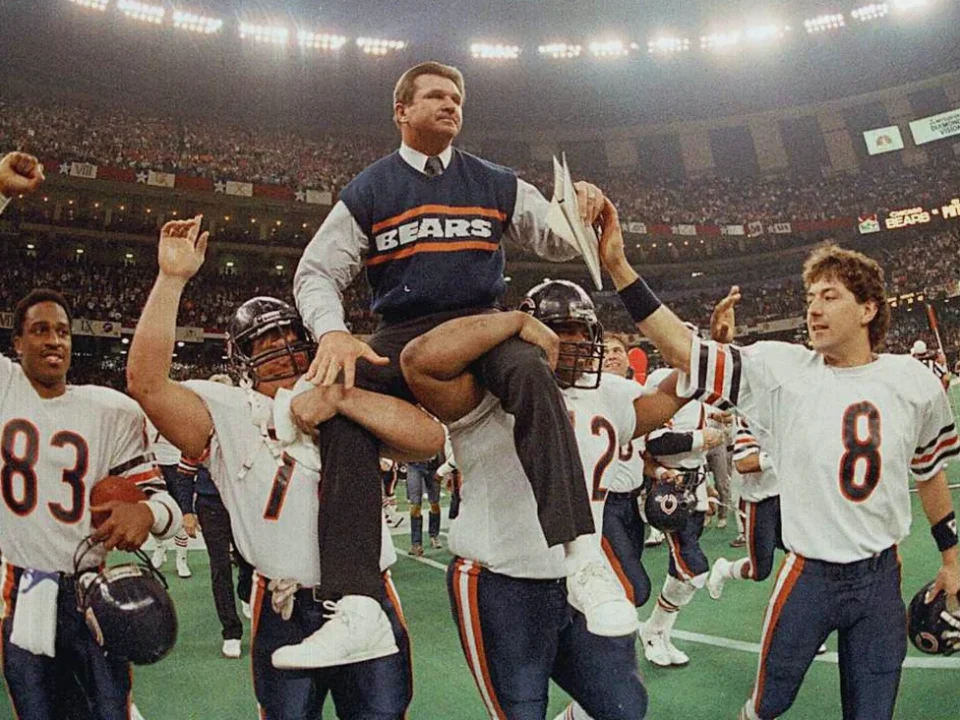
Chicago’s victory delivered the city’s first major professional sports championship in 22 years. Ditka and Ryan were carried from the field after the game, and the 1985 Bears became one of the NFL’s most celebrated teams.
Five division titles, then a difficult ending
The Bears captured the NFC Central in five consecutive seasons from 1984 through 1988. They lost in the divisional round in each of the two seasons following their Super Bowl victory, then returned to the NFC Championship Game after the 1988 season before falling again to San Francisco.
Ryan departed shortly after Super Bowl XX to become the Eagles’ head coach. Chicago’s celebrity grew, injuries repeatedly affected McMahon, and the Bears never returned to the Super Bowl under Ditka.
After a 5-11 campaign in 1992, Chicago fired Ditka. He described the dismissal as an experience unlike any he had faced and said he hoped never to endure another day like it.
Ditka coached the Bears from 1982 through 1992 and won Associated Press NFL Coach of the Year honors in 1985 and 1988. His overall head-coaching record was 121-95.
Following four seasons away from coaching, he returned to the sideline with New Orleans in 1997. The Saints went 15-33 over his three seasons. His time there was defined in part by the 1999 trade for Texas running back Ricky Williams, when New Orleans surrendered its remaining selections in that draft along with first- and third-round picks in 2000 to move up to No. 5 overall.
Williams’ injury-hit rookie year and a three-win Saints season ended Ditka’s coaching career. Ditka and Williams had also drawn national attention after posing as groom and bride, respectively, on the cover of ESPN The Magazine.
Football voice and Chicago symbol
Ditka never returned to coaching, but he remained a prominent NFL figure on television. After leaving Chicago, he worked for NBC, then joined CBS following his Saints dismissal. He later became a familiar ESPN personality on NFL Live, Sunday NFL Countdown and Monday Night Football.
His public profile also reached beyond football. He appeared as himself in television programs including Coach, According to Jim, Entourage and the final episode of Cheers. He also appeared in the film Kicking & Screaming with Will Ferrell and Robert Duvall.
In Chicago, his image became part of the city’s larger sports culture. The “Bill Swerski’s Superfans” sketches on Saturday Night Live elevated Ditka into a comic-book version of a local icon, placing “Da Coach” alongside Michael Jordan in the imagination of devoted Bears fans.
Ditka entered the Pro Football Hall of Fame in 1988 while still coaching Chicago. His legacy covered nearly every part of the league: star player, championship assistant, Super Bowl head coach, broadcaster and enduring symbol of Bears football.
After his dismissal from Chicago, Ditka reflected on the game that shaped his life. He described himself simply as a football player from Aliquippa who went on to Pitt, saying football had made his life extraordinary.