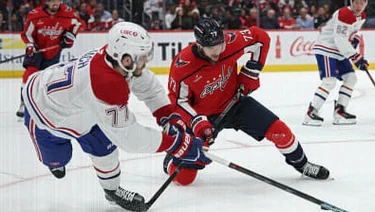
The New York Rangers will open the 2026-27 regular season on Sept. 29 carrying a clear early-season mandate: make Madison Square Garden a problem for visitors again. A 34-39-9 finish left them eighth in the Metropolitan Division and outside the Stanley Cup Playoffs, and the home-ice collapse was a major reason why.
Mike Sullivan enters his second season behind the bench with a reshaped roster and little time to sort it out. The NHL’s new 84-game schedule has shortened camp, while as many as seven offseason arrivals could be in the opening-night lineup.
Quick facts
- New York begins 2026-27 with 10 home games in its first 17 outings.
- The Rangers opened last season 0-6-1 at Madison Square Garden, including five shutout losses.
- Pavel Dorofeyev joins New York after scoring 37 regular-season goals and 12 playoff goals for Vegas.
- First-round pick Alberts Smits, 18, is getting a look beside Braden Schneider on the third pairing.
- Gabe Perreault closed his rookie season with 19 points over his final 23 games.
Home ice has to turn around
The Rangers won only six of their first 25 games at the Garden last season, going 6-15-4 and falling behind the playoff pace well before the stretch run. Their opening seven-game home skid was the worst such start in franchise history.
That makes the opening schedule especially important. New York will play 10 times at home over its first 17 games, and the club needs its new pieces settled quickly enough to avoid another early hole.
The incoming group includes forwards Dorofeyev, Oliver Bjorkstrand, Eeli Tolvanen and Joe Veleno, plus defensemen Sean Durzi, Marcus Pettersson and Smits. Chemistry, roles and special-teams assignments will be central camp work.
What a playoff push requires
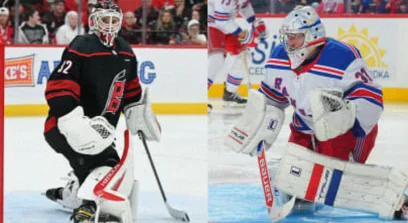
Igor Shesterkin needs to be in the Vezina Trophy conversation for the Rangers to climb back into the postseason field. Behind him, Joonas Korpisalo is projected as the backup.
On the blue line, Adam Fox and Vladislav Gavrikov remain the top pair, while Pettersson and Durzi are expected to handle a demanding second-pair workload. New York also needs Noah Laba to absorb difficult center minutes, including defensive-zone faceoffs and penalty-killing work previously handled by Vincent Trocheck.
Starting games with more urgency is another requirement. The Rangers were minus-11 in first-period goal differential last season, tied for 20th in the League, despite finishing only minus-14 overall. They trailed after 20 minutes 32 times and recovered for only five wins, posting a 5-22-5 record in those games; the League average was 26.5 games trailing after one period.
Dorofeyev is expected to supply a major share of the offense, while Perreault must continue the surge he showed late last year. A stronger first period, steadier home results and a high-end season from Shesterkin would give New York its clearest route back into the race.
Dorofeyev gets the scoring assignment
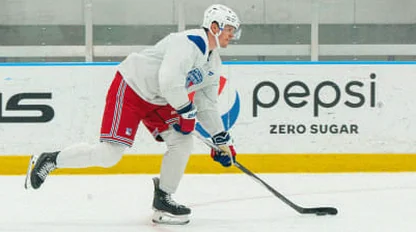
Dorofeyev arrives from the Vegas Golden Knights on a seven-year, $77 million contract carrying an $11 million annual cap hit. He is not the same type of creator Artemi Panarin was during most of his seven seasons in New York before his trade to the Los Angeles Kings last season, but the Rangers acquired Dorofeyev for his finishing.
The 37-goal regular season and 12-goal playoff run in Vegas underline that expectation. In camp, he has skated with J.T. Miller and Bjorkstrand, a group that could give Dorofeyev a distributor in Miller and more room to hunt pucks around the net.
New York could also place Dorofeyev in the right faceoff circle on the power play, opposite Mika Zibanejad on the left side. That alignment would give the Rangers legitimate shooting threats from both flanks.
Smits has a real opening
Smits was selected fifth overall in the 2026 NHL Draft less than three months ago, but the 18-year-old defenseman arrives with an unusually deep résumé. He represented Latvia at both the 2026 Winter Olympics and the IIHF World Championship, and spent last season in top professional leagues in Finland and Germany.
At 6-foot-3 and 205 pounds, Smits has the build to handle the NHL game. He has been paired with Schneider in early camp work and has stood out physically. If he does not make the Rangers immediately, Hartford of the American Hockey League appears to be the likely landing spot, keeping him close for a recall.
Young forwards in the picture
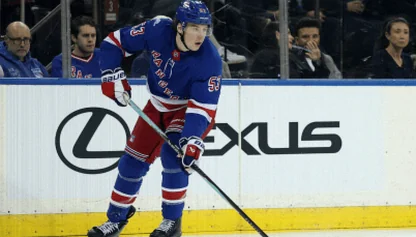
Perreault produced 27 points, including 12 goals and 15 assists, in 49 games as a rookie. Six of those points came on the power play, and his numbers rose sharply once he became a lineup regular beginning March 1.
Over his final 23 games, Perreault had 19 points and ranked fourth on the Rangers in scoring and shots on goal with 41. His nine goals ranked third on the club, while his seven even-strength goals and 15 even-strength points were tied for the team lead. He also ranked in the 93rd percentile among NHL forwards with two long-range goals.
The No. 23 selection in the 2023 draft could open beside Zibanejad and Alexis Lafreniere, giving him a chance to build on that finish. He entered draft season with an average fantasy draft position of 128.0.
Jaroslav Chmelar also pushed his way into the picture after a late recall from Hartford. He recorded four goals and two assists in 22 games, averaging 9:30 in a fourth-line role while bringing skating, puck strength and a physical edge.
Chmelar is penciled into a line with Veleno and Tye Kartye. That unit may not draw the marquee minutes, but it gives New York a chance to establish a more dependable bottom six from opening night.
Projected opening lineup
| Position | Projected unit |
|---|---|
| First line | Gabe Perreault — Mika Zibanejad — Alexis Lafreniere |
| Second line | Pavel Dorofeyev — J.T. Miller — Oliver Bjorkstrand |
| Third line | Will Cuylle — Noah Laba — Eeli Tolvanen |
| Fourth line | Tye Kartye — Joe Veleno — Jaroslav Chmelar |
| First defense pair | Vladislav Gavrikov — Adam Fox |
| Second defense pair | Marcus Pettersson — Sean Durzi |
| Third defense pair | Alberts Smits — Braden Schneider |
| Goaltenders | Igor Shesterkin; Joonas Korpisalo |