Milan’s Europa League meeting with Red Bull Salzburg brings together two clubs at very different points in their work with young players. Salzburg have spent years turning recruitment and development into a route towards elite football, even if their domestic dominance has faded after ten consecutive league titles. For Milan, whose Milan Futuro side was formed in 2024 and then dropped straight into the fourth tier, the Austrian model offers a sharp reminder that the passage from academy football to senior competition must be built patiently and consistently.
Key takeaways
- Red Bull Salzburg have gone three seasons without a league title after winning ten championships in succession.
- The club’s academy recruits locally at first, expands across Austria from Under-14 level, Europe from Under-16, and globally from Under-18.
- Salzburg’s development staff place intensity, forward play and immediate ball recovery after possession is lost at the centre of their identity.
- Liefering, Salzburg’s second team in Austria’s second division, is effectively an Under-19 group competing in a demanding senior league.
- Jannik Schuster progressed through Salzburg’s youth sides, Liefering and the first team before joining Brentford in May, where he became a Premier League starter from the third round.
- The academy director recalled Inter’s strong pursuit of Benjamin Sesko when the striker was 15 or 16, before he chose Salzburg.
Salzburg’s long-term method under greater pressure
For much of the past 15 years, Salzburg have been among football’s most productive development clubs. Erling Haaland spent only the 2019 calendar year with the first team before moving on, while Dayot Upamecano and Sadio Mané required roughly 18 to 24 months in the system. Benjamin Sesko and Dominik Szoboszlai stayed longer, but each also emerged as part of the club’s established pathway towards a higher level.
The current cycle is less dominant. Salzburg are now looking back towards the academy that produced players such as Konrad Laimer, Xaver Schlager and Luka Sucic as they attempt to reclaim the Austrian title. Their sporting centre sits close to the German border, but the scouting network reaches far beyond that region.
Manfred Pamminger, who oversees the academy, said the defining trait sought in a player is intensity. Salzburg want footballers willing to be brave, attack with purpose and accept risk. Regaining the ball quickly after losing it remains one of the principles the club expects its teams to carry through the age groups.
Recruitment and player improvement are the two pillars of the structure. Salzburg begin by identifying the strongest prospects in their immediate area, widen the search nationwide from Under-14, move into the European market at Under-16 and work worldwide from Under-18. Once a player is in the building, the club aim to provide a stable footballing framework rather than changing direction with every coach.
Pamminger’s view is that many clubs allow the preferences of individual managers to reshape the playing style from season to season. Salzburg instead decide first what their teams should look like, then recruit and train players suited to that idea. The academy believes its facilities remain strong and sees the present period not as a slowdown, but as an effort to rediscover the recruitment edge that fuelled its earlier success.
That task has become harder. A decade or more ago, only a small group of European clubs moved quickly and professionally in youth scouting. Now the competition is far broader, particularly in West Africa. Salzburg have previously found success in countries including Nigeria, Senegal, Ghana, Mali and Ivory Coast, but Premier League sides are increasingly active in the same markets. Post-Brexit regulations mean that players from Mali or Nigeria can be acquired at the same age as German or Austrian prospects, increasing the pressure on clubs hoping to arrive first.
Technology forms part of the process. Salzburg collect extensive data down to Under-15 and Under-14 level, a depth of information that is not common across academy football. The challenge, Pamminger said, is making sense of those figures without burdening young players with too much statistical detail.
The club also uses SoccerBot360, a virtual training and diagnostic system in which six projectors create a full-circle environment. A player may be asked to identify and strike six targets within a set time. The assessment considers technical execution and decision-making, as well as cognitive areas including orientation and anticipation. Salzburg also believe it can indicate how a player responds to frustration and how well he understands the game. A trialist can impress on the training pitch yet still be rejected after a poor result in the test.
Why the route through senior football matters
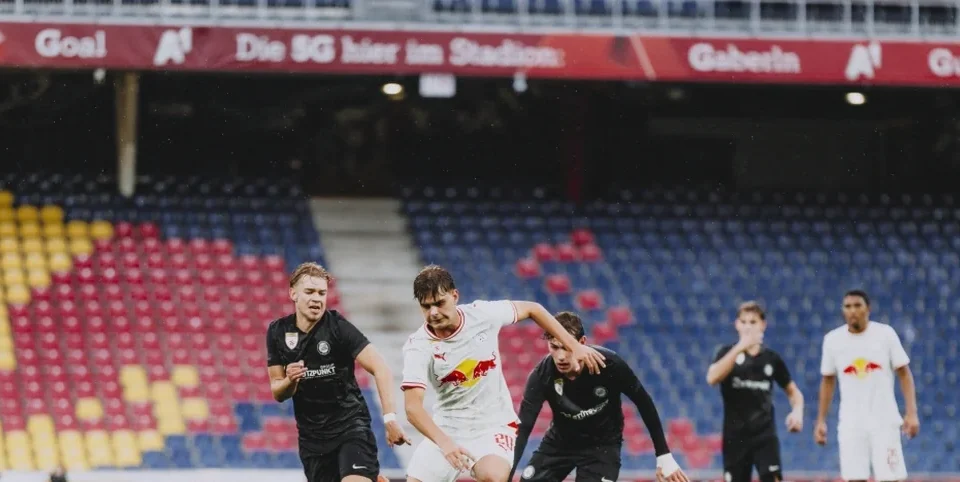
The bridge between youth football and the first team is Liefering, Salzburg’s second side in Austria’s second division. Pamminger described it as the youngest B team in Europe: in practical terms, it resembles an Under-19 squad playing against adults. Austria’s second tier may not be defined by elite technical quality, but its physical demands make it a difficult environment for teenagers.
Schuster’s rise illustrates the intended route. Born in 2006, he is the son of a successful ski jumper who also coached Germany’s national ski-jumping team. Schuster began his football education as a striker before developing into a central defender. After appearing for Salzburg’s youth teams, Liefering and the senior side, he moved to Brentford in May. By the third Premier League matchday, he was already a regular starter.
The comparison with Italy carries particular relevance for Milan. Milan Futuro was created in 2024, but the team was relegated to the fourth division in its first season. Pamminger said he had long been struck by the distance separating Primavera football from the senior game in Italy, arguing that the gap is too large without a second-team structure.
He also questioned Italy’s matchday squads of 26 players, with 15 substitutes available despite only five being permitted to enter the match. Salzburg’s preference is for young footballers to play for Liefering at the weekend rather than remain unused on a first-team bench. Minutes in a serious competitive setting, he argued, are essential to development.
The same club-first thinking applies to coaches. Salzburg look for young, motivated staff who are prepared to learn and work within the established style. Former internationals may begin with Under-12 or Under-14 teams rather than being placed immediately with older players. The club believe coaching must be learned from the lower age groups upwards, and that the club should set the footballing direction rather than leave it to each individual manager.
That does not mean academy coaching is a dead end. Marco Rose and Matthias Jaissle both began their coaching journeys within Salzburg’s system. The message for Milan on a European night is not simply about producing talent, but about creating a coherent route for it: recruitment, coaching, data, senior minutes and a club identity working towards the same destination.