Seattle’s route back into the playoff race starts with finding offense without losing the hard-checking identity that has kept it competitive on many nights. The Kraken open the 2026-27 regular season on Sept. 29 after a 34-37-11 finish left them sixth in the Pacific Division and outside the Stanley Cup Playoffs.
Key takeaways
- Bobby McMann scored 10 goals in 18 games after arriving from Toronto and signed a six-year, $34.5 million extension.
- Mackie Samoskevich joins Seattle after a June trade with Florida and is in line for a larger offensive assignment.
- Shane Wright enters the final year of his entry-level deal looking to rebound from a 27-point season.
- Joey Daccord and Philipp Grubauer will again carry the crease behind an experienced blue line.
- Seattle must improve a penalty kill that ranked 31st and a power play that finished 20th last season.
Scoring depth is the central issue
Lane Lambert enters his second season behind the Seattle bench with a roster that needs more finish. The Kraken produced 2.73 goals per game in 2025-26, ranking 28th in the NHL, and captain Jordan Eberle was the club’s leading scorer with 26 goals and 55 points in 80 games.
Eberle, now 36, remains a key part of the attack, but Seattle needs more from its younger forwards. Matty Beniers, 23, Ryan Winterton, 23, and Kaapo Kakko, 25, are all expected to add to the scoring load. Wright, 22, may be the biggest swing player in that group.
The fourth pick of the 2022 NHL Draft recorded 12 goals and 27 points in 74 games last season, a step back from the 19-goal, 44-point campaign he posted over 79 games in 2024-25. Seattle has given Wright time, first sending him back to junior and later allowing him to develop in the American Hockey League. Now, with his three-year entry-level contract reaching its final season, the center needs to establish himself.
Wright’s junior résumé shows the upside Seattle is still chasing. He finished his final full Ontario Hockey League season with Kingston in 2021-22 with 32 goals and 94 points in 63 games.
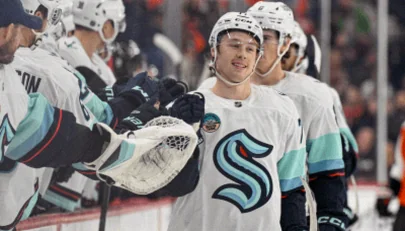
McMann offered an immediate answer after Seattle acquired him from the Maple Leafs on March 6. The 30-year-old supplied 10 goals and four assists in his first 18 Kraken games, then committed to the club on June 21 with a six-year contract carrying a $5.75 million annual cap hit.
His post-trade production led Seattle in goals per game at 0.56, points per game at 0.78 and shots per game at 3.22. McMann put 58 shots on net and delivered 30 hits during that 18-game stretch. His 24.25 mph top skating speed ranked seventh in the League, while his 267 bursts above 20 mph placed him in the 98th percentile. He also finished among the stronger forwards in high-danger goals, with 15, and mid-range goals, with nine.
McMann reached a career-best 29 goals last season and has a previous NHL high of 46 points. His average fantasy draft position sits at 132.2, but Seattle will be more concerned with whether his late-season surge becomes a full-year scoring presence.
Samoskevich is another major piece of that solution. Seattle paid a 2026 first-round selection and a conditional 2027 second-round pick to acquire the 23-year-old from Florida on June 21. He won the Stanley Cup with the Panthers in 2024-25, when he had 15 goals and 31 points in 72 games, then followed with 12 goals and 32 points across 77 games last season.
After spending much of his Florida tenure in bottom-six usage, Samoskevich should get a wider opening in Seattle. He signed a three-year, $11.55 million deal on July 1, worth $3.85 million annually.
Berkly Catton could also push into a more prominent role. The 20-year-old had seven goals and 17 points in 66 games as a rookie, but his track record includes a 38-goal, 109-point season in 57 games for Spokane in the WHL in 2024-25. Seattle selected Catton eighth overall in the 2024 draft, and added ice time could put him in the top-six conversation.
Defense, goaltending and special teams will set the floor
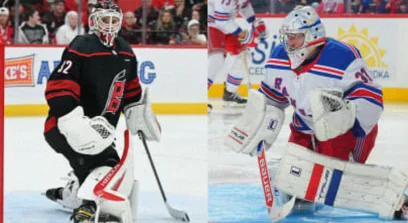
Seattle allowed 3.13 goals per game last season, 23rd in the League, so the club cannot simply try to trade chances with Pacific Division opponents. Daccord and Grubauer form the goaltending tandem, while the blue line has veteran anchors in Vince Dunn, Adam Larsson, Brandon Montour and Ryan Lindgren.
The Kraken’s playoff hopes will depend on tightening their own-zone work and getting dependable nights from the crease. Those improvements also need to carry into special teams. Seattle’s penalty kill operated at 72.2 percent, second from the bottom at 31st in the NHL, while its power play converted at 19.5 percent, ranking 20th.
Projected Seattle lineup
Seattle’s expected forward and defense groups put the new scoring additions alongside familiar core pieces:
| Unit | Projected players |
|---|---|
| First line | Bobby McMann — Matty Beniers — Jordan Eberle |
| Second line | Jared McCann — Shane Wright — Kaapo Kakko |
| Third line | Mackie Samoskevich — Chandler Stephenson — Berkly Catton |
| Fourth line | Ryan Winterton — Frederick Gaudreau — Jacob Melanson |
| Defense pair | Vince Dunn — Adam Larsson |
| Defense pair | Ryker Evans — Brandon Montour |
| Defense pair | Ryan Lindgren — Cale Fleury |
| Goaltenders | Joey Daccord; Philipp Grubauer |