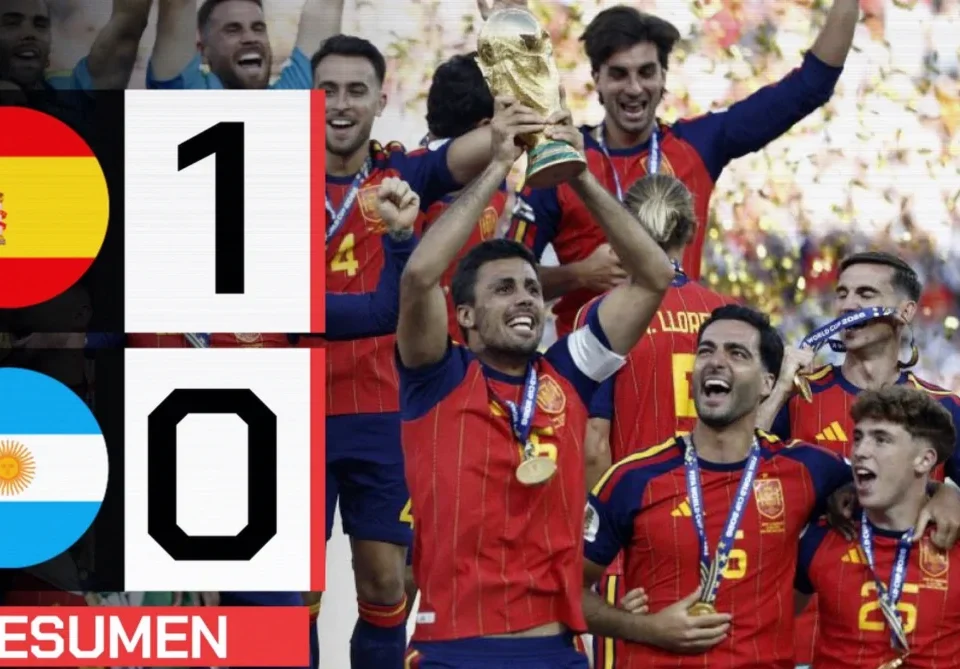
Spain completed their World Cup campaign with a second star after defeating Argentina in extra time in New Jersey, where Ferran Torres struck in the 106th minute to settle a final defined by Spanish control, Argentine resistance and a tense closing siege.
SEO Title: Spain win second World Cup after Ferran Torres extra-time goal against Argentina
SEO Description: Spain beat Argentina in the World Cup final in New Jersey, with Ferran Torres scoring in the 106th minute after Enzo Fernández was sent off.
Spain 1-0 Argentina: World Cup final in New Jersey
- Spain began the final with the greater share of possession and built their attacks around Rodri’s distribution and Dani Olmo’s movement between the lines.
- Olmo created an early opening for Lamine Yamal, but the youngster’s finish was comfortably held by Emiliano Martínez.
- Argentina reached half-time without testing Unai Simón. Julián Álvarez was isolated in attack, while Lisandro Martínez was forced off injured and replaced by Nicolás Otamendi.
- The match grew increasingly physical. Mac Allister caught Olmo, Tagliafico was involved in a challenge on Yamal, and Leandro Paredes quickly became involved in a confrontation after coming on.
- Spain continued to push in the second half, with Ferran Torres, Yamal and Pau Cubarsí all going close against Martínez.
- Argentina were reduced to 10 men before extra time when Enzo Fernández received a second yellow card.
- With Spain camped around the Argentine penalty area, Nico Williams supplied Torres in the 106th minute. The forward’s finish delivered the decisive goal.
- Argentina finally committed numbers forward after falling behind, sending high balls toward the Spanish box, but Unai Simón and Spain’s defence protected the lead.
A final won through control and patience
The dry surface and the caution usually associated with a World Cup final limited clear chances for long stretches. A hydration break did little to change the rhythm: Spain retained the ball, while Argentina stayed compact and waited for an opportunity to break.
Rodri again set Spain’s tempo, while Olmo gave the side a route into dangerous areas. Yamal had been one of the pre-final focal points, but Spain’s performance was collective rather than dependent on one player. Cubarsí, still remarkably young for this stage, handled the demands of a final alongside Messi and Álvarez without a visible mistake.
Argentina’s approach became more combative as the game went on. Lionel Messi remained largely on the margins while Spain pressed higher and higher, and Martínez repeatedly kept the holders in the contest before Fernández’s dismissal altered the balance further.
The second star
Torres’ extra-time finish, created by Williams, gave Spain the breakthrough their territorial dominance had been seeking. The goal came with Argentina already a man down and turned the closing minutes into an anxious test rather than a celebration.
Spain survived that late pressure to finish the tournament as world champions. Luis de la Fuente’s team leave New Jersey with the country’s second World Cup title, earned through a composed final performance in which Argentina did not register a shot until they were chasing the game.