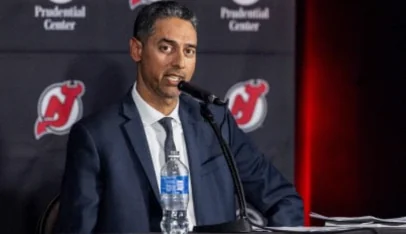
Sunny Mehta did not return home to New Jersey with a modest target. The first-year Devils general manager knows a postseason berth or a climb from last season’s seventh-place finish in the Metropolitan Division would count as progress, but the standard he carries from Florida is the Stanley Cup.
“If we do better than last year, that is a success,” Mehta said. “But if we do not win the Stanley Cup, I will probably be disappointed regardless.”
It is an emotional benchmark, Mehta readily admits, and one he calls irrational. Still, it fits a New Jersey native who grew up in Totowa, played at Ramapo High School and watched the Devils win all three of their championships. After helping the Florida Panthers capture consecutive Cups in 2024 and 2025, he is back with the organization where he previously spent four seasons as director of hockey analytics.
New Jersey has missed the playoffs in 11 of the past 14 seasons. Mehta sees a return to the tournament and the development of year-to-year consistency as meaningful steps, but he has no interest in disguising the club’s ultimate ambition.
Depth is the central roster project
Mehta believes the Devils’ biggest upgrade is not merely a stronger fourth line. He sees a forward group built to keep pressure on opponents after Jack Hughes and Nico Hischier leave the ice.
Last season, New Jersey was at its best with either of its top centers on the rink and fell off too sharply without them. The front office’s response was to seek players capable of handling larger roles, rather than simply stocking the bottom of the roster with replacement-level depth.
Mehta pointed to the conversation he had with Connor Brown about rookie forward Amadeus Lombardi. In Mehta’s view, the Devils do not have a traditional fourth line this season; the club can roll two units with first-line ability and two more that resemble second lines elsewhere in the League.
The additions of Lombardi, Declan Chisholm, Luke Evangelista and Anthony Mantha are part of that approach. Mehta compared the process, not the expected style of play, to Florida’s work in assembling complementary pieces around its established core. The Panthers added key contributors including Sam Reinhart, Sam Bennett, Gustav Forsling and Carter Verhaeghe while already featuring Aleksander Barkov, Jonathan Huberdeau, Aaron Ekblad and Sergei Bobrovsky.
New Jersey starts with Hughes, Hischier and Jesper Bratt. The task is finding enough value around them while managing the salary cap and identifying contracts that allow the roster to stay complete.
A fast Devils identity, at both ends
Mehta does not subscribe to the notion that every championship team must play the same way. Florida’s identity suited its roster and coaching staff, he said, while the Tampa Bay Lightning, Chicago Blackhawks and Los Angeles Kings reached the top using distinctly different methods.
For this Devils group, he expects speed, skill and hockey sense to be the foundation. That applies without the puck as much as it does in transition or the offensive zone.
He cited a Sept. 18 scrimmage sequence from Luke Hughes, who used his skating through the neutral zone to erase a play before gaining possession. Mehta wants New Jersey’s pace to show up in closing gaps, disrupting breakouts and recovering pucks, not just in generating scoring chances.
That philosophy also informs the plan around the club’s young talent. Lombardi has yet to play an NHL game, but Mehta said coach Sheldon Keefe understands that a contender sometimes needs to give developing players a chance to reveal their upside.
At the same time, the general manager stressed that a lineup cannot be overloaded with inexperienced players. Young skaters need veteran NHL support and favorable situations; otherwise, team losses and poor habits can become part of their development. Mehta believes New Jersey has enough established talent to provide that insulation while still making room for prospects.
Keefe and Mehta have aligned quickly
Mehta arrived without a prior working relationship with Keefe, but he said their early months together have been smooth. Their conversations have covered the team’s strengths, its weaknesses and the kinds of players Mehta wanted added.
Keefe’s tactical understanding stands out to Mehta, as does the coach’s ability to consider longer-term roster questions alongside the immediate need to win games. Mehta said there was no major resistance when he laid out the front office plan, and he has found Keefe’s explanations of systems and bench decisions equally clear.
The relationship remains new, with much of their work occurring during the summer, but Mehta said the two have consistently viewed key issues in similar ways.
Less reliance on Hughes, a new crease plan
The Devils did not pursue better depth solely because of Jack Hughes’ health history. Mehta said the underlying concern was evident even in games Hughes played: New Jersey needed to remain dangerous and reliable during the shifts when Hughes and Hischier were off the ice.
Depth can soften the impact of injuries, but Mehta noted that every club declines when elite players are unavailable. His priority is building a team that is excellent when healthy rather than trying to solve the unpredictable nature of injuries altogether.
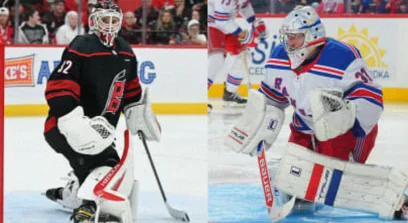
That same resource-allocation thinking shaped the goaltending decision. New Jersey traded Jacob Markstrom to the Panthers on July 2, opening a different path in net with Jake Allen and Nico Daws.
Mehta said Markstrom’s departure was not a judgment that the veteran cannot rebound. He believes Markstrom can help Florida win. The trade, instead, reflected differing organizational circumstances and gave the Devils flexibility to spend elsewhere.
Allen, Mehta said, is a quality goaltender and professional on a favorable contract. Daws now has an opening to establish what he can provide at the NHL level.
Save percentage and wins will remain obvious measures for the position, but Mehta views goaltending through the salary-cap lens as well. With performance at the position often volatile and difficult to forecast, he is wary of committing major assets to the crease when those resources can be used in areas he believes are more predictable.
A familiar jersey, and a familiar face in the front office
For Mehta, the job has also brought a daily reminder of the Devils teams he watched growing up. Martin Brodeur, the Hall of Fame goalie and now the club’s executive vice president of hockey operations, is part of the front office.
Mehta called the experience surreal at first, given Brodeur’s stature in franchise history, but said the transition into working together has been easy. He described Brodeur as approachable, humble and straightforward to collaborate with despite everything he achieved as a player.
The homecoming comes with sentiment, but Mehta’s blueprint is practical: use speed throughout the lineup, keep building around Hughes, Hischier and Bratt, protect young players with established help, and make the Devils difficult to handle for all 60 minutes. The measuring stick, however, remains the one that followed him back from Florida.