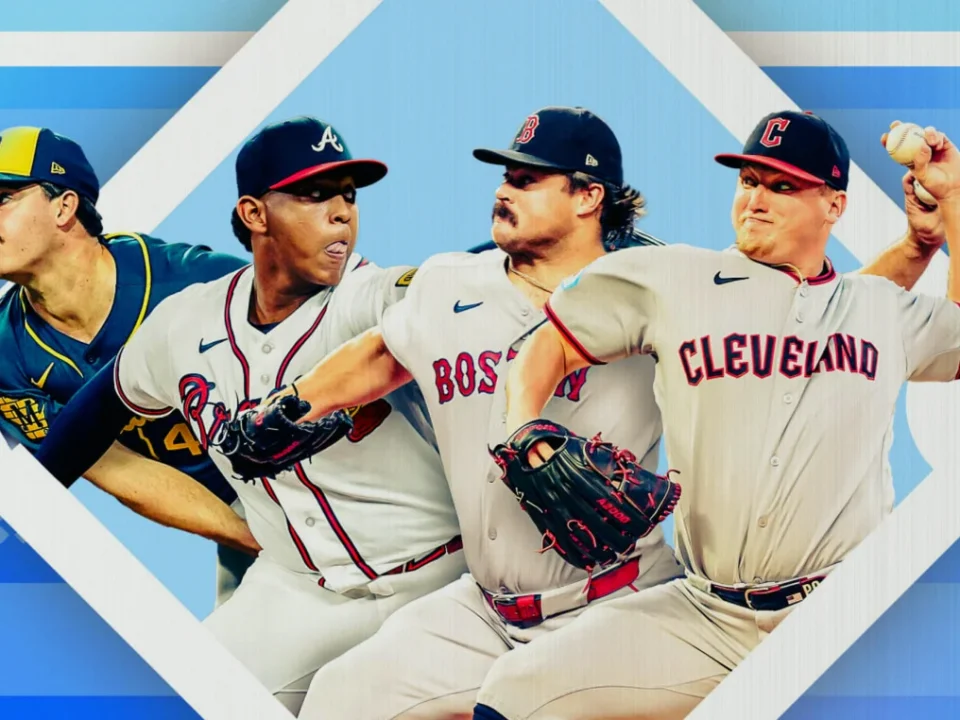
Rookies have never needed much invitation to step into October. Last fall, Trey Yesavage struck out 12 Dodgers in Game 5 of the World Series, setting a rookie record in the Fall Classic as Toronto rode his first full big-league season deep into the postseason. This October brings another wave of young players with the chance to leave a similar mark.
Recent October reminders
- Yesavage gave the Blue Jays a signature World Series performance last year, punching out a dozen Los Angeles hitters in Game 5.
- Yankees right-hander Cam Schlittler made postseason history against Boston in the AL Wild Card Series, becoming the first pitcher to work at least eight scoreless innings with 12 or more strikeouts and no walks.
- Milwaukee reliever Jacob Misiorowski fanned 16 of the 46 hitters he faced in the playoffs, a 34.8 percent strikeout clip. Schlittler and Misiorowski now enter this season as Cy Young Award favorites.
- On the position-player side, the 2023 World Series run featured meaningful rookie contributions from Texas teammates Evan Carter and Jace Jung, along with Arizona’s Corbin Carroll.
This year’s field has its own set of first-year players ready for the October spotlight. Some are being asked to start games, some to protect late leads, and some to provide the one swing that changes a series.
The 10 rookies who could shape the postseason
-
Parker Messick, LHP, Guardians
Messick is not merely Cleveland’s best rookie option; he has pitched like one of the game’s best starters. His 4.9 fWAR ranked ninth among Major League pitchers, while his 6.3 bWAR placed fifth. Over 186 1/3 innings, the left-hander posted a 2.56 ERA, a 1.06 WHIP and 193 strikeouts.
The 6-foot southpaw keeps barrels off the ball with command and a six-pitch arsenal. Right-handed hitters managed a .599 OPS against him, while lefties had a .689 mark. Gavin Williams remains part of the Guardians’ Game 1 discussion, but Messick has the look of the club’s present-day ace and a major piece of its future.
-
Payton Tolle, LHP, Red Sox
Boston has handed its Wild Card Series opener against the Yankees to Tolle, a clear sign of how quickly the rookie lefty has earned trust. He finished with a 3.03 ERA and 171 strikeouts in 148 2/3 innings, third among rookies in punchouts.
Tolle has become a favorite around New England, and his 7.4-foot extension makes his arsenal play even bigger. He leans on a 95-97 mph four-seamer, a 94-96 mph sinker and an 87-90 mph cutter. The Yankees will see plenty of uncomfortable pitches from the left side in Game 1.
-
Logan Henderson, RHP, Brewers
Milwaukee won 103 games and still may give a rookie the ball as its No. 2 starter. Henderson has given the Brewers every reason to make that choice. Among pitchers with at least 90 innings, his 0.84 WHIP was second best in the majors, his 2.47 ERA ranked fifth and his 24.5 percent K-BB rate stood sixth.
His fastball does more than its average velocity might suggest because of its flat approach into the zone. A low-80s changeup with sharp arm-side movement and strong separation from the heater gives him another dependable finishing pitch.
-
Didier Fuentes, RHP, Braves
Fuentes is only 21 and could still return to a starting role down the road, but Atlanta has found a high-leverage reliever and has no reason to disturb that arrangement. The 6-foot right-hander used his 96-99 mph four-seamer 69 percent of the time and struck out 31.0 percent of opposing hitters.
That strikeout rate ranked 10th among 213 pitchers with at least 70 innings, sitting near Schlittler’s 31.4 percent and teammate Chris Sale’s 30.9 percent. Fuentes gets quality extension toward the plate, then mixes a mid-80s slider and an 88-90 mph splitter reserved for left-handed hitters.
-
Chase DeLauter, OF, Guardians
Health was the question around DeLauter throughout his climb through the minors. This season supplied a convincing answer: 133 games and 559 plate appearances. He hit .287/.363/.457 with 16 home runs and 11 stolen bases, and his 131 wRC+ led Cleveland, ahead of Steven Kwan’s 114 and Travis Bazzana’s 110.
DeLauter has split time between right field and designated hitter, and October will not be entirely new territory for him. He made his Major League debut during last season’s Wild Card Series.
-
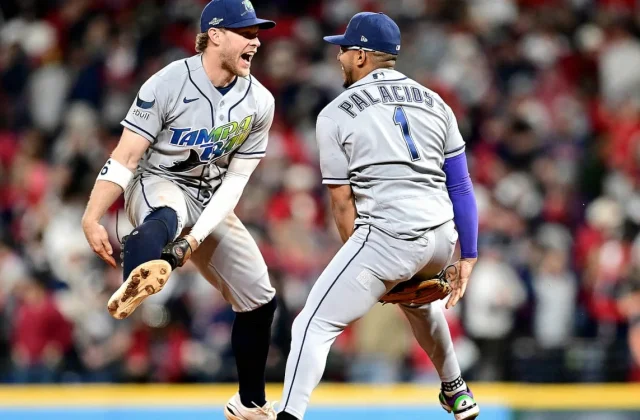
Brody Hopkins, RHP, Rays
Hopkins issued 92 walks in 94 Triple-A innings, a total that made a rookie starting job unrealistic. Tampa Bay shifted him to relief, where his premium stuff can take over in shorter bursts.
He produced the Rays’ 43 fastest pitches of the season and reached 101.8 mph. His curveball averaged 87.1 mph, six mph faster than the typical Major League curve, and he also owns a cutter in the mid-90s. If he commands the strike zone, Hopkins could become Tampa Bay’s version of the David Price who helped the club in 2008.
-
Bradgley Rodriguez, RHP, Padres
San Diego has plenty of star power, but its bullpen may be the club’s strongest October card. Rodriguez has been an important part of that group, appearing in 68 games, second most on the roster, while recording a 2.19 ERA and 81 strikeouts.
The 22-year-old can bring a 97-99 mph four-seamer and sinker, but the changeup is his separator. At 88-91 mph, it held hitters to a .132 average and generated a 39.9 percent whiff rate.
-
George Lombard Jr., SS, Yankees
Lombard’s first Major League stretch has included uneven moments at the plate and in the field, but he finished the regular season moving in the right direction. In his final 10 games, he went 12-for-42, a .286 average, with four homers. He had hit only three home runs across his first 32 big-league games.
There have been occasional mistakes at shortstop, though his hands, actions and arm still point to an infielder capable of making an October-saving play. With Aaron Judge sidelined for the Wild Card Series against Boston, New York needs contributions from throughout its lineup.
-
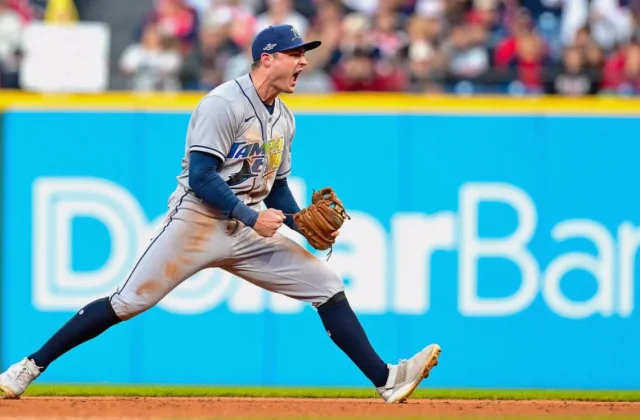
Victor Mesa Jr., OF, Rays
Tampa Bay acquired Mesa from Miami in February in a transaction that did not draw much attention. Seven months later, the 25-year-old is positioned to start in a corner-outfield spot during the playoff run.
His defense has been a major asset, particularly an arm that ranks in the 94th percentile. He also provided useful left-handed offense, posting a .498 slugging percentage. Among Rays with at least 250 plate appearances, only MVP candidate Junior Caminero, at .524, finished higher.
-
Spencer Jones, OF, Yankees
Judge’s absence puts added pressure on the Yankees to find power elsewhere, and Jones has the raw impact to supply it despite the swing-and-miss concerns. His average exit velocity was 94.1 mph, narrowly above Judge’s 94.0 mph, while his 55.1 percent hard-hit rate trailed only Judge’s 57.5 percent among Yankees with at least 150 batted-ball events.
Jones completed the regular season at .245/.313/.429 with 11 homers in 86 games. His center-field defense will matter, too, if New York is to make a serious push for its first championship since 2009.
A rookie-heavy October stage
Every postseason asks young players to handle assignments that can feel larger than a regular-season night in June or July. Tolle has the Game 1 responsibility in Boston. Messick and Henderson could anchor division contenders from the rotation. Fuentes, Rodriguez and Hopkins may be called upon with the tying run on base. For Jones, Lombard, Mesa and DeLauter, one clean at-bat or one play in the field could become the memory that lasts.
That is the October bargain for a rookie: the stage arrives before anyone can be sure he is ready. History says a few of them usually are.