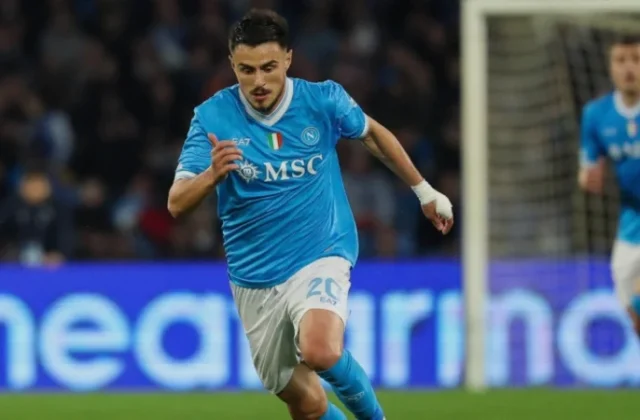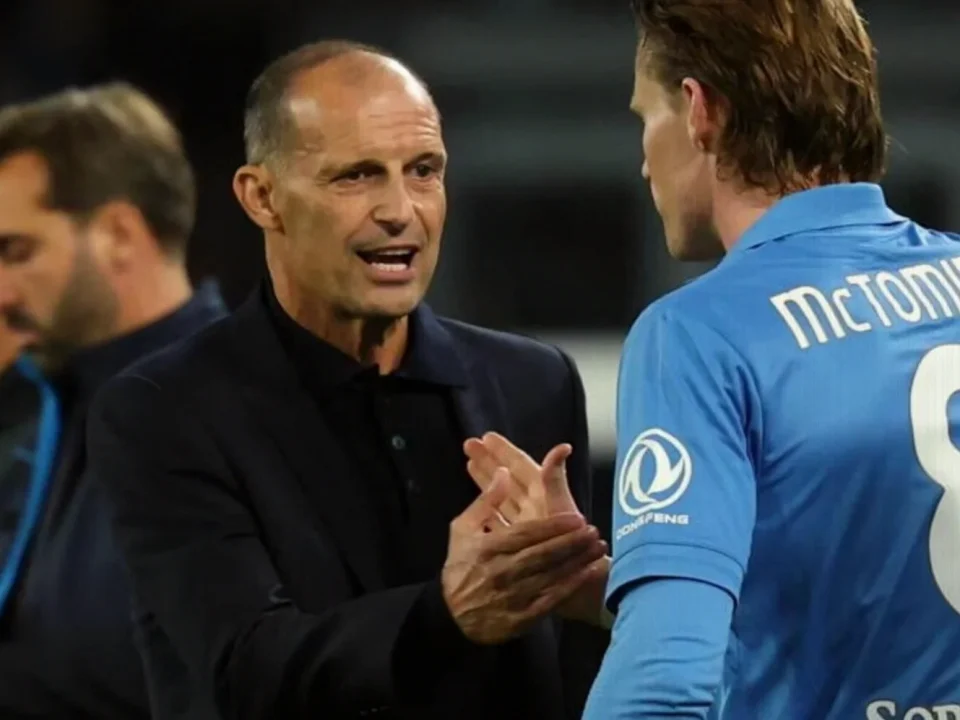
Naples woke to a different image of Massimiliano Allegri after the meeting with Frosinone at the Maradona: not the coach waiting behind his defensive line, but one willing to push his side forward and make the opposition react.
The result was a reminder that Allegri’s reputation has often been reduced to one idea. His most celebrated Juventus years were built on control, resilience and a back line associated with Andrea Barzagli, Leonardo Bonucci and Giorgio Chiellini, but his coaching has never been limited to protecting a narrow advantage.
Quick facts
- Napoli faced Frosinone at the Maradona Stadium.
- Massimiliano Allegri set Napoli up with an aggressive approach.
- Neres, Hojlund and Lang formed the attacking trio highlighted on the night.
- The approach moved Napoli between deeper defensive phases and sustained pressure higher up the pitch.
- The display challenged the familiar view of Allegri as a coach concerned only with defensive football.
Against Frosinone, Napoli did not merely defend their way through the contest. Allegri sent out an attacking front three of Neres, Hojlund and Lang, asking his team to take territory and force the game into the opponent’s half.
It was a choice that caught an opponent prepared for caution. Napoli could still retreat when required, but their response was not to remain in a low block; they sought to recover the ball and turn defence into pressure further forward.
That is the element often lost in discussions of Allegri. He is a pragmatic coach rather than an ideologue, more concerned with the demands of a match than with proving loyalty to one permanent system.
His simplicity has regularly been mistaken for a lack of imagination. Yet the capacity to identify the moment, adjust the team and choose the useful solution has been central to his work across a career marked by major trophies.
The Frosinone night therefore belongs in Napoli’s longer season as more than an isolated tactical surprise. In a period requiring solutions, Allegri showed that his version of management can include attack, initiative and risk when the occasion calls for them.
He does not need to present himself as football’s great theorist. His case rests on reading games clearly, organising his players accordingly and finding a route to victory — even when that route asks Napoli to play on the front foot.