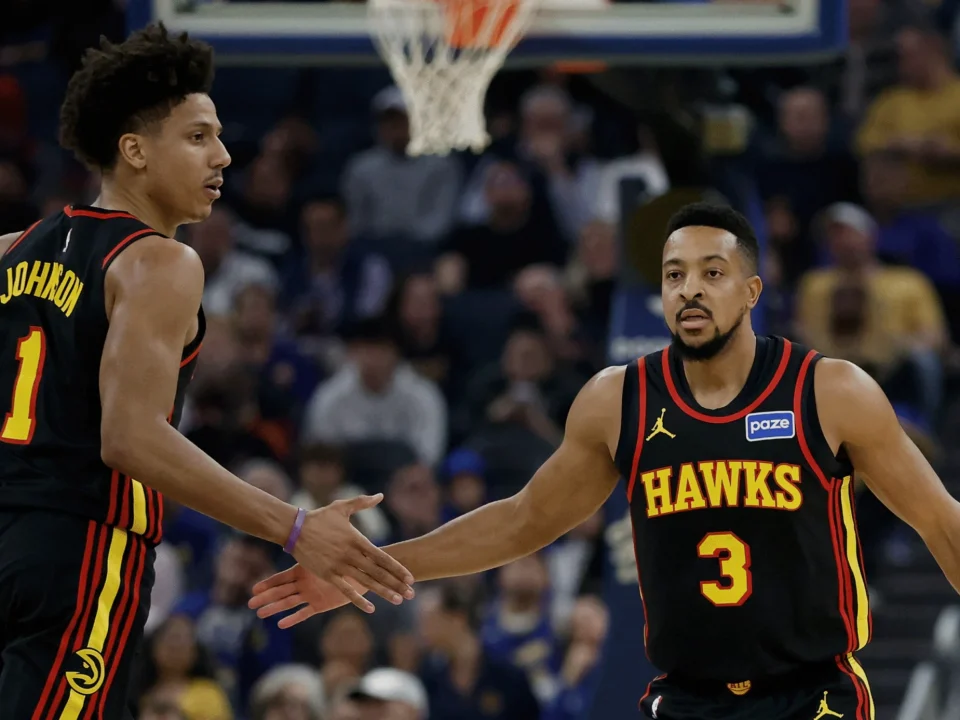
Atlanta enters the new season with a roster built to make the floor crowded on the defensive end and wide open on the other. Quin Snyder has perimeter stoppers in Dyson Daniels, Nickeil Alexander-Walker and newcomer Luguentz Dort, a pair of proven scoring guards in Alexander-Walker and CJ McCollum, and an All-NBA centerpiece in Jalen Johnson. The immediate question is not whether the Hawks have enough playable bodies. It is how Snyder stacks them.
The Hawks finished 46-36 last season, good for sixth in the East, before their first-round exit. They held both a 1-0 edge and a 2-1 advantage over the Knicks, only to see New York take the final three games and continue all the way to the championship. Atlanta’s two postseason wins over the Knicks were more than the other three opponents New York faced on its title run combined.
Atlanta’s late-season surge helped shape the optimism around this group. After sitting at minus-1.3 points per 100 possessions before the All-Star break, 19th in the league, the Hawks jumped to plus-9.7 after the break, fourth overall. The 11.0-point swing was the NBA’s largest second-half improvement in 27 years. The schedule was not unforgiving — only eight of Atlanta’s 20 post-break victories came against teams that ended above .500 — but the club carried that form into a far tougher playoff matchup.
The McCollum trade changed Atlanta’s present tense. The deal for Trae Young did not bring back young players or future draft capital, but McCollum helped the Hawks go 27-14 when he played. Over the final two months, Atlanta climbed from ninth to sixth in the conference. The veteran point guard averaged 18.7 points, giving the Hawks another reliable late-clock option alongside Johnson and Alexander-Walker.
A crowded rotation around Johnson
Johnson is the roster’s biggest constant after making his first All-Star team and landing on an All-NBA squad last year. He posted 22.5 points, 10.3 rebounds, 7.9 assists and 1.2 steals per night, carrying more playmaking responsibility while still functioning as Atlanta’s lead forward. Onyeka Okongwu, who recorded 15.2 points, 7.6 rebounds and 3.1 assists per game, gives that group a mobile starting center possibility.
The five-man unit of McCollum, Alexander-Walker, Daniels, Johnson and Okongwu has a compelling case to open games. It went 20-10 and produced a plus-20.3 net rating last season. But that lineup did not include Dort or Aaron Wiggins, two offseason additions who could force Snyder to revisit the balance between offensive spacing, point-of-attack defense and bench scoring.
Alexander-Walker’s breakout gives the Hawks another reason to lean into that decision. He won Most Improved Player after averaging 20.8 points, 3.7 assists and 3.4 rebounds while shooting 45.9% from the field, 39.9% from deep and 90.2% at the foul line. With Daniels and Dort available to handle difficult defensive assignments, Atlanta can create different looks without asking Alexander-Walker to fill every job on the wing.
Wiggins may be the player with the clearest runway for a bigger statistical jump. He arrives after contributing to Oklahoma City’s 2025 championship team and its 2026 run to the Western Conference finals, though his Thunder role never rose beyond 24.2 minutes per game, a mark set during his 2021-22 rookie season. He has reached double-figure scoring just once, at 12.0 points in 2024-25, but owns career shooting marks of 48.7% overall and 38% from three. Atlanta already shot the ball well from distance last season; Wiggins could help turn that volume into more efficient offense if his minutes rise.
Dort, Wiggins, Jock Landale, Buddy Hield, Corey Kispert, Ryan Nembhard, Henri Veesaar, rookie guard Kingston Flemings, rookie big Zuby Ejiofor and Asa Newell give Snyder a deep bench to sort through. The coach’s preference is clear: generate turnovers, turn those possessions into transition chances, and get up close to 40 three-point attempts per game. Atlanta was 14th in offensive efficiency and 10th on defense last season, leaving room for growth at both ends despite the 46-win finish.
Preseason should reveal the first answers. Flemings, the lottery selection, will be worth tracking as he learns behind McCollum. The reserve power-forward minutes behind Johnson are also open, with Mouhamed Gueye, Newell and Ejiofor competing for a place in the regular rotation. Snyder must determine not only his starting five, but which players are best equipped to enter from the bench without disrupting the defensive identity.
Dates that will test the Hawks
Atlanta opens its regular-season slate against Orlando on Oct. 21, a Southeast Division measuring-stick game between the teams that finished first and second in the division last year. The top four Southeast clubs were separated by only three games, and several teams in the division view themselves as playoff-caliber.
The Knicks visit on Nov. 29 in the first regular-season meeting following their playoff series. Young’s first game back in Atlanta since his trade to Washington comes Feb. 1, when the Wizards face the Hawks. Miami arrives Feb. 8, three days before the Feb. 11 trade deadline, in another matchup that could matter in the division race.
Atlanta’s April 4 game against Philadelphia carries its own scheduling concern. It will be the eighth road date in an 11-game stretch as the regular season heads toward its closing weeks, a difficult spot against a 76ers roster loaded with star talent.