Toronto’s offseason has been built around a familiar face and a different mandate: Kawhi Leonard is back with the Raptors, seven years after leading the franchise to its lone championship, with a deeper and more developed supporting cast waiting for him. After a 46-36 season that ended in the opening round, Toronto is trying to turn a solid fifth-place finish in the East into a real postseason run.
Leonard joins a roster that already made a jump
The Raptors were one of the league’s most improved teams last season, particularly in the areas that tend to travel through an 82-game schedule. Their offensive efficiency made a major year-over-year leap, with only Charlotte improving more in points per 100 possessions. Toronto also climbed into the NBA’s top five defensively.
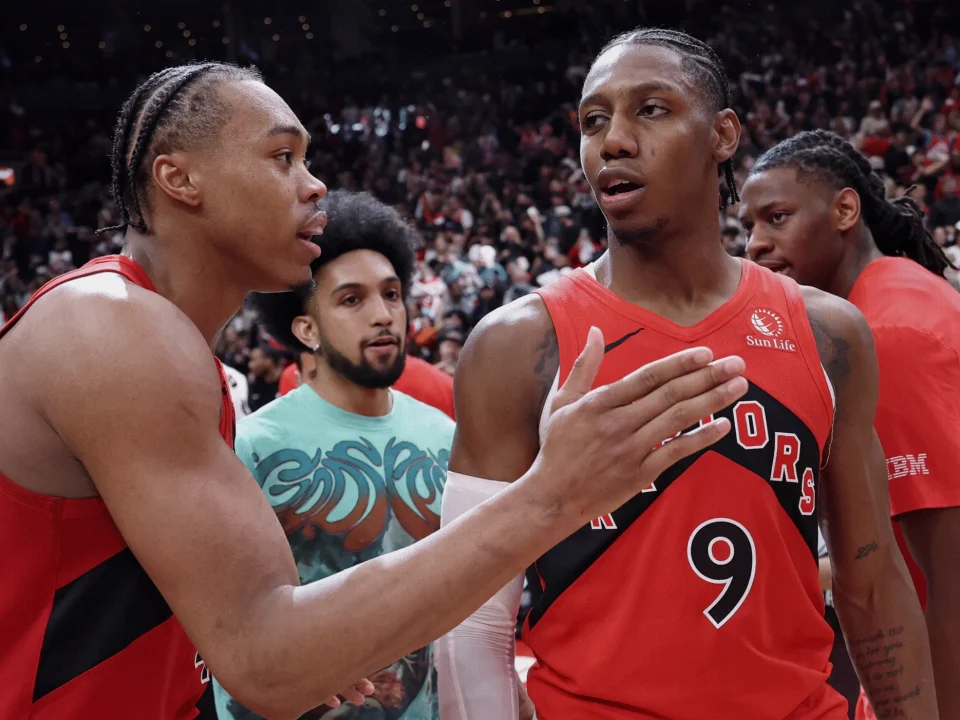
Scottie Barnes emerged as one of the league’s premier two-way players, while RJ Barrett carried the efficiency of his regular season into a strong playoff performance. Still, the Raptors’ first-round loss to Cleveland left them in a familiar spot. Toronto is one of five Eastern Conference clubs without a playoff-series victory since 2020.
- Last season: 46-36, fifth in the Eastern Conference, eliminated in the first round.
- Offseason additions: Kawhi Leonard, Kyle Anderson, Jaden Bradley and Allen Graves.
- Core question: How quickly can Barnes, Barrett and Immanuel Quickley adjust to Leonard’s return?
Leonard’s availability will remain the central roster-management issue. In his six seasons with the Clippers, he appeared in 22 of a possible 37 playoff games. Toronto, however, has a roster capable of handling regular-season minutes without asking Leonard to carry every possession, potentially allowing the club to preserve him for April and May.
Transition game gives Toronto its foundation
The Raptors’ clearest statistical edge last season came in the open floor. They produced 18.9 fast-break points per game, best in the league, and gave up only 12.5, second fewest. That 6.4-point transition margin was the largest posted by any NBA team over the past seven seasons.
Fast breaks accounted for 16.5 percent of Toronto’s scoring, the highest share in the NBA. The next step is handling the possessions that do not get moving early. Only Indiana was less efficient in shots taken during the final six seconds of the shot clock.
That is where Leonard can change the texture of the offense. Over the last three seasons, his 53.0 effective field-goal percentage on late-clock attempts ranks ninth among 131 players with at least 250 such field-goal tries. If Toronto sustains its transition advantage while finding cleaner answers late in possessions, it has a route into the East’s top tier.
Murray-Boyles could force a bigger role
Collin Murray-Boyles gave Toronto a useful glimpse of what he can become during the Cleveland series. The 21-year-old rookie was one of only three first-year players, alongside VJ Edgecombe and Dylan Harper, to average more than 20 minutes in the playoffs.
- Murray-Boyles averaged 27.3 minutes in the first-round series, up from 21.9 during the regular season.
- His playoff minutes exceeded Jakob Poeltl’s 19.2 per game.
- He shot 66 percent, averaging 1.3 steals and 1.1 blocks per game.
- He finished the close games: Murray-Boyles was on the court late in each of Toronto’s three games decided by five points or fewer.
- He went without a playoff three-pointer but made 17 of 50 attempts from deep in the regular season, a 34 percent clip.
If that outside shooting holds, Murray-Boyles can provide enough spacing to share the floor with Leonard and Barnes. Defensively, that three-man group would be versatile and difficult to attack through switches. The concern is more basic: with all three listed at 6-foot-8 or shorter, Toronto will need to prove it can rebound adequately in those alignments.
Early schedule tests and preseason questions
Training camp and preseason should reveal how Toronto intends to organize its half-court possessions. Barnes, Barrett and Quickley have not played alongside this version of Leonard, and the Raptors must determine whether Leonard will be the primary engine, a frequent screener for Barnes, or a blend of both.
Quickley’s condition is worth tracking after he missed 16 of Toronto’s final 19 games last season, including the entire Cleveland series. His mobility and availability could shape how much creation the Raptors can place around Leonard and Barnes.
Dates to circle
- Nov. 2, Raptors at Clippers: Leonard returns to Intuit Dome in Toronto’s seventh game and its first road trip to the Western Conference.
- Nov. 15, Knicks at Raptors: New York has won 13 consecutive games against Toronto. The Raptors lost all five meetings last season by an average margin of 19.6 points, and the first two meetings this year form a Toronto mini-series.
- Dec. 16, Spurs at Raptors: Victor Wembanyama makes San Antonio’s only Toronto visit. The Spurs have taken the previous five meetings between the teams.
- Jan. 5, Raptors at Cavaliers: The first of four Toronto-Cleveland matchups scheduled within six weeks. Cleveland’s defensive performance was the sharper separator between wins and losses in their first-round series.
- Jan. 10, 76ers at Raptors: The second of four Raptors-Philadelphia games. Their first meeting comes Nov. 12 in Philadelphia, when Toronto faces a rest disadvantage.
The personnel is no longer the same as the group that won the 2019 title, but Leonard’s return gives Toronto a proven late-game closer to pair with its younger core. The rotation work starts with finding the right balance: enough Leonard to lift the offense, enough depth to protect him, and enough Barnes-Murray-Boyles minutes to see whether the Raptors can build a switchable front line that holds up when the games tighten.