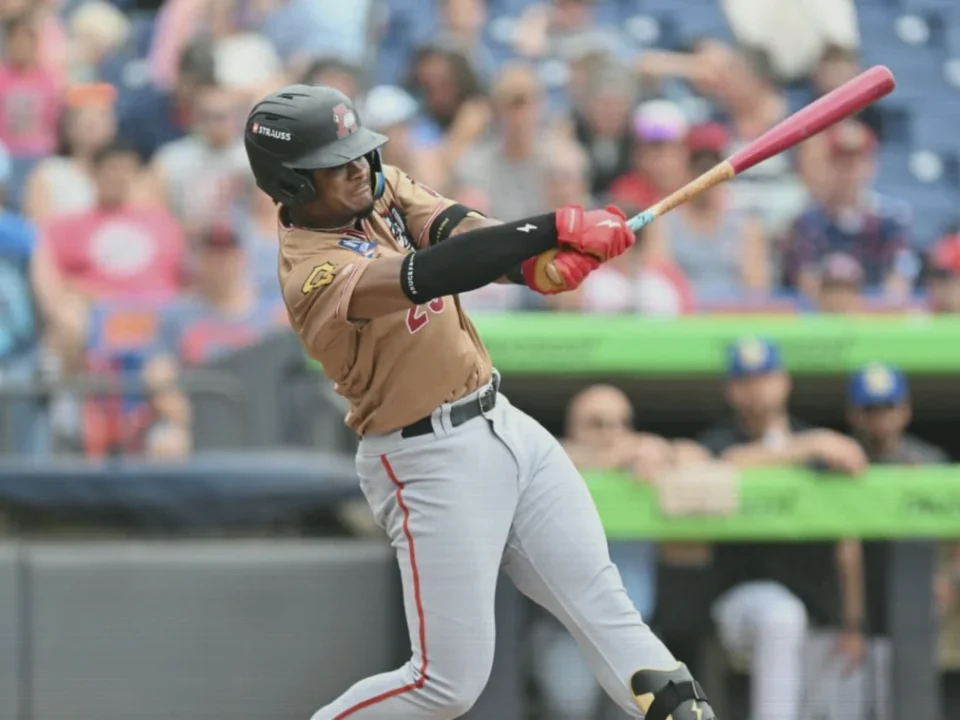
Murf Gray’s first full professional season moved in a hurry, carrying the 22-year-old third baseman from Single-A Bradenton to Double-A Altoona and onto the sport’s Top 100 prospect list. The Pirates drafted the Fresno State product for his bat, but the bigger story of 2026 was how quickly he absorbed the daily work required to turn that ability into production.
A fast climb through the system
- The Pirates took Gray in Competitive Balance Round B of the 2025 MLB Draft. He did not play in affiliated games after the draft, instead using that period to add strength to his 6-foot-3, 230-pound frame.
- He opened 2026 in Bradenton, even though the organization believed his talent could carry him beyond the Single-A level.
- Gray advanced through three affiliates during the season and finished the year with Double-A Altoona.
- Across those stops, he hit .305 with a .969 OPS and 32 home runs.
- His performance lifted him to No. 91 on MLB Pipeline’s Top 100 Prospects list, where he stands fourth among Pittsburgh prospects.
The numbers jumped off the page, but the Pirates see the season as more than a power surge. Michael Chernow, the club’s director of coaching and player development, pointed to a player who made steady adjustments from April through September.
“He is a better player now than he was in April,” Chernow said, crediting Gray’s work ethic and his ability to process feedback and recognize what matters in his game.
Gray admitted the pace of his rise surprised him. He entered his first season in pro ball intending to listen, learn and take something from every clubhouse and every coach along the way. That meant discussing hitting plans, taking ground balls seriously and paying attention to the footwork and small routines that carry a player through a long season.
The approach behind the production
Gray traces part of his growth back to 2024, when he played for the Wareham Gatemen in the Cape Cod Baseball League during his freshman year of college. Working with hitting coach Mike Mobbs helped him understand that professional baseball was a realistic path, while also sharpening the mental side of his game.
One lesson has stayed with him: no “TOB,” or transfer of blame. If an at-bat goes poorly or an error lands on the board, Gray’s first response is not to fault the field, a teammate or the flow of the game. He wants ownership, an adjustment and a clean move to the next play.
That mindset became particularly important with his chase rate. Pittsburgh’s development staff stressed the value of taking walks and using patience to create more chances for impact contact. Gray’s walk rate rose after his move from High-A Greensboro to Altoona, and his on-base percentage improved even as his batting average dipped at the tougher level.
Double-A presented a different test. Pitchers had better stuff and located it with more precision, requiring Gray to carry an approach beyond the first trip to the plate. He described the adjustment as a chess match: thinking ahead, remembering how pitchers attacked earlier in the game and maintaining that plan over a season.
Chernow said the encouraging part is that Gray’s improved swing decisions have not cost him the contact quality that defines his offensive profile. The organization still sees a hitter capable of changing a game with one swing, but now with a more complete understanding of when to let pitches go.
Third base remains the assignment
Gray entered pro ball as a Gold Glove finalist in college, though his size has naturally raised questions about whether first base could be part of his future. For now, the Pirates remain focused on keeping him at third base.
Chernow believes Gray has a chance to handle the hot corner in the Major Leagues. The offseason priority will be improving his side-to-side range, making sure his movement to the right and left is sufficient for the position. If he continues to show that range, Chernow sees no reason Gray cannot stay at third.
Pittsburgh has shown with recent highly regarded picks such as Paul Skenes and Konnor Griffin that it will not slow a player simply to follow a conventional timetable. Gray’s 2026 climb put him in that conversation. He has already moved farther, faster than he expected, and the major league opportunity is the one he has been working toward through the early mornings and late nights.
For Gray, reaching Pittsburgh would represent a chance to repay the people who believed in him. After one season that rewrote the timetable, he heads into the winter with a stronger approach, a clearer defensive task and a place among the organization’s most compelling young bats.